


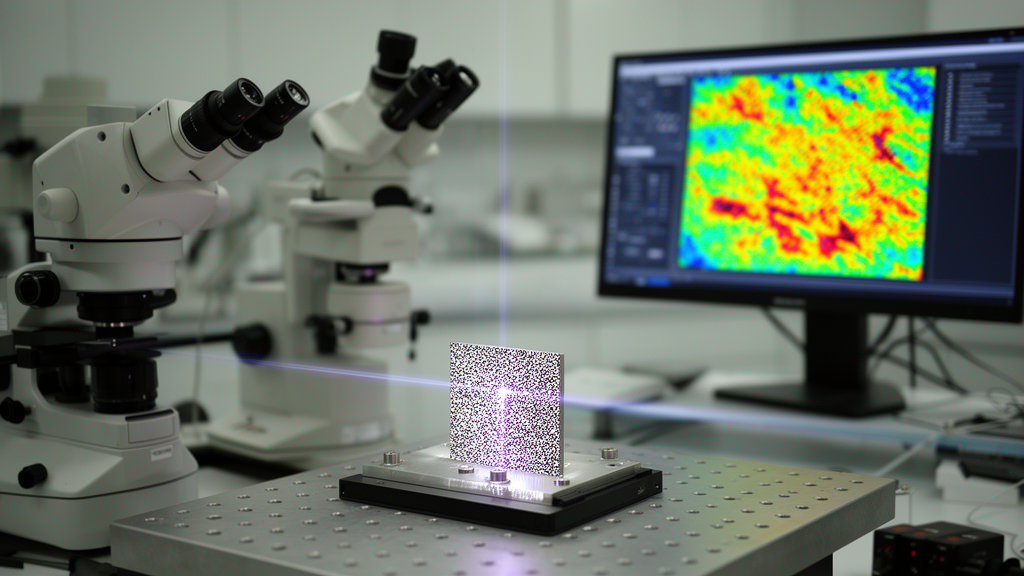
Engineers who measure how materials and structures deform under load have long relied on digital image correlation, a camera-based technique that tracks the motion of randomly patterned speckles painted onto a surface. A new neural network architecture called DNet-MRSP, described in Neural Computing and Applications, now promises to make that tracking both dramatically more accurate and fast enough for live industrial monitoring. On a structured benchmark of 36,000 reference-deformed image pairs, the system achieves a mean End-Point Error of just 0.00302 ± 0.00050 pixels while processing 448.3 frames per second on a single GPU.
That combination of sub-pixel precision and real-time throughput is what the authors present as an optimized accuracy-latency trade-off, one that has eluded previous deep learning approaches to the problem. The core insight behind the new framework concerns a subtle but consequential flaw in how texture information flows through modern neural networks. Digital image correlation depends on stochastic speckle patterns, and the reliability of the measurement hinges on fine details such as speckle edges and micro-scratches.
In conventional architectures, a texture-quality map highlighting which regions of the image are trustworthy is typically computed once at full resolution and then downsampled to guide the deeper layers of an encoder. That naive downsampling blurs away exactly the high-frequency information the technique depends on, producing what the researchers call scale-mismatched guidance. The guidance signal becomes coarser than the features it is supposed to modulate, and the network loses its grip on the very details that determine sub-pixel accuracy.
DNet-MRSP addresses this by generating speckle priors at every scale the network works with. The architecture is built on a five-level U-Net backbone, a convolutional encoder-decoder design originally developed for biomedical image segmentation and now widely adopted for dense prediction tasks. Its contracting path extracts multi-scale spatial features through five successive encoding phases, each using a stride-two convolution rather than max-pooling, a choice the authors say preserves more fine-grained structural information from the speckle patterns.
The expanding path then reconstructs the displacement field, and it is here that the novel Multi-Resolution Speckle Prior Module comes into play. Rather than a single full-resolution prior, the module produces a pyramid of prior maps, one for each decoder stage, at 1/4, 1/2, and full resolution. Each prior is a four-channel tensor containing not only the predicted horizontal and vertical displacement components but also the associated aleatoric uncertainty, a per-pixel estimate of how confident the network is in its own prediction.
These priors are concatenated with the upsampled feature maps before each subsequent decoding stage, so the expansive path is continuously informed by coarser displacement estimates that act as geometric constraints. The result is a hierarchical refinement process in which transitional scale anchors at lower resolutions steer the final full-scale field restoration, allowing the network to handle both large-scale translations and localized micro-strains. The design also departs from the dominant trend in optical flow research.
State-of-the-art models such as RAFT achieve high precision through iterative refinement, maintaining a dense four-dimensional correlation volume and repeatedly updating their motion estimates through a recurrent loop. That approach delivers accuracy but imposes significant computational latency, which limits its usefulness in real-time industrial settings. DNet-MRSP instead executes a single, deterministic forward pass from input to prediction, computing localized correlation on mid-level features rather than an expensive all-pairs global tensor.
The authors argue that this non-iterative, feed-forward structure is the primary driver of its processing efficiency, and that the explicit injection of scale-aware speckle priors into the hierarchical decoder replaces the work that recurrent loops would otherwise perform. The quantitative results bear this out. On the structured evaluation dataset of 36,000 full reference-deformed image pairings, each 128 by 128 pixels, DNet-MRSP recorded a mean End-Point Error of 0.00302 ± 0.00050 pixels.
The closest competitor, the Transformer-based TransFlow, achieved an EPE of 0.0123 ± 0.0144 pixels, roughly four times higher. Deep DIC, a domain-specific baseline, reached only 1.97721 pixels, while RAFT-DIC, which adapts RAFT's correlation and update techniques to speckle properties, degraded to 4.42217 pixels. FlowFormer++ managed 1.21673 pixels.
In physical units, the new model reduced displacement errors to a mean absolute error of 0.0085 ± 0.0014 micrometers and a root mean squared error of 0.0151 ± 0.0025 micrometers, which the authors present as evidence of superior structural tracking fidelity. The speed comparison is equally striking. Deep DIC retains the lowest raw execution latency at 1.75 ± 1.66 milliseconds, corresponding to a throughput of 570.8 frames per second, but its accuracy is poor.
DNet-MRSP runs at 2.23 ± 1.70 milliseconds, a modest penalty that buys the massive improvement in sub-pixel precision. More dramatically, it is roughly nine times faster than RAFT-DIC, which requires 20.02 milliseconds per frame because of its recurrent GRU loop, and it avoids entirely the severe latency of Transformer-driven frameworks such as TransFlow, which the paper reports at 1705.42 milliseconds per frame, a figure that makes live structural monitoring impractical. For edge deployments on factory floors or in structural health monitoring, that difference between milliseconds and seconds is decisive.
The training regime reflects the multi-scale philosophy of the architecture. The network was implemented in PyTorch, trained on an NVIDIA RTX A5000 GPU with the AdamW optimizer at a learning rate of 10 to the power of minus four over 100 epochs with a batch size of eight. A composite objective function combines an L1-norm End-Point Error loss with a probabilistic negative log-likelihood term, stabilized through a beta-NLL formulation to prevent degenerate variance estimates, plus a prior entropy regularizer that keeps the hierarchical priors informative rather than letting them collapse to trivial values.
Losses were computed at three spatial resolutions with fixed weights of 0.1, 0.2, and 0.7, and gradients were clipped to a maximum norm of 1.0. The uncertainty outputs are produced by a unified four-channel head that simultaneously regresses the displacement field and the log-variance of each component, enabling dense per-pixel aleatoric uncertainty modeling without any post-processing lag. Qualitative results reinforce the quantitative story.
Visualization of the Deep DIC baseline showed a structural similarity index of 0.5177, with error accumulation concentrated in regions of acute strain gradients and localized speckle stretching, exactly the conditions where single-scale pipelines struggle. RAFT-DIC handled complex motion distributions but remained bound to its expensive recursive runtime. The proposed model, by contrast, produced displacement maps with smooth field transitions across complicated, high-gradient sub-regions, and its integrated uncertainty map showed that the network is aware of boundary effect zones and tracking limits, with confidence degrading sensibly near region-of-interest boundaries and high-strain contours.
An architectural ablation test isolating the transition from a single-resolution baseline configuration to the hierarchical multi-resolution prior deployment was also performed, and the authors describe how the prior pyramid simplifies feature matching in the shallow, high-resolution decoder layers by enforcing spatial and geometric constraints before final full-scale restoration. The authors are candid about the limits of their approach. The framework assumes uniform surface illumination, and severe specular reflections, strong highlights, or unexpected localized shadowing can obscure the speckle textures and distort the multi-resolution priors.
Extreme out-of-plane deformations can cause decorrelation that exceeds the tracking bounds of the localized mid-level correlation blocks, and the current weights are tuned around fixed spatial target bounds, making the network sensitive to physical variations in speckle size. Future work, they write, will explore illumination-invariant loss layers, adaptive spatial windowing, and unconstrained spatial alignment steps, along with explicit Expected Calibration Error metrics to validate the uncertainty fields.
Subject of Research: Multi-resolution speckle priors for scale-aware and simultaneous probabilistic digital image correlation
Article Title: Multi-resolution speckle priors for scale-aware and simultaneous probabilistic digital image correlation
Article References: Okatch, T., Nyaberi, J., Jeong, H., Nam, H., Yeom, S., & Yu, K. (2026). Multi-resolution speckle priors for scale-aware and simultaneous probabilistic digital image correlation. Neural Computing and Applications, 38(20), 845. https://doi.org/10.1007/s00521-026-12631-w
Image Credits: AI Generated
DOI: 10.1007/s00521-026-12631-w
Keywords: digital image correlation, speckle patterns, U-Net, optical flow, deep learning, displacement measurement, uncertainty estimation, real-time monitoring, RAFT, computer vision, experimental mechanics, neural network architecture
Cite Scienmag News
Blake Davidson. (October 24, 2026). New AI Reads Speckle Patterns at Multiple Scales for Fast, Precise Displacement Mapping. Scienmag. https://scienmag.com/new-ai-reads-speckle-patterns-at-multiple-scales-for-fast-precise-displacement-mapping/
Blake Davidson. "New AI Reads Speckle Patterns at Multiple Scales for Fast, Precise Displacement Mapping." Scienmag, 24 October 2026, https://scienmag.com/new-ai-reads-speckle-patterns-at-multiple-scales-for-fast-precise-displacement-mapping/. Accessed 24 October 2026.
Blake Davidson. "New AI Reads Speckle Patterns at Multiple Scales for Fast, Precise Displacement Mapping." Scienmag. October 24, 2026. https://scienmag.com/new-ai-reads-speckle-patterns-at-multiple-scales-for-fast-precise-displacement-mapping/


