Sunday, October 25, 2026
Science
No Result
View All Result
  • Login
  • HOME
  • SCIENCE NEWS
  • CONTACT US
  • HOME
  • SCIENCE NEWS
  • CONTACT US
No Result
View All Result
Scienmag
No Result
View All Result
Home Science News Medicine

New 19-Item Scale Measures What Nurses Know About Health Literacy Practice

October 25, 2026
in Medicine
Ophelia Keating
By Ophelia Keating Scienmag Editorial Profile - Health Services Research
Reading Time: 2 mins read
0
New 19-Item Scale Measures What Nurses Know About Health Literacy Practice

New 19-Item Scale Measures What Nurses Know About Health Literacy Practice

65
SHARES
587
VIEWS
Share on FacebookShare on Twitter
ADVERTISEMENT

Researchers in Taiwan have developed and validated a new questionnaire designed to measure how much registered nurses know about putting health literacy principles into practice. The instrument, called the Health Literacy Practice Knowledge Scale for Nurses (HLPKSN), was described in a cross-sectional study published in BMC Nursing. After a structured development process involving literature review, item development, expert review, pilot testing and statistical evaluation, the final version contains 19 items and showed acceptable internal consistency, with a KR-20 coefficient of 0.705.

Health literacy is recognized in the study as a key determinant of health outcomes and a global priority under the United Nations 2030 Sustainable Development Goals. The authors note that although nurses play a pivotal role in delivering health literacy–responsive care, objective, psychometrically validated instruments for assessing nurses' health literacy practice knowledge have remained limited, particularly in Chinese-speaking contexts. The HLPKSN was created to fill that gap and to support competency-based nursing education.

The development process followed a multi-stage design. After pilot testing, the scale was administered as an online survey in November 2024 to a convenience sample of 434 registered nurses in Taiwan. The psychometric evaluation combined Classical Test Theory with Rasch analysis, examining both reliability and item statistics and how well individual items and respondents fit the measurement model.

The results indicated satisfactory performance at the item level. Mean item difficulty was 0.73 and mean item discrimination was 0.34, values the authors characterized as acceptable. Rasch model fit was good, with both Infit and Outfit statistics falling within the acceptable range of 0.7 to 1.3.

Item reliability reached 0.98 and item separation was 7.27, indicating that the 19 items were reliably ordered along the difficulty continuum. Performance at the person level was weaker. Person reliability was 0.59 and person separation was 1.20, which the researchers interpreted as meaning the scale distinguishes approximately two ability strata among respondents.

Because of this limited person separation, the authors conclude that the HLPKSN is currently best suited to group-level assessment rather than high-stakes individual discrimination. Despite that constraint, the study's conclusions position the scale as a content-valid and practice-oriented tool. The authors state that the HLPKSN provides an objective means of identifying knowledge gaps among nursing staff, evaluating educational interventions, and supporting competency-based nursing education and continuing professional development to strengthen health literacy–responsive nursing practice.

The findings carry caveats worth emphasizing. The sample was a convenience sample drawn from a single country and surveyed at one time point, so the results reflect that population and cannot be generalized automatically to nursing workforces elsewhere. The authors published the instrument as open access, allowing other research teams to examine and test it independently.

Subject of Research: Development and psychometric validation of the health literacy practice knowledge scale for nurses

Article Title: Development and psychometric validation of the health literacy practice knowledge scale for nurses

Article References: Chung, Y.-T., Cheng, S.-F., Chen, T.-L., & Kuo, C.-L. (2026). Development and psychometric validation of the health literacy practice knowledge scale for nurses. BMC Nursing. https://doi.org/10.1186/s12912-026-05584-x

Image Credits: AI Generated

DOI: 10.1186/s12912-026-05584-x

Keywords: Development, psychometric, validation, health, literacy, practice, knowledge, scale, nurses, scientific research

Cite Scienmag News

Ophelia Keating. (October 25, 2026). New 19-Item Scale Measures What Nurses Know About Health Literacy Practice. Scienmag. https://scienmag.com/new-19-item-scale-measures-what-nurses-know-about-health-literacy-practice/

Ophelia Keating. "New 19-Item Scale Measures What Nurses Know About Health Literacy Practice." Scienmag, 25 October 2026, https://scienmag.com/new-19-item-scale-measures-what-nurses-know-about-health-literacy-practice/. Accessed 25 October 2026.

Ophelia Keating. "New 19-Item Scale Measures What Nurses Know About Health Literacy Practice." Scienmag. October 25, 2026. https://scienmag.com/new-19-item-scale-measures-what-nurses-know-about-health-literacy-practice/

Tags: cross-sectional nursing research Taiwandevelopmentdevelopment of health literacy questionnairesglobal health literacy initiativesHealthhealth literacy knowledge scale for nurseshealthcare provider health literacy trainingitem analysis in nursing surveysKnowledgeliteracymeasurement of nurses' health literacy competencenurse education and health literacyNurse health literacy practice assessmentnursesPracticePsychometricpsychometric validation of nursing instrumentsscaleScientific Researchsustainable development goals and healthcare workforceuse of Rasch analysis in healthcare researchvalidation
Share26Tweet16
Previous Post

Exploratory OCTA study probes macular vessel density in lens dislocation

Next Post

New Chalcone Compound B15 Eases Acute Lung Injury in Mice by Blocking p38 MAPK Signaling

Related Posts

Transformer AI Model Predicts Survival in Rare Lung Neuroendocrine Cancers
Medicine

Transformer AI Model Predicts Survival in Rare Lung Neuroendocrine Cancers

October 25, 2026
Post-COVID Syndrome Linked to Greater Sex Life Impairment in German Survey
Medicine

Post-COVID Syndrome Linked to Greater Sex Life Impairment in German Survey

October 25, 2026
Underweight Outweighs Obesity in Gastrointestinal Cancer Death Risk in Type 2 Diabetes
Medicine

Underweight Outweighs Obesity in Gastrointestinal Cancer Death Risk in Type 2 Diabetes

October 25, 2026
GPs Differ in Diagnosing Depression and Anxiety, Shaping Patients’ Care Paths
Medicine

GPs Differ in Diagnosing Depression and Anxiety, Shaping Patients’ Care Paths

October 25, 2026
When Two Rare Immune Diseases Look Alike: A Diagnostic Puzzle Unraveled
Medicine

When Two Rare Immune Diseases Look Alike: A Diagnostic Puzzle Unraveled

October 25, 2026
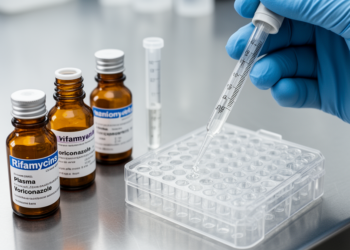
Rifamycins can sharply reduce voriconazole exposure, review finds
Medicine

Rifamycins can sharply reduce voriconazole exposure, review finds

October 25, 2026
Next Post
New Chalcone Compound B15 Eases Acute Lung Injury in Mice by Blocking p38 MAPK Signaling

New Chalcone Compound B15 Eases Acute Lung Injury in Mice by Blocking p38 MAPK Signaling

  • Mothers who receive childcare support from maternal grandparents show more optimized

    Mothers who receive childcare support from maternal grandparents show more parental warmth, finds NTU Singapore study

    27656 shares
    Share 11059 Tweet 6912
  • University of Seville Breaks 120-Year-Old Mystery, Revises a Key Einstein Concept

    1061 shares
    Share 424 Tweet 265
  • Bee body mass, pathogens and local climate influence heat tolerance

    682 shares
    Share 273 Tweet 171
  • Researchers record first-ever images and data of a shark experiencing a boat strike

    546 shares
    Share 218 Tweet 137
  • Groundbreaking Clinical Trial Reveals Lubiprostone Enhances Kidney Function

    531 shares
    Share 212 Tweet 133
Science

Embark on a thrilling journey of discovery with Scienmag.com—your ultimate source for cutting-edge breakthroughs. Immerse yourself in a world where curiosity knows no limits and tomorrow’s possibilities become today’s reality!

RECENT NEWS

  • Tirzepatide Tied to Lower Suicidal Ideation Risk in Obesity and Depression
  • Transformer AI Model Predicts Survival in Rare Lung Neuroendocrine Cancers
  • Nigerian Vocational Lecturers See AI Readiness as Multidimensional Skill Set
  • Germanium photodetector hits 110 GHz bandwidth for 400-Gbps AI optical links

Categories

  • Agriculture
  • Anthropology
  • Archaeology
  • Athmospheric
  • Biology
  • Biotechnology
  • Blog
  • Bussines
  • Cancer
  • Chemistry
  • Climate
  • Earth Science
  • Editorial Policy
  • Marine
  • Mathematics
  • Medicine
  • Pediatry
  • Policy
  • Psychology & Psychiatry
  • Science Education
  • Science News
  • Social Science
  • Space
  • Technology and Engineering

Subscribe to Blog via Email

Enter your email address to subscribe to this blog and receive notifications of new posts by email.

Join 5,151 other subscribers

© 2025 Scienmag - Science Magazine

Welcome Back!

Login to your account below

Forgotten Password?

Retrieve your password

Please enter your username or email address to reset your password.

Log In
No Result
View All Result
  • HOME
  • SCIENCE NEWS
  • CONTACT US

© 2025 Scienmag - Science Magazine

Discover more from Science

Subscribe now to keep reading and get access to the full archive.

Continue reading