


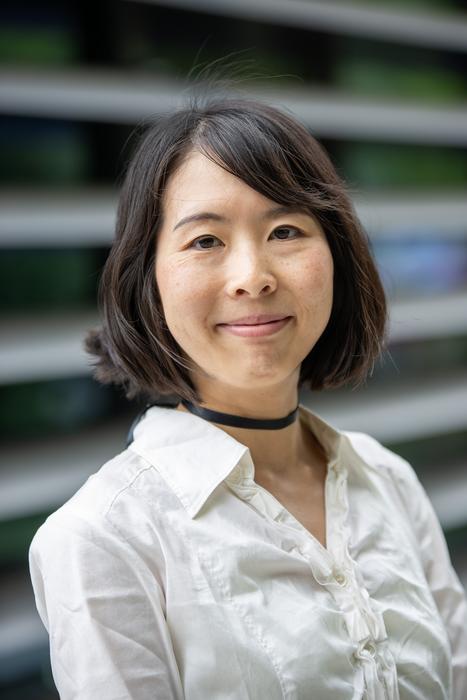
Neuroscientist Ayuno Nakahashi has been awarded a three-year fellowship from the Human Frontier Science Program, making her one of only 11 percent of successful candidates for this highly prestigious international award. At the German Primate Center – Leibniz Institute for Primate Research, she will study social interactions and decision-making in rhesus monkeys, the basis for understanding neurological conditions such as those that occur in autism.

Credit: Karin Tilch, DPZ
Neuroscientist Ayuno Nakahashi has been awarded a three-year fellowship from the Human Frontier Science Program, making her one of only 11 percent of successful candidates for this highly prestigious international award. At the German Primate Center – Leibniz Institute for Primate Research, she will study social interactions and decision-making in rhesus monkeys, the basis for understanding neurological conditions such as those that occur in autism.
Social interactions are a fundamental part of our daily lives. We need to understand the intentions, beliefs and actions of our counterparts if we are to succeed in our daily lives. If we fail to interpret social cues, this can cause lasting social stress. However, how our brain processes interactions, reads signals and makes decisions is far from fully understood. This is where Ayuno Nakahashi’s project comes in. In a novel experimental environment in which the monkeys can move freely, she will observe how the animals interact when foraging together and simultaneously record the activity of nerve cells in the brain during action planning and execution.
“The Göttingen Campus is an ideal place for this project,” says Nakahashi, who is also a member of the Sonderforschungsbereich 1528 Cognition of Interaction. The German Primate Center has recently set up a unique laboratory, the Exploration Room, where two partner animals can roam freely at the same time and explore a variety of different experimental devices. “Although the animals are not restricted, we have full experimental control, can record brain activity wirelessly and use AI-based action recognition tools,” says Nakahashi. Later in the project, the neuroscientist will collaborate with computer scientists from the Campus Institute Data Science at the University of Göttingen. “The close and established collaborations between different disciplines, including behavioral biologists, psychologists, and computational neuroscientists, will be a huge advantage,” says Nakahashi.
With this project, Ayuno Nakahashi is joining a new direction in neuroscience that breaks away from conventional research methods. Traditionally, animals were tested individually when they had been acclimatized to a fixed experimental setting after several months of training. New techniques that can wirelessly record the activity of nerve cells in the brain now make it possible to analyze much more naturalistic scenarios, such as the interaction of two animals foraging for food. “This is something very new and particularly exciting,” says Nakahashi.
“Because rhesus monkeys are very close to humans in evolutionary terms, I hope that my findings will ultimately help to better understand neurodiversity such as autism spectrum disorder.” People with autism spectrum disorder find it difficult to interpret social cues, which can cause frequent misunderstandings and considerable stress.
The Human Frontier Science Program
The Human Frontier Science Program funds interdisciplinary projects in the life sciences. The focus is on research that challenges existing paradigms and uses new approaches and techniques. The grant is highly prestigious and competitive, with only eleven percent of applicants receiving funding this year.
Cite Scienmag News
Courtney Benton. (May 7, 2024). Neuroscientist from Göttingen receives prestigious research grant. Scienmag. https://scienmag.com/neuroscientist-from-gottingen-receives-prestigious-research-grant/
Courtney Benton. "Neuroscientist from Göttingen receives prestigious research grant." Scienmag, 7 May 2024, https://scienmag.com/neuroscientist-from-gottingen-receives-prestigious-research-grant/. Accessed 5 September 2026.
Courtney Benton. "Neuroscientist from Göttingen receives prestigious research grant." Scienmag. May 7, 2024. https://scienmag.com/neuroscientist-from-gottingen-receives-prestigious-research-grant/

