


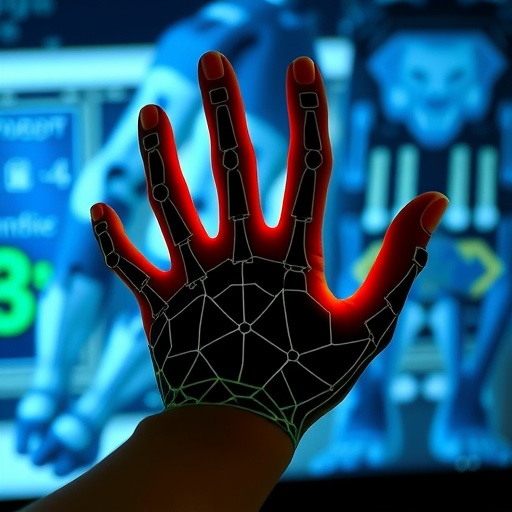
A new approach to telepresence is bringing remote touch closer to reality by combining neuromorphic tactile sensing with a finely distributed haptic display. The system, described by researchers M. Singuaroli, M. Filosa, D. Leonardis and colleagues in Communications Engineering, is designed to transmit cutaneous feedback across a distance, allowing a user to feel localized contact rather than receiving only a single vibration or broad mechanical cue. The work points toward a future in which teleoperated robots, virtual environments and remote human interaction could communicate not only where an object is, but also how and where it is touching the skin.
Most current telepresence systems concentrate on vision and sound, while touch is often reduced to simple force feedback. A robotic arm may report that it has encountered resistance, for example, but the person controlling it may not know whether contact occurred at the fingertips, the side of the hand or another specific region. That missing spatial information can make delicate manipulation difficult. The new research addresses this limitation by treating touch as a distributed sensory signal. Instead of representing contact as one generalized alert, the system aims to preserve the location and fine structure of tactile events as they move between a remote environment and a human operator.
At the sensing end, the technology relies on neuromorphic tactile sensing, an approach inspired by the way biological nervous systems encode rapidly changing stimuli. Conventional sensors typically sample pressure at fixed intervals, generating a continuous stream of measurements even when nothing is happening. Neuromorphic sensors can instead produce event-based signals, responding when pressure, deformation or another physical quantity changes significantly. This can reduce unnecessary data and emphasize the moments that matter most, such as the instant a robotic fingertip touches a surface, begins to slide or encounters a change in texture.
The importance of event-based sensing becomes clearer when tactile information must travel through a communication system in real time. Touch is highly sensitive to delay, noise and loss of timing. A signal that arrives too late can make a remote object feel disconnected from the user’s actions, while excessive data can burden the processing and communication pipeline. Neuromorphic encoding offers a possible solution by representing tactile changes as compact streams of events rather than repeatedly transmitting unchanged values. In principle, this can support faster responses, lower data loads and more precise synchronization between a remote robot and the person controlling it.
The second part of the system is a haptic display capable of delivering fine, distributed cutaneous feedback. Cutaneous feedback refers to sensations generated in the skin, including pressure, contact, vibration and localized deformation. It differs from kinesthetic feedback, which communicates forces and movements through muscles, tendons and joints. A motor pulling on a user’s finger can suggest that an object is resisting movement, but it does not necessarily recreate the sensation of contact on the skin. A distributed cutaneous interface can complement or replace that broad cue by stimulating multiple small regions, creating a tactile map that indicates where contact is occurring.
This distinction could have major consequences for teleoperation. A remote manipulator working with fragile objects needs more than an estimate of total force. The operator may need to recognize whether an object is slipping, whether a grasp is centered, or whether one edge is pressing harder than another. Distributed stimulation can communicate these differences through spatial patterns across the hand or another body area. The user’s nervous system can then interpret the pattern as a localized tactile event, potentially improving awareness without requiring the operator to watch every detail on a screen.
The research is especially relevant to robotic telepresence, where human intelligence and machine reach are combined. In hazardous environments, a person could control a robot while receiving tactile information from tools and surfaces located far away. In medicine, remote robotic procedures could benefit from more detailed contact cues, although clinical applications would require extensive validation and strict safety testing. Industrial inspection, underwater exploration, space robotics and assistance for people with limited mobility are other areas in which a richer sense of remote touch could provide practical value. The same architecture could also influence immersive virtual and augmented reality, where convincing interaction depends on more than visual realism.
A central challenge is transforming physical contact into a signal that the brain can interpret naturally. Human skin contains several classes of mechanoreceptors, each tuned to different aspects of touch, including sustained pressure, rapid vibration and skin movement. Their responses are not simply a record of raw force; they are structured in space and time. A successful artificial system therefore needs to capture meaningful changes and reproduce them through an interface in a way that is perceptually clear. Neuromorphic sensing and distributed output address opposite ends of this problem: the sensor extracts dynamic tactile events, while the haptic display reconstructs them as localized stimulation.
The work also highlights why tactile communication cannot be evaluated only by measuring hardware performance. A sensor may detect a tiny pressure change, and an actuator may produce a precisely controlled vibration, but the decisive question is whether the person using the system can distinguish and act on the information. Perception, comfort, latency and cognitive workload all matter. If the interface delivers too many signals at once, the user may become confused or fatigued. If the signals are too weak or poorly mapped, important contact events may disappear. The promise of the reported system lies in its attempt to connect sensing, signal processing and human perception as one integrated telepresence loop.
By enabling fine distributed cutaneous feedback, the researchers are helping move haptics beyond the era of generic buzzing motors and single-point force cues. The technology does not make remote touch identical to physical contact, and practical systems will still need advances in wearable materials, actuator density, calibration, wireless communication and long-term comfort. Even so, the combination of event-driven tactile sensing and spatially resolved skin stimulation offers a compelling blueprint for more expressive remote interaction. If these ideas can be scaled and reliably integrated, telepresence may begin to feel less like looking through a window and more like extending the body into another place.
Cite Scienmag News
Denise Maddox. (August 20, 2026). Neuromorphic tactile sensors and haptic displays deliver distributed touch feedback in telepresence. Scienmag. https://scienmag.com/neuromorphic-tactile-sensors-and-haptic-displays-deliver-distributed-touch-feedback-in-telepresence/
Denise Maddox. "Neuromorphic tactile sensors and haptic displays deliver distributed touch feedback in telepresence." Scienmag, 20 August 2026, https://scienmag.com/neuromorphic-tactile-sensors-and-haptic-displays-deliver-distributed-touch-feedback-in-telepresence/. Accessed 4 September 2026.
Denise Maddox. "Neuromorphic tactile sensors and haptic displays deliver distributed touch feedback in telepresence." Scienmag. August 20, 2026. https://scienmag.com/neuromorphic-tactile-sensors-and-haptic-displays-deliver-distributed-touch-feedback-in-telepresence/


