


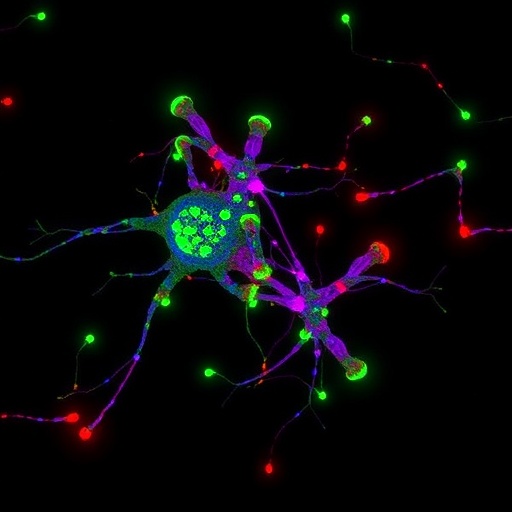
A molecular handshake between a neuronal adhesion protein and a cell-surface receptor may help explain why some brain tumors behave less like isolated masses and more like tissues embedded in the nervous system. In a study published in Nature Neuroscience, Y.S. Kim, S.M. Gillespie, A.C. Geraghty and colleagues identify an interaction between neuroligin-3, or NLGN3, and CSPG4 that maintains oligodendrocyte precursor cells in a progenitor-like state while promoting the proliferation of glioma cells. The work links neural signaling, cell identity and the physical mechanics of tissues in a single mechanism.
Neuroligin-3 is best known as a cell-adhesion molecule associated with neuronal communication. It helps organize specialized contact sites between neurons and other cells, contributing to the architecture of neural circuits. In the tumor microenvironment, however, neuroligin-3 has emerged as a powerful influence on glioma biology. Rather than acting only as a structural component of synapses, it can participate in signals released by active neural tissue and interpreted by tumor cells. The new study focuses on a more direct possibility: that NLGN3 interacts with CSPG4 on the surface of precursor and tumor cells to alter their behavior.
CSPG4, short for chondroitin sulfate proteoglycan 4, is a membrane-associated molecule found on several immature cell populations, including oligodendrocyte precursor cells, or OPCs. These cells normally serve as a renewable pool that can produce oligodendrocytes, the specialized glial cells responsible for insulating neuronal axons with myelin. To remain useful, OPCs must balance self-renewal with differentiation. The researchers’ findings indicate that the NLGN3–CSPG4 interaction helps keep these cells in a progenitor state, preserving characteristics associated with continued growth rather than terminal maturation.
That biological state is particularly important in the brain, where progenitor cells occupy environments shaped by constant mechanical and electrical activity. Cells do not respond only to chemical signals. They also sense stiffness, tension, compression and the physical forces generated when neighboring cells attach, move or change shape. Mechanotransduction is the process by which these physical cues are converted into biochemical signals. Through this system, a cell can translate the architecture of its surroundings into changes in gene expression, cytoskeletal organization, metabolism and proliferation.
The study places mechanotransduction at the center of the NLGN3–CSPG4 pathway. When extracellular molecules engage receptors at the cell surface, they can influence the actin cytoskeleton, the dynamic network that gives cells shape and enables movement. Forces transmitted through membrane proteins may then activate intracellular signaling pathways and alter the nucleus, where decisions about growth and differentiation are made. In this model, the interaction between NLGN3 and CSPG4 is not simply a molecular tether. It functions as a mechanical and signaling interface that reinforces a progenitor-like program.
Gliomas may exploit this developmental circuitry. These tumors contain cells with varying degrees of differentiation, and the most adaptable populations can resist treatment, repopulate tumors and respond to signals from surrounding brain tissue. By engaging CSPG4 and related mechanosensitive systems, NLGN3 may help glioma cells preserve properties that support rapid expansion. The reported connection between the interaction and tumor proliferation suggests that glioma cells can co-opt a mechanism originally used by normal neural precursor cells to remain responsive and regenerative.
The findings also sharpen the picture of the tumor microenvironment. Gliomas are not composed solely of malignant cells; they are surrounded by neurons, astrocytes, oligodendrocytes, precursor cells, blood vessels and extracellular matrix. Every component contributes chemical, electrical or physical information. A molecule associated with neuronal connectivity can therefore influence tumor growth indirectly or directly, while a receptor associated with immature glial cells can become part of a cancer-promoting signaling network. This convergence may help explain why glioma progression is tightly connected to the biology of the healthy brain.
From a therapeutic perspective, the NLGN3–CSPG4 axis offers several possible points of intervention, although translating a molecular discovery into a safe treatment will require considerable work. Blocking the interaction could weaken signals that preserve the progenitor state or fuel glioma proliferation. Yet both proteins also participate in normal neural and glial biology, so indiscriminate inhibition could disrupt development, repair or neuronal communication. Future studies will need to determine precisely how the interaction is assembled, which downstream mechanotransduction pathways it activates and whether tumor cells depend on it more strongly than healthy precursor cells.
The broader message is that cancer growth can be governed by forces as well as factors. The study by Kim and colleagues presents glioma proliferation as an outcome of molecular recognition combined with physical signaling: NLGN3 and CSPG4 meet at the cell surface, mechanical information is transmitted inward, and a progenitor-like state is maintained. By connecting neural adhesion, glial development and tissue mechanics, the work adds another layer to the rapidly evolving understanding of brain tumors—and suggests that the next generation of glioma therapies may need to target not only what tumor cells receive, but also how they physically sense the brain around them.
Cite Scienmag News
Cassandra Pierce. (August 6, 2026). Neuroligin-3–CSPG4 mechanotransduction preserves oligodendrocyte progenitors and promotes glioma growth. Scienmag. https://scienmag.com/neuroligin-3-cspg4-mechanotransduction-preserves-oligodendrocyte-progenitors-and-promotes-glioma-growth/
Cassandra Pierce. "Neuroligin-3–CSPG4 mechanotransduction preserves oligodendrocyte progenitors and promotes glioma growth." Scienmag, 6 August 2026, https://scienmag.com/neuroligin-3-cspg4-mechanotransduction-preserves-oligodendrocyte-progenitors-and-promotes-glioma-growth/. Accessed 5 September 2026.
Cassandra Pierce. "Neuroligin-3–CSPG4 mechanotransduction preserves oligodendrocyte progenitors and promotes glioma growth." Scienmag. August 6, 2026. https://scienmag.com/neuroligin-3-cspg4-mechanotransduction-preserves-oligodendrocyte-progenitors-and-promotes-glioma-growth/


