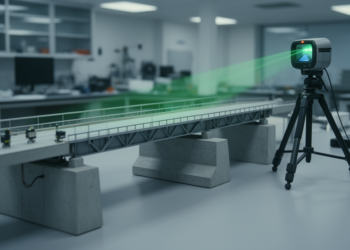
A laboratory flume in India has yielded a new data-driven tool for one of hydraulics’ quieter workhorses: the side weir, the structure that quietly siphons water out of main channels to feed irrigation canals, stormwater overflows, and urban drainage networks. Engineers at Aligarh Muslim University built a two-cycle rectangular labyrinth side weir, ran 190 experimental flow conditions past it, and then trained an artificial neural network to predict the structure’s discharge coefficient. The network achieved a coefficient of determination of 0.9586 with a root mean square error of 0.0186, comfortably outperforming a conventional non-linear regression equation fitted to the same data. The work, published in Discover Fluid Mechanics, addresses a geometry that the authors say has received far less attention than its trapezoidal, triangular, and arced labyrinth cousins.
Side weirs operate under what hydraulic engineers call spatially varied flow: because water leaves the main channel continuously along the weir’s length, both the discharge and the flow depth change from one end of the structure to the other. The classical way to quantify this diversion goes back to De Marchi, who assumed that the specific energy of the flow remains constant along the weir crest. Under that assumption, the discharge per unit weir length depends on the discharge coefficient, the acceleration due to gravity, the height of the weir crest above the channel bed, and the flow depth at each point along the channel centreline. Getting that coefficient right is the difference between a diversion structure that delivers its design flow and one that quietly underperforms for decades.
Labyrinth weirs take the basic idea and fold it. Instead of a straight crest, the wall is zig-zagged into cycles, which stretches the effective crest length within the same channel width. According to prior studies cited in the paper, this geometric trick can boost a side weir’s flow-diverting efficiency by a factor of roughly 1.5 to 4.5 compared with a straight crest. Earlier laboratory work has also shown how sensitive these structures are to detail: changing a labyrinth weir’s corners from sharp 90-degree angles to rounded profiles increased mean discharge capacity by about 15 percent in one experimental campaign. Yet most of that research has concentrated on arced or piano-key layouts, leaving the rectangular labyrinth configuration, particularly multi-cycle versions, comparatively unexplored.
The experimental programme took place in the Advanced Hydraulic Lab of the Civil Engineering Department at Aligarh Muslim University. The team used a reinforced-concrete main flume 9.74 metres long, 0.50 metres wide, and 0.38 metres deep, set on a bed slope of 0.012. The side weir itself was fabricated from galvanized iron sheets with a sharp-edged crest and fixed to the right boundary of the main channel, 7.30 metres downstream of the inlet. Each of its two rectangular cycles measured 15 centimetres in length and 20 centimetres in depth, with 15 centimetres separating the cycles. Crest heights of 11, 14, and 18 centimetres were tested, and a downstream sluice gate controlled the flow depth in the channel.
Measuring how much water actually left through the side weir required some plumbing of its own. Diverted flow entered a secondary channel 4.29 metres long and 0.22 metres wide, where a sharp-crested rectangular measuring weir, dubbed Weir-A, quantified the diverted discharge. The main-channel flow and the diverted flow were then recombined and routed through a return channel ending in a second measuring structure, Weir-B, which captured the total discharge. Splitter plates and wave suppressors were installed ahead of both channel sections to damp turbulence and surface oscillations. All runs were conducted under free-flow conditions with a well-ventilated nappe and subcritical flow in the main channel, on a rigid bed without sediment movement, and the campaign produced 190 experimental data sets.
Before any modelling, the team reduced the physics to three dimensionless groups through Buckingham’s theorem: the upstream Froude number, the ratio of channel width to upstream flow depth, and the ratio of upstream flow depth to crest height. A first predictive equation was then fitted by non-linear regression, with exponents determined in MATLAB using 80 percent of the data and validated on the remaining 20 percent, after rows with outliers exceeding three standard deviations were removed. The resulting regression formula captured the general trend but left noticeable scatter around the ideal one-to-one agreement between measured and predicted values. It returned a coefficient of determination of 0.8443 on the training data and 0.8233 on validation, with a mean absolute percentage error of 2.9034 and a root mean square error of 0.0375, figures the authors judged reasonable but short of the accuracy they wanted for such a non-linear flow problem.
The neural network was brought in to close that gap. The researchers used a standard feed-forward backpropagation architecture with a single hidden layer, implemented in MATLAB, taking the three dimensionless groups as inputs and the discharge coefficient as the output. All input and output patterns were normalized between zero and one, weights and biases were initialized randomly, and the number of hidden neurons was chosen by trial and error against performance metrics. Training stopped when the mean squared error fell to 0.0001, and because network performance varies run to run, the configuration was retrained several times and the setup minimizing the mean absolute percentage error while maximizing the coefficient of determination was retained. The best network achieved a coefficient of determination of 0.9586, a mean absolute percentage error of 1.1931, and a root mean square error of 0.0186, with predictions closely tracking the measured values on both training and validation data.
A sensitivity analysis built into the study identified the Froude number, the dimensionless ratio of flow inertia to gravity, as the single most influential input for predicting the discharge coefficient. The experimental observations themselves pointed the same way: increasing upstream flow depth and Froude number raised the discharge coefficient, apparently by enhancing the flow diversion capacity, while increasing the relative crest height reduced it, consistent with greater flow resistance at the crest. The data also showed clearly non-linear relationships between the coefficient and its governing parameters, which helps explain why the linear-in-parameters regression struggled and why a flexible, non-parametric learner such as a neural network fared better on this problem.
The comparison with earlier work underlines why geometry-specific models matter. A previous experimental study of arced labyrinth side weirs reported discharge coefficients generally ranging between roughly 0.75 and 1.15, while the present rectangular two-cycle configuration produced values between approximately 0.78 and 1.17. The ranges overlap, but the authors argue that the underlying hydraulic behaviour differs because of crest geometry and flow patterns, so predictive models tuned for arced labyrinth side weirs cannot simply be transferred to rectangular ones. In that sense, the study’s contribution is as much the new experimental data set as the model itself: 190 laboratory measurements on a geometry that previous literature largely skipped.
The authors suggest the fitted regression equation and the trained network’s weights and biases, both reported in the paper, can serve hydraulic engineers designing rectangular labyrinth side weirs to regulate heads at distributaries and diversion points. The usual caveats apply. The models were calibrated and validated exclusively on laboratory data from a single flume, a single two-cycle geometry, three crest heights, and subcritical free-flow conditions, and the regression equation in particular is recommended only within the range of the present data set. Scaling such laboratory correlations to full-scale canals, different cycle numbers, or submerged flow conditions remains untested, so field application should be treated as an extrapolation until validated against independent measurements.
Subject of Research: Artificial neural network prediction of the discharge coefficient of a two-cycle rectangular labyrinth side weir based on laboratory flume experiments
Article Title: ANN-based prediction of discharge coefficient in rectangular labyrinth side weirs
Article References: Amir, M., Ansari, M. A., Hussain, A., & Kumar, S. (2026). ANN-based prediction of discharge coefficient in rectangular labyrinth side weirs. Discover Fluid Mechanics, 2(1), Article 3. https://doi.org/10.1007/s44369-026-00007-5
Image Credits: AI Generated
DOI: 10.1007/s44369-026-00007-5
Keywords: labyrinth side weir, discharge coefficient, artificial neural network, hydraulics, open channel flow, Froude number, non-linear regression, spatially varied flow, experimental flume, irrigation canals, feed-forward backpropagation, water diversion
Cite Scienmag News
Blake Davidson. (October 29, 2026). Neural Network Predicts Flow Through Rectangular Labyrinth Side Weirs. Scienmag. https://scienmag.com/neural-network-predicts-flow-through-rectangular-labyrinth-side-weirs/
Blake Davidson. "Neural Network Predicts Flow Through Rectangular Labyrinth Side Weirs." Scienmag, 29 October 2026, https://scienmag.com/neural-network-predicts-flow-through-rectangular-labyrinth-side-weirs/. Accessed 30 October 2026.
Blake Davidson. "Neural Network Predicts Flow Through Rectangular Labyrinth Side Weirs." Scienmag. October 29, 2026. https://scienmag.com/neural-network-predicts-flow-through-rectangular-labyrinth-side-weirs/