


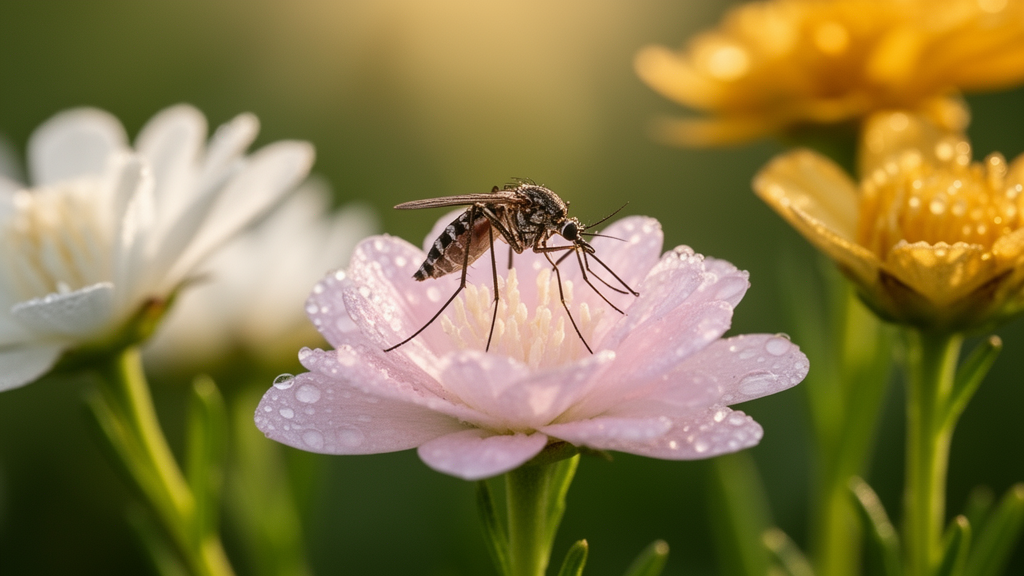
Adult Anopheles gambiae s.l., the mosquito species complex that transmits malaria, live markedly different lifespans depending on which plant foods they feed on, according to a study published in Scientific Reports on 27 October 2026. In laboratory experiments, mosquitoes fed on the fruit of Carica papaya survived a mean of 8.2 days, while those fed on flowers of Malvastrum coromandelianum lived 21.1 days on average. The work was carried out by Khadidiatou Cissé-Niambélé, Jacob C. Koella and Guibéhi Benjamin Koudou, and is currently available as an accepted manuscript ahead of final editorial formatting.
The researchers ran two experiments. In the first, adult mosquitoes were offered flowers of Thevetia nerifolia, Malvastrum coromandelianum, Ixora coccinea and Tabernanthe iboga, or fruit of Carica papaya. The team measured the concentrations of sucrose, fructose and glucose in the nectar and fruit juice, along with how long the mosquitoes lived and how large their sugar meals were. Two patterns stood out: mosquitoes took larger nectar meals from the plant species associated with greater longevity, while the total sugar concentration in the food had little effect on survival. This suggests that something in the nectar beyond its overall energy content may influence how long the insects live.
In the second experiment, mosquitoes were given solutions of glucose, sucrose, fructose or trehalose at two energy concentrations, 1.97 or 19.97 kilocalories per 100 millilitres, and their longevity was monitored. Sucrose increased longevity, whereas trehalose reduced it: mean lifespan was 14.1 days on sucrose but only 4.8 days on trehalose. The result indicates that the specific type of sugar, not just the amount of energy it delivers, matters for mosquito survival, since trehalose and sucrose were provided at the same concentrations.
The study is a laboratory experiment on adult mosquitoes under controlled feeding conditions, so the findings reflect survival under those specific conditions rather than longevity in the field. The authors note that mosquitoes regularly feed on plant nectar, which provides energy for key life-history traits including longevity, but that the effects of nectar quantity and sugar composition on mosquito longevity had remained poorly understood. The researchers say their findings highlight the potential role of nectar plants in mosquito longevity and suggest that nectar composition, beyond sugar content, may contribute to mosquito survival. Because the article is being shared early to provide faster access to peer-reviewed, accepted research, it is subject to further edits and will be replaced by the final Version of Record.
Subject of Research: The effects of nectar source and sugar type on the longevity of Anopheles gambiae s.l. mosquitoes
Article Title: Effects of nectar and sugar on the longevity of the mosquito Anopheles gambiae s.l.
Article References: Cissé-Niambélé, K., Koella, J. C., & Koudou, G. B. (2026). Effects of nectar and sugar on the longevity of the mosquito Anopheles gambiae s.l.. Scientific Reports. https://doi.org/10.1038/s41598-026-77578-3
Image Credits: AI Generated
DOI: 10.1038/s41598-026-77578-3
Keywords: Anopheles gambiae, mosquito longevity, nectar, sugar composition, sucrose, trehalose, Malvastrum coromandelianum, Carica papaya, life-history traits, malaria vector, Scientific Reports, Effects
Cite Scienmag News
Beatrice Stafford. (October 28, 2026). Nectar Plants Shape Mosquito Longevity, with Sugar Type Making a Difference. Scienmag. https://scienmag.com/nectar-plants-shape-mosquito-longevity-with-sugar-type-making-a-difference/
Beatrice Stafford. "Nectar Plants Shape Mosquito Longevity, with Sugar Type Making a Difference." Scienmag, 28 October 2026, https://scienmag.com/nectar-plants-shape-mosquito-longevity-with-sugar-type-making-a-difference/. Accessed 10 November 2026.
Beatrice Stafford. "Nectar Plants Shape Mosquito Longevity, with Sugar Type Making a Difference." Scienmag. October 28, 2026. https://scienmag.com/nectar-plants-shape-mosquito-longevity-with-sugar-type-making-a-difference/




