

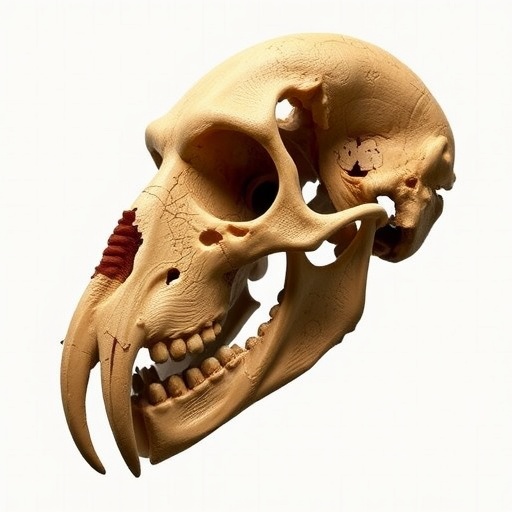
In a groundbreaking study published in Archaeological and Anthropological Sciences, researchers have delved into the enigmatic world of Neanderthal behavior through the unique lens of their relationship with herbivore crania. This research, conducted in Level 3 of the Des-Cubierta Cave located in the scenic Lozoya Valley of Madrid, Spain, aims to unravel the spatial dynamics that influenced the symbolic accumulation of these crania by Neanderthals. The full implications of this study extend far beyond mere archeological curiosity, potentially reshaping our understanding of Neanderthal cognition and their socio-cultural practices.
The investigation centers around the fascinating accumulation of herbivore skulls and remains, suggesting that these items were not merely left as refuse but held significant symbolic value for the Neanderthals. By interpreting the spatial patterns of these remains, researchers are piecing together a formation model that reveals insights into the rockfall dynamics that may have played a pivotal role in the processes of accumulation. Such a model provides a theoretical framework to parse the evolutionary behaviors and symbolic practices attributed to Neanderthals, once thought to be less sophisticated than their Homo sapiens counterparts.
An important aspect of the research is its interdisciplinary approach, integrating archeology with geology to assess the effects of natural processes on the distribution of artifacts. By understanding how rockfall dynamics contribute to the arrangement of crania within the cave, the study highlights the intersection of natural and anthropogenic influences in the creation of archeological sites. The careful analysis of these dynamics enables researchers to hypothesize about the intentional behaviors of Neanderthals in selecting and utilizing herbivore remains for symbolic purposes, potentially indicating complex cognitive skills.
Moreover, the research methodology employed by the authors—L. Villaescusa, E. Baquedano, and D.M. Martín-Perea—was robust and multifaceted. Field studies included detailed mapping of the cave’s interior and systematic excavation of crania deposits, documenting their spatial context. Coupled with geological analyses, including sedimentology and paleoenvironmental reconstruction, the results derived from this study reveal a more nuanced understanding of how crania may have accumulated over time. Such methodological rigor ensures that conclusions drawn about Neanderthal behavior are grounded in empirical evidence, opening new avenues for archaeo-anthropological inquiry.
Through this study, the researchers contend that the spatial arrangement of these crania suggests deliberate actions by Neanderthals, akin to symbolic practices observed in later human cultures. The proposition that Neanderthals formed collections or assemblages of significance raises intriguing questions about the capacity for symbolic thought in hominin evolution. The implications of this research challenge existing paradigms about the cognitive limits of our ancient relatives and their potential for ritualistic or cultural activities.
The Neanderthal relationship with herbivore crania also serves as a rich site for exploring the evolution of symbolic thought. The act of collecting these crania could reflect complex social structures and beliefs, potentially related to territory, hunting strategies, or even spiritual connections to the animals they relied upon. Keywords such as “accumulation,” “symbolic behavior,” and “rockfall dynamics” resonate throughout the paper, emphasizing the pivotal elements that frame this discourse.
Further, the geographic context of the Des-Cubierta Cave cannot be overstated. Nestled within the varied topography of Madrid’s Lozoya Valley, the cave serves as a natural laboratory for understanding the interplay between environmental factors and Neanderthal behavior. Investigating how the cave’s geology affected the accumulation and preservation of skulls enhances our comprehension of hominin interaction with their surroundings, thereby situating these ancient practices within their ecological context.
As the research unfolds, the implications for future studies are significant. By demonstrating the intricacy of Neanderthal symbolic life, the study invites further exploration into other archaeological sites where similar patterns may occur. Other researchers might be encouraged to reassess existing finds, potentially leading to a broader recognition of Neanderthal complexity in regional contexts across Europe. This could foster a renaissance in Neanderthal scholarship, shifting focus from strictly survival-oriented narratives to one that includes emergent cultural and symbolic practices.
The conclusions drawn from Villaescusa et al.’s work also intersect with current debates within paleoanthropology regarding the trajectory of human evolution. If Neanderthals engaged in behaviors previously thought to be exclusive to Homo sapiens, we may need to reconsider the timeline and conditions that fostered cognitive development within hominin lineages. This, in turn, raises vital questions about the relationships and interactions between species and their intangible legacies in the progression of human culture.
Overall, the study advances our understanding of the enigmatic Neanderthal by framing them not purely as primitive predecessors but as complex beings capable of symbolic thought and behaviors. As more evidence comes to light, it may very well reshape the narrative of human evolution, compelling us to rethink our own origins and the essential elements of what it means to be human. As researchers continue to explore the depths of history retained in places like the Des-Cubierta Cave, the conversation around Neanderthals and their contributions to our shared heritage is bound to grow ever more intricate and fascinating.
This captivating exploration of Neanderthal life, anchored in scientific rigor, provides a compelling lens through which to view our ancestors. As we peer into the past, we find not only remnants of ancient lives but also echoing insights into the evolving nature of consciousness and cultural expression that define humanity. The story of Neanderthals and their symbolic use of herbivore crania thus becomes a chapter in a much larger narrative about our shared journey through time, illustrating the complexities of existence long before modern humans walked the earth.
In summary, Villaescusa and colleagues adeptly weave geological, archeological, and cognitive insights into a comprehensive narrative regarding Neanderthal behavior, leaving an indelible mark on our understanding of human evolution. This study will undoubtedly spark continued interest and research in an area that promises to yield increasingly rich and rewarding revelations about our past.
Subject of Research: Neanderthal symbolic accumulation of herbivore crania in Des-Cubierta Cave.
Article Title: Towards a formation model of the Neanderthal symbolic accumulation of herbivore crania: Spatial patterns shaped by rockfall dynamics in Level 3 of Des-Cubierta Cave (Lozoya valley, Madrid, Spain).
Article References: Villaescusa, L., Baquedano, E., Martín-Perea, D.M. et al. Towards a formation model of the Neanderthal symbolic accumulation of herbivore crania: Spatial patterns shaped by rockfall dynamics in Level 3 of Des-Cubierta Cave (Lozoya valley, Madrid, Spain). Archaeol Anthropol Sci 18, 16 (2026). https://doi.org/10.1007/s12520-025-02382-5
Image Credits: AI Generated
DOI: https://doi.org/10.1007/s12520-025-02382-5
Keywords: Neanderthal, herbivore crania, symbolic behavior, rockfall dynamics, archaeological sciences.


