

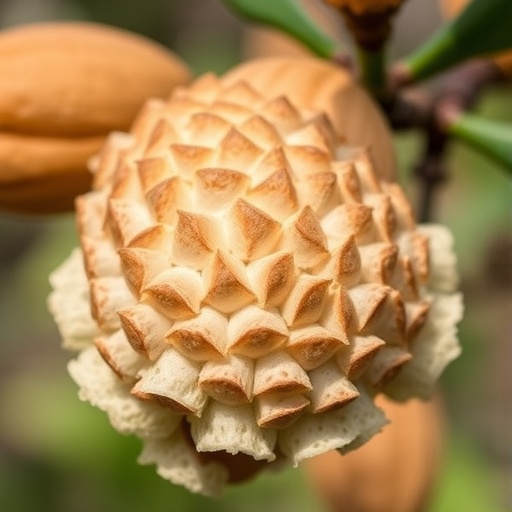
In the relentless battle against plant pathogens, the almond industry faces an escalating threat from anthracnose, a devastating fungal disease caused by Colletotrichum godetiae. Almond (Prunus dulcis), an economically vital crop cultivated extensively across regions such as the United States, Spain, Australia, Türkiye, and Morocco, has traditionally relied on synthetic fungicides for disease management. However, this dependency raises profound environmental concerns and contributes to the emergence of resistant pathogen strains, prompting the urgent search for more sustainable, biologically grounded alternatives.
A groundbreaking study emerging from the Universidade de Lisboa brings promising insights into the natural fungal communities harbored by almond trees, suggesting they may hold the key to innovative biocontrol strategies. This research, recently published in Agricultural Ecology and Environment, meticulously documents the diversity of fungi residing both inside and on the surfaces of almond tissues, revealing native fungal species with powerful antagonistic effects against the anthracnose pathogen.
Anthracnose disease in almonds is particularly challenging due to its epidemiological drivers. The pathogen thrives in wet spring conditions with temperatures between 20 to 25 °C, aggressively infecting flowers, leaves, branches, and young fruits. Infection manifests as sunken lesions and fruit mummification, culminating in significant yield reductions. Current management practices emphasize prophylactic fungicide applications during flowering and early fruit set stages. While effective in suppressing pathogen spread, these chemical interventions inadvertently disrupt beneficial microbial communities, leave harmful residues, and select for fungicide-resistant pathogen populations.
To systematically explore the almond mycobiome, researchers implemented an extensive tissue sampling strategy across 16 almond cultivars, including organs such as flowers, leaves, branches, and fruits. Utilizing both surface disinfection protocols and non-disinfected samples allowed for precise differentiation between endophytic fungi—organisms living within plant tissues—and epiphytic fungi dwelling on surface layers. This methodological rigor facilitated the isolation of close to 20,000 fungal strains, representing a staggering diversity spanning 39 genera across major fungal phyla including Ascomycota, Basidiomycota, and Mucoromycota.
Remarkably, the distribution of fungal communities was highly organ- and cultivar-specific. Branch samples yielded the highest total isolates, exceeding six thousand, while fruits exhibited the most intense endophytic colonization at over 90%. Leaves and branches showed pronounced fungal diversity, as quantified by Shannon diversity indices reaching 2.25. Among cultivars, ‘Lauranne’, ‘Soleta’, and ‘Belona’ hosted the richest mycobiomes. Across all tissues, Alternaria emerged as the dominant genus, complemented by frequent occurrences of Cladosporium, Rhizopus, Penicillium, and Trichoderma. Intriguingly, some genera were strictly confined to either disinfected or non-disinfected samples, indicating niche specialization and ecological partitioning within the almond fungal ecosystem.
To interrogate the biocontrol potential of this native fungal repertoire, the team conducted dual culture assays with 24 representative isolates challenged against C. godetiae. These confrontation experiments revealed stark variability in antagonistic efficacy. Notably, isolates of Trichoderma viridescens, Neurospora intermedia, and Trichoderma citrinoviride showed exceptional inhibition of pathogen mycelial growth, achieving up to 83.7% average suppression and peaking near 91.6% during final observations. T. viridescens was especially potent, diminishing conidial production by an extraordinary 99.3% while rapidly overgrowing the pathogen culture. Statistical analyses via two-way ANOVA confirmed that inhibition dynamics were significantly influenced both by fungal isolate identity and temporal progression (p < 2 × 10⁻¹⁶).
Beyond mere growth suppression, some fungal isolates exhibited targeted anti-sporulation activity. Species such as Stemphylium vesicarium, Talaromyces amestolkiae, and Clonostachys chloroleuca strongly curtailed pathogen sporulation by over 92%, albeit exerting limited direct effects on colony expansion. This decoupling indicates distinct modes of antagonism, possibly involving interference with conidiogenesis signaling pathways. Conversely, certain Penicillium, Cladosporium, and Diaporthe isolates paradoxically stimulated pathogen conidia production, emphasizing the complexity and nuanced nature of fungal–fungal interactions within the almond orchard microbiome.
Macroscopic observations revealed a rich tapestry of interaction types, including fungal overgrowth, contact-mediated inhibition, chemical distance inhibition, and mycelial replacement phenomena. These multifaceted antagonistic strategies underscore the evolutionary arms race occurring at the microscale within host tissues, with native fungal inhabitants effectively competing or cooperating to influence pathogen dynamics. Harnessing such ecological relationships offers a promising avenue for the development of biologically based disease management tools.
The implications of this study extend well beyond almond pathology. By illuminating the intrinsic potential of native endophytic and epiphytic fungi adapted to the host environment, it paves the way for biofungicide formulations that align with ecological resilience and sustainable production paradigms. The identified fungal strains, notably Trichoderma viridescens and T. citrinoviride, are prime candidates for further formulation and field trials, given their robust inhibitory profiles and capacity to suppress both pathogen growth and reproductive inoculum.
As the agricultural sector increasingly prioritizes environmental stewardship and the minimization of chemical inputs, microbial biocontrol strategies embolden efforts to stabilize crop yields while safeguarding ecosystem health. The integration of microbiome-based solutions into almond production systems may substantially reduce dependency on synthetic fungicides, preserving beneficial microbial consortia critical for plant health and soil fertility.
This study illustrates a compelling case of leveraging advanced microbiological and ecological techniques to unlock the hidden defensive arsenal residing within plant-associated fungal communities. Future research focusing on detailed mechanistic studies, fungal metabolite profiling, and compatibility with agronomic practices will be essential to translate these findings into scalable, commercially viable interventions.
In conclusion, the native fungal communities inhabiting almond orchards embody a rich natural resource with the capacity to transform disease management approaches for anthracnose. By capitalizing on their inherent biocontrol powers, the almond industry stands to gain more sustainable, efficacious, and environmentally harmonious means to combat one of its most pernicious threats.
Subject of Research: Not applicable
Article Title: Selection of fungi derived from almond orchards for biological control of almond anthracnose caused by Colletotrichum godetiae
News Publication Date: 20-Jan-2026
References:
DOI: 10.48130/aee-0025-0015
Keywords: Agriculture, Environmental sciences, Biomedical engineering


