

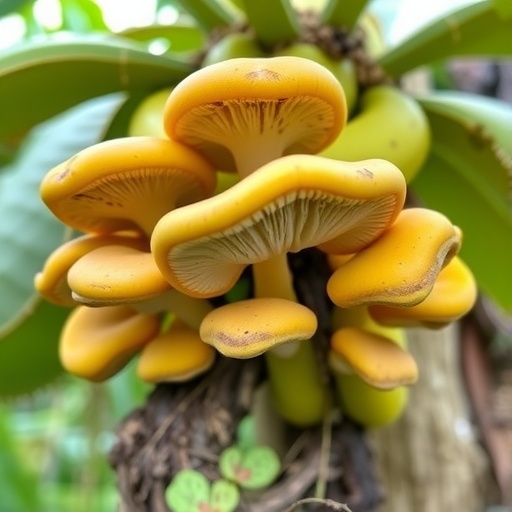
A promising advancement in the fight against the devastating Fusarium wilt disease has emerged from a collaborative study conducted in Southern Vietnam. This research, spearheaded by a team that includes Tran V.T., Dinh T.Q., and Le D.D., unveils the potential of native fungi and actinobacteria as biocontrol agents against Fusarium oxysporum f. sp. cubense tropical race 4 (TR4). The extent of TR4’s destructiveness on Cavendish bananas has raised alarms globally, pushing researchers to explore innovative, sustainable solutions for safeguarding this essential crop.
The significance of this research stems from the growing global concern over food security and agricultural sustainability. The Cavendish banana variety represents a major staple in international commerce, particularly in tropical regions where it is cultivated extensively. As TR4 continues to wreak havoc across plantations, particularly in Southeast Asia, the search for effective alternatives to chemical fungicides—often detrimental to the environment—has never been more urgent. The study offers a fresh perspective on biological control methods, suggesting that harnessing naturally occurring microbes could form a cornerstone of sustainable agricultural practices.
In a carefully designed experimental framework, the research team isolated several native fungal strains and actinomycetes from local ecosystems. These microorganisms were subjected to rigorous testing to evaluate their antagonistic properties against Fusarium oxysporum TR4. The methodology included in vitro assays using various concentrations of the microbial agents applied to infected plant tissues to measure their efficacy. Observations were meticulously documented, and results indicated pronounced inhibition of fungal growth when treated with specific strains of the fungi and actinobacteria that were sourced locally.
The implications of the findings are manifold. By utilizing endemic species, the study emphasizes not just the efficacy of biocontrol agents but also the ecological advantages they present. Native fungi and actinobacteria are more likely to synergize with local soil microorganisms, reducing the risk of introducing foreign species that could upset delicate ecosystems. This localized approach may also enhance the resilience of crops, as plants grown with native microbial partners might develop stronger defensive mechanisms against pests and diseases over time.
Furthermore, the study emphasizes the potential economic benefits for local farmers. The transition to biocontrol agents could lead to decreased reliance on chemical fungicides, lowering production costs and promoting healthier fruit yields. This is especially critical for smallholder farmers who often operate under tight margins. Empowering them with sustainable practices not only helps in combating plant diseases but also contributes to a holistic vision of agricultural profitability and environmental stewardship.
As part of their research, Tran and colleagues integrated education and outreach to ensure that their findings could be implemented in real-world farming scenarios. They collaborated with local agricultural extension services to develop training programs aimed at equipping farmers with the knowledge needed to adapt these biocontrol strategies effectively. This grassroots approach underscores the collaborative effort that is essential for transforming scientific discoveries into tangible agricultural solutions.
The results are also creating waves in the scientific community, inspiring further research into other native biocontrol agents that may have been overlooked in the past. This work not only paves the way for further academic inquiries but may also stimulate the creation of biopesticides from these naturally occurring species, which could be marketed globally. Such innovation would align well with the increasing consumer demand for organic and sustainably sourced products, thereby ensuring market relevance.
Equally important is the research’s potential to inform policies surrounding agricultural practices and crop protection strategies at scales extending beyond Vietnam. As countries grapple with the impacts of climate change on food systems, findings from this study may influence how governments and international organizations approach biocontrol in agricultural policy. The significance of integrating ecological strategies into agriculture cannot be understated, especially as ecosystems face unprecedented pressures.
Recognizing the need for collaboration across disciplines, this research spurs dialogue among agronomists, microbial ecologists, and policymakers to forge new partnerships for sustainable agriculture. As scientists delve deeper into the microbial world, further discoveries are likely to surface that could shift the paradigms of crop management and biocontrol. This study serves as a springboard for a more integrated understanding of how agricultural and ecological health are interlinked, highlighting the critical need to consider biotic relationships in agricultural innovations.
The authors expect that their findings will prompt additional investigations into the genetic and biochemical mechanisms underpinning the interactions between the identified fungi and Fusarium oxysporum TR4. This deeper exploration could reveal biomarkers for resistance, enabling the development of next-generation-resistant crops. Enhancing the biological understanding of these interactions stands to unlock even greater potential in crop protection, ultimately fostering more resilient agricultural systems.
Looking forward, the researchers are optimistic that ongoing studies will shed light on other beneficial microorganisms that can be explored for diverse agroecosystems. The hope is to build a comprehensive repository of microbial resources that can be strategically utilized to fortify crop health across different agricultural landscapes. In a world where food security is under constant scrutiny, every step taken towards sustainable agricultural practices can resonate on a global scale.
The research represents not just an isolated study but part of a burgeoning movement among scientists seeking to revolutionize agricultural practices through ecology-centric methods. Initiatives like these illustrate a shift away from chemical dependency towards regenerative agriculture—setting a precedent for how future research can embrace innovation while respecting natural ecosystems.
In conclusion, with the publishing of their findings in the upcoming issue of International Microbiology, Tran, Dinh, and Le have set the stage for a meaningful discussion on biocontrol methods, native biodiversity, and sustainable agriculture. Their work highlights an essential pathway where science can meet tradition, ultimately leading to healthier crops and resilient farming communities in the face of emerging agricultural challenges.
Subject of Research: Biocontrol methods against Fusarium oxysporum f. sp. cubense tropical race 4.
Article Title: Biocontrol potential of a native fungi and actinomyces collection against Fusarium oxysporum f. sp. cubense tropical race 4 causing fusarium wilt disease on cavendish banana in Southern Vietnam.
Article References: Tran, V.T., Dinh, T.Q., Le, D.D. et al. Biocontrol potential of a native fungi and actinomyces collection against Fusarium oxysporum f. sp. cubense tropical race 4 causing fusarium wilt disease on cavendish banana in Southern Vietnam. Int Microbiol (2026). https://doi.org/10.1007/s10123-025-00764-2
Image Credits: AI Generated
DOI: 03 January 2026
Keywords: indigenous microorganisms, Fusarium wilt, sustainable agriculture, biocontrol, Cavendish banana.


