


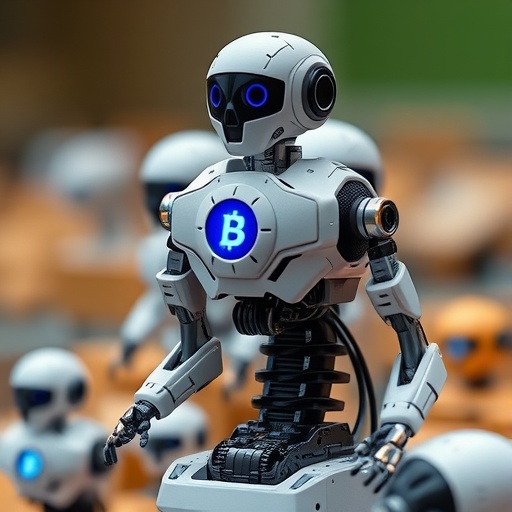
In an era where the intersection of robotics, artificial intelligence, and education is rapidly transforming how young minds engage with technology, a groundbreaking program at Virginia Tech is leading the charge to redefine STEM learning. Bolstered by a significant grant exceeding $500,000 from the National Science Foundation, researchers at Virginia Tech are advancing an innovative initiative known as robot theater. This dynamic after-school program fuses the precision of robotics with the evocative power of performance art, providing grade school children with immersive opportunities to explore the intricacies of human-robot interaction. The program uses movement, dance, music, and storytelling as conduits for understanding robotics, while introducing foundational concepts of AI ethics in a uniquely embodied learning environment.
The robot theater initiative owes its origins to Myounghoon “Philart” Jeon, a professor of industrial and systems engineering at Virginia Tech’s College of Engineering. Conceived in 2015 during his tenure at Michigan Technological University and launched the following year, Jeon’s vision sought to dismantle traditional barriers in STEM education by integrating performing arts with robotic technologies. Over nearly a decade, the program has been extensively refined, transcending disciplinary boundaries to marry engineering with artistic expression. This synthesis allows children not only to interact with robots but also to inhabit a space where technology is not cold and inaccessible, but playful, creative, and ethically meaningful.
Central to the robot theater program is its emphasis on experiential learning through creative modules encompassing acting, dance, music, and drawing. Each session combines structured guidance with ample free-play, allowing young participants to engage in hands-on exploration while nurturing their technical curiosity. Unlike conventional robotics programs that may lean heavily on coding from the outset, robot theater prioritizes movement and gesture as entry points to understanding complex technological concepts. This approach capitalizes on embodied cognition, where physical experience is fundamental to grasping abstract ideas about robotics and artificial intelligence.
One of the most novel facets of the program is its deliberate integration of ethics related to AI and robotics—an area often overlooked in early education. The newly acquired NSF funding aims to deepen this aspect by developing a curriculum that highlights the ethical dimensions of human-robot interaction, including critical issues such as fairness, privacy, bias, and responsible use. These considerations are woven seamlessly into performance and play rather than presented as dry theoretical content. For example, children may interact with robots equipped to track their dance movements, opening pathways to discussions about data privacy and algorithmic transparency through relatable, narrative-driven activities.
The interdisciplinary team spearheading this effort includes not only Jeon but also Koeun Choi, an associate professor specializing in child development and family science, whose insights into cognitive growth have informed the program’s pedagogical framework. In addition, Qin Zhu, an associate professor of engineering education with expertise in ethics and curriculum design, contributes to shaping the program’s enhanced focus on fostering AI literacy and ethical awareness. Together, the team aspires to cultivate a generation of young learners who are not only technologically adept but also critically mindful of the societal implications of robotics and artificial intelligence.
The impact of robot theater extends beyond isolated classrooms. It has been regularly conducted at Eastern Montgomery Elementary School, the Child Development Center for Learning and Research at Virginia Tech, and local childcare centers, making it an integral part of the community’s educational ecosystem. The program’s visibility was further amplified in 2022 when it showcased a professional-level performance at Virginia Tech’s Cube during Ut Prosim Society Weekend. This show artfully combined robotics, live music, and motion tracking technologies to raise awareness about climate change, exemplifying how robot theater can intersect with pressing global issues through creative performance.
Looking ahead, the NSF-backed expansion envisions broader dissemination of the program’s curriculum and materials, making them openly accessible on platforms like GitHub to encourage adoption and adaptation across diverse educational contexts nationwide. Moreover, the initiative seeks to venture beyond traditional classroom settings, introducing flexible formats such as one-day workshops and summer sessions, including implementation in museums and informal learning environments. This versatility aims to cater to varying learning preferences and schedules, generating wider engagement and impact.
From a technical standpoint, robot theater’s underlying philosophy capitalizes on the interplay between robotics hardware capabilities and software-driven AI functionalities, embedded within an artistic framework. The robots used in the program are designed to respond to children’s movements and gestures with real-time feedback, facilitated by sensors and motion tracking technologies. This interaction underscores key computational concepts such as sensor integration, signal processing, and algorithmic response, tangible in ways accessible to young learners. Simultaneously, the creative modules foster critical thinking about the design and ethical constraints of autonomous systems, encouraging reflection on how technology shapes human experiences.
The program’s commitment to embodied learning challenges traditional didactic models by placing students in active roles where they become co-creators of knowledge rather than passive recipients. This shift has profound implications for STEM education, especially in cultivating inclusivity and sustained interest among diverse populations who might otherwise view robotics and AI as intimidating or opaque fields. By embedding ethical inquiry within playful, interpersonal engagements with robots, the program promotes nuanced understandings of how technological artifacts operate within social and moral landscapes.
As artificial intelligence becomes increasingly woven into the fabric of daily life, early education in AI ethics assumes critical importance. Robot theater’s pioneering methodology offers a replicable model for how technology and arts integration can nurture responsible citizenship and technological fluency simultaneously. The program’s future iterations, supported by robust empirical research such as literature reviews, focus groups, and participatory workshops, will further refine pedagogical strategies geared toward identifying gaps in current AI education and optimizing curriculum responsiveness to learner needs.
In essence, Virginia Tech’s robot theater program exemplifies a forward-looking paradigm in STEM education—one that acknowledges the urgent necessity of ethical literacy while leveraging performance arts as an innovative medium for technology engagement. Supported by significant NSF funding, this initiative not only equips children with technical skills but also empowers them to interrogate the societal ramifications of robots and AI. Such an approach is poised to revolutionize how the next generation comprehends, interacts with, and ultimately shapes the future of intelligent machines and human collaboration.
Contact for further information is Chelsea Seeber at Virginia Tech, reachable via chelseab29@vt.edu or by phone at 540-231-2108.
News Publication Date: September 15, 2025
Web References:
- http://ise.vt.edu
- http://eng.vt.edu
- https://liberalarts.vt.edu/departments-and-schools/department-of-human-development-and-family-science/faculty/koeun-choi.html
- https://hci.icat.vt.edu/research-directory/people/qin-zhu.html
- https://news.vt.edu/articles/2022/11/clahs-robottheater.html
Cite Scienmag News
Courtney Benton. (September 23, 2025). National Science Foundation Grant Fuels Advances in Ethical Robots and AI. Scienmag. https://scienmag.com/national-science-foundation-grant-fuels-advances-in-ethical-robots-and-ai/
Courtney Benton. "National Science Foundation Grant Fuels Advances in Ethical Robots and AI." Scienmag, 23 September 2025, https://scienmag.com/national-science-foundation-grant-fuels-advances-in-ethical-robots-and-ai/. Accessed 4 September 2026.
Courtney Benton. "National Science Foundation Grant Fuels Advances in Ethical Robots and AI." Scienmag. September 23, 2025. https://scienmag.com/national-science-foundation-grant-fuels-advances-in-ethical-robots-and-ai/


