

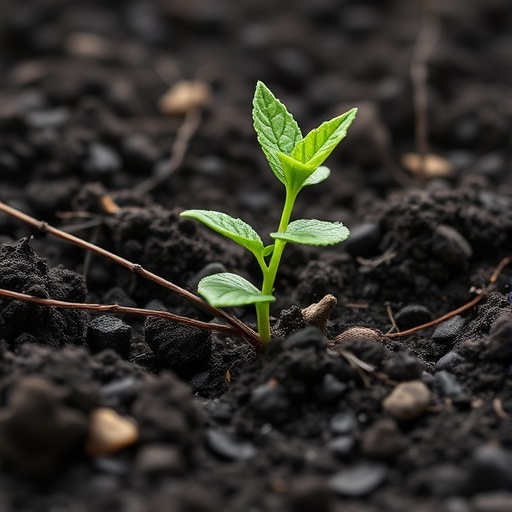
In a groundbreaking advancement poised to transform sustainable agricultural practices and environmental remediation, scientists have engineered an innovative nanomaterial that simultaneously accelerates the degradation of harmful herbicides in soil and fortifies crops against contamination. This pioneering material offers a comprehensive approach addressing the dual challenge of purifying contaminated soils while safeguarding food quality and crop health—an achievement previously unaccomplished by conventional remediation technologies.
Herbicides represent a critical tool in modern agriculture, controlling weeds to maximize crop yields. Yet many widely used herbicides, such as acetochlor, persist stubbornly in environments, posing significant health and ecological risks. Acetochlor, classified as a possible carcinogen, lingers in soils long after application, gradually infiltrating plant systems, reducing agricultural productivity, and threatening human food safety. Equally concerning is the behavior of its degradation byproducts, which exhibit greater mobility and are absorbed more readily by crops, complicating the problem exponentially.
To confront this multifaceted predicament, researchers have synthesized a nitrogen-doped biochar-modified zero-valent iron nanocomposite (NC-ZVI), ingeniously combining biochar substrates with highly reactive metal nanoparticles. This novel material exploits the synergistic properties of biochar’s porous carbon matrix and the potent redox activity of zero-valent iron, further enhanced by nitrogen doping to optimize electron transfer and catalytic efficiency. The resultant composite functions as a versatile multi-interface agent, interacting intimately with soil matrices, chemical contaminants, and root surfaces concurrently.
Extensive laboratory experiments revealed NC-ZVI’s remarkable efficacy in accelerating acetochlor degradation. Within just a week, approximately 90% of the herbicide was eliminated from treated soils, reaching a near-complete 96.7% removal after three weeks. When benchmarked against conventional nano iron materials and classic soil remediation agents, NC-ZVI demonstrated a significant leap in degradation kinetics and total contaminant removal, highlighting its superior catalytic performance and pollutant accessibility.
However, the innovation extends beyond mere soil detoxification. Significantly, when applied to plants grown in contaminated soils, NC-ZVI induced the formation of an iron plaque on plant roots—a naturally occurring iron oxide layer known to act as a protective bio-barrier. This plaque effectively immobilizes herbicide residues and their metabolites at the root-soil interface, dramatically reducing their translocation into plant vascular systems. As a result, treated maize plants exhibited more than an 80% reduction in internal concentrations of acetochlor compounds.
Alongside chemical safety benefits, a profound improvement in plant physiological status was observed. Maize subjected to NC-ZVI treatment produced biomass exceeding 200% of that observed in untreated contaminated soil, underscoring the material’s capacity not only to prevent pollutant uptake but also to stimulate healthier, more vigorous growth. This dual effect of simultaneous contamination mitigation and crop enhancement marks a critical advancement for agricultural sciences.
Microscopic and molecular analyses illuminated the underlying mechanisms governing NC-ZVI’s multifunctionality. Nitrogen doping modifies the electronic structure of biochar, enhancing its surface chemistry and facilitating faster electron transfer during reductive degradation reactions. This enhancement boosts zero-valent iron’s catalytic breakdown of acetochlor by promoting effective pollutant adsorption, electron donation, and subsequent molecular cleavage. Meanwhile, biochar’s high surface area and chemical affinity aid in sequestering contaminants from soil particles, rendering them more bioavailable for degradation.
Environmental sustainability considerations were integral to the study’s scope. Beyond chemical remediation, microbial community assessments revealed that soils treated with NC-ZVI demonstrated partial restoration of microbial diversity and activity previously compromised by herbicide pollution. This finding suggests that the material not only detoxifies soil but also fosters ecological recovery, which is vital for maintaining long-term soil fertility and resilience.
Economic viability is a cornerstone of this innovation. The synthesis of NC-ZVI leverages abundant raw materials and straightforward doping techniques, culminating in production costs estimated at less than a tenth of those associated with standard zero-valent iron nanoparticles. This cost-effectiveness coupled with scalable manufacturing bodes well for widespread adoption in agricultural regions burdened by persistent herbicide contamination.
This research heralds a paradigm shift in environmental remediation by integrating plant-soil interactions into nanomaterial design. Traditionally, soil decontamination and plant protection have been addressed as isolated goals, often with limited success in bridging the two. The NC-ZVI system’s holistic approach, engaging both degradation pathways in soils and physiological defenses within plants, exemplifies innovative convergence between material science and agroecology.
The authors advocate that this multi-interface strategy lays foundational groundwork for next-generation remediation technologies that are simultaneously efficient, sustainable, and economically accessible. By harmonizing chemical, biological, and physical processes at multiple environmental scales, NC-ZVI represents a versatile platform with promising applications beyond acetochlor, potentially extendable to diverse persistent organic pollutants affecting global agricultural contexts.
While these compelling laboratory and greenhouse results set a new benchmark, the researchers emphasize the necessity for comprehensive field trials to examine long-term effectiveness, ecological interactions, and human safety implications under varying agronomic conditions. Such studies will be instrumental in validating the technology’s real-world feasibility and determining its role within integrated crop management systems.
In conclusion, the development of nitrogen-doped biochar-modified zero-valent iron nanocomposites ushers in a sophisticated, multifunctional solution for managing herbicide contamination, advancing toward a future where agricultural productivity, environmental integrity, and public health can coexist harmoniously.
Subject of Research:
Environmental remediation and agricultural crop protection using nitrogen-doped biochar-modified zero-valent iron nanocomposites.
Article Title:
Novel multi-interface regulation of acetochlor fate in a soil-plant system using N-doped biochar-modified zero-valent iron nanocomposites for enhanced degradation and protective root iron plaque formation
News Publication Date:
11 February 2026
Web References:
http://dx.doi.org/10.1007/s42773-025-00567-8
References:
Zhang, X., Zhang, P., Jiao, L. et al. Novel multi-interface regulation of acetochlor fate in a soil-plant system using N-doped biochar-modified zero-valent iron nanocomposites for enhanced degradation and protective root iron plaque formation. Biochar 8, 48 (2026).
Image Credits:
Xiangyu Zhang, Peng Zhang, Le Jiao, Yanwei Zhang, Hongwen Sun & Chenglan Liu
Keywords:
Biochar, zero-valent iron nanoparticles, nitrogen-doping, acetochlor degradation, soil remediation, crop protection, herbicide, iron plaque, environmental chemistry, sustainable agriculture, nanocomposite, microbial community restoration


