


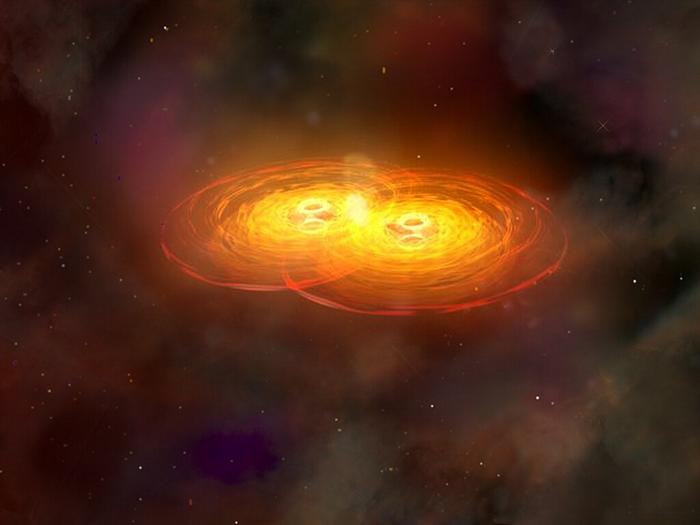
Similar to the ripples produced from dropping a stone in water, the collision of large celestial objects, such as black holes, generates gravitational waves – ripples in the fabric of space-time.

Credit: NASA/CXC/A.Hobart, Public domain, via Wikimedia Commons
Similar to the ripples produced from dropping a stone in water, the collision of large celestial objects, such as black holes, generates gravitational waves – ripples in the fabric of space-time.
A specific type, nanohertz gravitational waves, was identified in 2023. These waves have such a low frequency that it took scientists over 10 years to see a complete cycle. However, how these waves are generated is still unclear.
Some scientists thought they came from a first-order phase transition – a change in the universe’s structure as it expands and cools down. Yet a new study published in Physical Review Letters challenges that theory.
Dr Andrew Fowlie, Assistant Professor at Xi’an Jiaotong-Liverpool University (XJTLU), China, and an author of the paper, says: “Theorists and experimentalists have speculated nanohertz gravitational waves originated from a known transition that happened very soon after the big bang – a change that generated the masses of all the known fundamental particles.
“However, our work uncovers serious problems with that otherwise appealing explanation of their origin.”
Incomplete transitions
“We found that to have created waves with such tiny frequencies, the transition would have to be supercool,” says Dr Fowlie.
We can understand supercooled transitions by thinking about ice and water. We all know that water changes to ice as temperature cools below freezing. Water may, however, become stuck in the liquid phase, even below the freezing point, slowing down the transition to ice.
However, Dr Fowlie explains why his research team believes nanohertz gravitational waves are not produced by supercooled first-order phase transitions. “These slow transitions would struggle to finish, as the transition rate is slower than the cosmic expansion rate of the universe.
“What if the transition sped up at the end? We calculated that even if this helped the transition to end, it would shift the frequency of the waves away from nanohertz.
“Thus, although nanohertz gravitational waves are cool, they are probably not supercool in origin.
“If these gravitational waves do come from first-order phase transitions, we now know that there must be some new, much richer physics going on – physics we don’t know about yet.”
Mysteries remain
Dr Fowlie and co-authors say their results show that more care is needed when studying supercool transitions.
“Because these are necessarily slow transitions, the usual simplifications of whether transitions complete or not won’t work.
“There are a lot of subtleties in the connections between the energy scale of the transitions and the frequency of the waves, so we need more careful and sophisticated techniques when considering gravitational waves and supercool transitions.”
“Understanding this field will help us understand the most fundamental questions about the origin of the universe.
“It also has links to applications that are closer to home, such as understanding how water flows through a rock, the best ways to percolate coffee, and how wildfires spread.”
Dr Fowlie’s interest in gravitational waves was sparked when they were first detected in 2015; he was working at Monash University, Australia, where they were quick to develop their investigations using this new breakthrough.
“I was lucky enough to be in the right place when it was still relatively early to be working in this field, so we could be ready to think about the impact that the phenomenology of gravitational waves and their detection can have on current models of physics.”
Journal
Physical Review Letters
Method of Research
Computational simulation/modeling
Subject of Research
Not applicable
Article Title
Can Supercooled Phase Transitions Explain the Gravitational Wave Background Observed by Pulsar Timing Arrays?
Article Publication Date
28-May-2024
COI Statement
The authors declare no conflict of interest
Cite Scienmag News
Bethany Barker. (August 16, 2024). Nanohertz gravitational waves are cool but not supercool. Scienmag. https://scienmag.com/nanohertz-gravitational-waves-are-cool-but-not-supercool/
Bethany Barker. "Nanohertz gravitational waves are cool but not supercool." Scienmag, 16 August 2024, https://scienmag.com/nanohertz-gravitational-waves-are-cool-but-not-supercool/. Accessed 5 September 2026.
Bethany Barker. "Nanohertz gravitational waves are cool but not supercool." Scienmag. August 16, 2024. https://scienmag.com/nanohertz-gravitational-waves-are-cool-but-not-supercool/

