


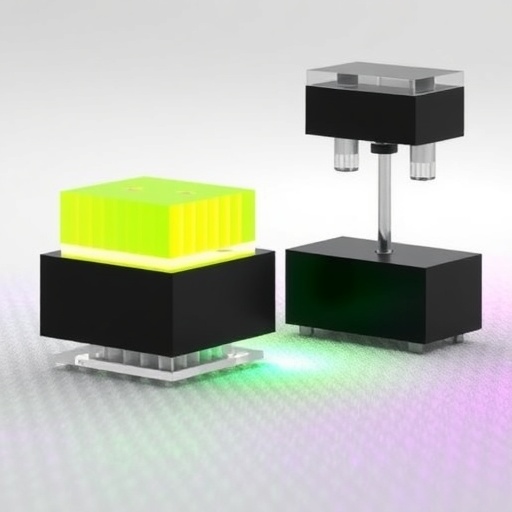
In a groundbreaking advancement that promises to revolutionize the field of ultrasonic detection, researchers have unveiled integrated optomechanical ultrasonic sensors capable of detecting pressure levels at the nano-Pascal scale. This unprecedented sensitivity marks a quantum leap beyond conventional sensors, opening new horizons in applications ranging from medical diagnostics to environmental monitoring and fundamental science research. The innovation, detailed in a March 2026 article in Light: Science & Applications, has garnered widespread attention for its seamless integration of optical and mechanical systems at the nano scale, thereby setting a new benchmark in sensor technology.
The technology centers on optomechanical systems—devices where light interacts with mechanical motion at a scale so minute that the detection of pressure waves at nano-Pascal levels becomes possible. Traditionally, ultrasonic sensors have been constrained by limits in sensitivity and noise interference, but by leveraging nano-fabrication techniques and precise control over optical cavities, the research team achieved a level of sensitivity that was previously deemed unattainable. This integrated approach allows for direct conversion of ultrasonic wave-induced mechanical vibrations into measurable optical signals, bypassing many of the inefficiencies found in electronic transduction methods.
At the heart of these sensors lies a tiny optomechanical resonator engineered to respond selectively to ultrasonic pressure waves. The device’s architecture consists of a nanostructured mechanical element coupled to an optical cavity, which can be finely tuned to resonate at specific frequencies corresponding to ultrasound. When ultrasonic waves impinge upon the mechanical element, they induce minute vibrations that shift the resonance of the optical cavity. These shifts are detected with extraordinary precision through interrogation with laser light, enabling detection of pressure changes as subtle as a few nano-Pascals—levels that are orders of magnitude lower than those measurable by conventional piezoelectric or capacitive ultrasonic sensors.
Developing a device sensitive to this scale involved surmounting several formidable technical obstacles. Chief among them was minimizing thermal and quantum noise that typically swamps weak signals at the nanoscale. The researchers employed innovative noise suppression techniques, including cryogenic cooling and sophisticated optical readout schemes that enhance signal-to-noise ratios dramatically. Additionally, advanced nanofabrication processes ensured that the mechanical elements had exceptionally high quality factors, meaning they vibrate with minimal energy loss and thus yield stronger signals in response to ultrasonic excitation.
One of the most striking features of this sensor technology is its compactness and potential for scalability. Unlike bulky and complex traditional ultrasonic systems, these integrated sensors occupy just a few hundred microns in size, allowing arrays of sensors to be fabricated on a single chip. This paves the way toward real-time, high-resolution ultrasonic imaging and sensing platforms that can be easily embedded into portable devices, wearables, or advanced robotic systems. The integration also promises lower production costs and increased robustness, making the technology accessible for a wide range of applications.
Medical applications stand out as immediate beneficiaries of these advances. Ultrasonic imaging, a staple of diagnostic medicine, could experience a leap in resolution and depth perception, enabling earlier and more accurate detection of pathological conditions. Furthermore, the ultra-sensitive sensors could detect subtle changes in tissue mechanics or blood flow with greater fidelity, offering new insights into cardiovascular, neurological, and musculoskeletal health. The compactness of the devices also raises the possibility of implantable sensors that monitor physiological changes in vivo without invasive procedures.
The environmental science sector is another fertile ground for the deployment of these sensors. From detecting faint acoustic signals in oceanography to monitoring structural health and detecting leaks or cracks in infrastructure, the capability to sense ultra-low pressure waves enables a level of awareness and responsiveness that was previously unattainable. For example, underwater sensors could monitor marine life or geological activity with exceptional clarity, contributing to conservation efforts and disaster prevention.
Beyond practical applications, the development of nano-Pascal level optomechanical sensors opens exciting pathways for fundamental physics experiments. Measuring weak acoustic waves with high precision allows researchers to explore phenomena such as quantum acoustics and the interaction between light and mechanical vibrations at previously inaccessible scales. These sensors could facilitate studies in non-classical states of sound, quantum information processing using phonons, and tests of the boundaries of classical mechanics.
The fabrication process for these integrated sensors involves state-of-the-art lithography and material engineering. Silicon-based substrates form the structural backbone of the sensors, upon which nano-scale mechanical structures are etched and paired with high finesse optical resonators. Precise alignment and coupling between the optical and mechanical components are critical, achieved through novel techniques that ensure maximum transduction efficiency and stability under operational conditions.
In addition to sensitivity and integration, the sensors exhibit remarkable bandwidth and frequency response, making them versatile tools across the ultrasonic spectrum. The tunability of the optical cavity resonance enables adaptability to different ultrasonic frequencies, allowing the same basic device architecture to be optimized for varied use cases. This flexibility is particularly advantageous for applications requiring detection of both high-frequency medical ultrasound and lower-frequency environmental signatures.
An important consideration for practical deployment is the sensor’s durability and operational stability. The research team addressed these factors by incorporating protective coatings and designing the mechanical elements to withstand environmental stressors such as temperature variations, humidity, and mechanical shock. The result is a robust device that maintains sensitivity and precision over extended periods, ensuring reliability in diverse real-world environments.
Looking forward, the integration of these sensors with emerging technologies such as on-chip photonics, wireless communication, and artificial intelligence heralds a new era of smart, interconnected ultrasonic sensing networks. Real-time data acquisition and processing could enable predictive analytics and autonomous decision-making in healthcare, environmental monitoring, industrial inspection, and defense. The synergy between nano-optomechanics and intelligent systems holds promise for revolutionizing how we perceive and interact with the ultrasonic world.
The impact of this innovation extends beyond science and technology; it touches on economic and societal dimensions as well. Enhanced sensor sensitivity coupled with miniaturization and integration reduces costs and energy consumption, promoting sustainable and scalable solutions tailor-made for a broad spectrum of markets. This democratization of advanced sensing technology has the potential to accelerate developments in healthcare delivery, environmental stewardship, and industrial efficiency at a global scale.
In conclusion, the integrated optomechanical ultrasonic sensors developed by Cao, Yang, Wang, and their colleagues represent a paradigm shift in ultrasound detection technology. By achieving nano-Pascal-level sensitivity within a compact, reliable, and scalable platform, these devices unlock opportunities that span scientific discovery, commercial innovation, and societal benefit. Their work stands as a testament to the transformative power of interdisciplinary research that melds optics, mechanics, nanotechnology, and materials engineering into a cohesive and impactful technology. As the field advances, these sensors are poised to become foundational components in an array of emerging applications, shaping the future landscape of ultrasonic sensing.
Cite Scienmag News
Denise Maddox. (March 16, 2026). Nano-Pascal Ultrasound Sensors Achieve Integrated Optomechanics. Scienmag. https://scienmag.com/nano-pascal-ultrasound-sensors-achieve-integrated-optomechanics/
Denise Maddox. "Nano-Pascal Ultrasound Sensors Achieve Integrated Optomechanics." Scienmag, 16 March 2026, https://scienmag.com/nano-pascal-ultrasound-sensors-achieve-integrated-optomechanics/. Accessed 4 September 2026.
Denise Maddox. "Nano-Pascal Ultrasound Sensors Achieve Integrated Optomechanics." Scienmag. March 16, 2026. https://scienmag.com/nano-pascal-ultrasound-sensors-achieve-integrated-optomechanics/


