


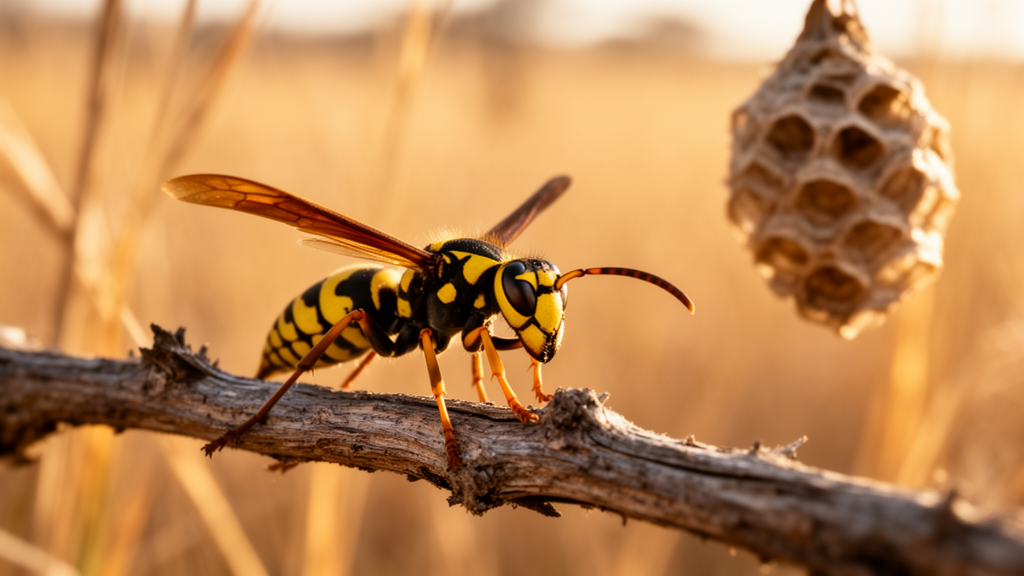
Deep in the museum collections of Belgium, a pair of tiny wasps collected in 1936 from what was then the Belgian Congo have just rewritten a chapter of African wasp evolution. A new study published in African Invertebrates describes for the first time the male of Ropalidia chromis, a species so strange that scientists had only ever seen a single female when it was named in 2024. That lone specimen carried a patchwork of traits that refused to fit into any known branch of the genus, and the newly examined male confirms the suspicion: this may be a living window into the ancestry of an entire group of African social wasps.
Ropalidia is one of the largest genera of paper wasps in the world, with nearly 300 species spread across the Old World tropics, most of them in Asia. For decades, African representatives of the genus were thought to number 56 species. Recent integrative taxonomic work, combining morphology with molecular analyses, has now pushed that figure to 116, revealing a genus far more diverse than anyone suspected, full of cryptic genetic lineages and localized speciation events that blur the boundaries between species. Despite this progress, a robust subgeneric classification remains elusive, and the African fauna can only be broadly split into two principal species groups: the capensis group and the non-capensis group.
The species R. chromis was described from a single female, the holotype, and it immediately stood out. Its clypeus, pronotum and first abdominal segment bear traits uncommon among African Ropalidia but widespread in other polistine genera such as Polistes. It also showed a mixture of features characteristic of both the capensis and non-capensis groups, leaving its affinities genuinely ambiguous. A second enigmatic species, R. mabawa from Tanzania, is known only from a female as well, with a darkened wing apex, shallow exoskeletal punctures and a rounded propodeum that make it resemble certain Belonogaster wasps rather than its closest relatives.
The new study, based on specimens held in the Royal Museum for Central Africa in Tervuren and the California Academy of Sciences, examined material collected at Eala in the Democratic Republic of the Congo in January 1936 by J. Ghesquiere. Among the specimens were males and females of R. chromis collected side by side, allowing the first formal description of the male sex. The male is a slender wasp with wings measuring 8.7 to 9.1 millimetres, a head distinctly wider than long, and an unusually elongated clypeal base. Its antennae carry tyloids, the pale sensory structures characteristic of male polistine wasps, which begin as a small blackish spot on the second flagellomere and grow progressively larger toward the antenna’s tip.
What makes the male so scientifically valuable is what it reveals about the species’ position in the genus. Males of the capensis group typically have elevated tyloids rising above the surface of the flagellomeres, but in R. chromis the tyloids are low and even depressed along much of the antenna. The male also possesses a tarsal spur on the first leg pair, a feature of the capensis group, yet its base is broader than in any examined member of that group. The distance between the antennal sockets, which recent phylogenetic work has identified as a higher-order character separating the two African species groups, measures 1.2 times the socket diameter in R. chromis, matching the average of the non-capensis group and contrasting with the 1.0 ratio typical of the capensis group.
Perhaps the most striking feature is the shape of the frons in both sexes. In R. chromis the area around the antennal bases and the median part of the face is depressed, unlike the flattened frons of every other African Ropalidia. Taken together with the angular, coarsely punctured first abdominal segment, the huge confluent punctures on the mesepisternum and the strong horizontal striae on the metepimeron, the evidence points to R. chromis as a third lineage within African Ropalidia, one that may sit close to the ancestral form from which the capensis and non-capensis groups diverged. Confirming that hypothesis will require fresh specimens suitable for genetic analysis, which the eighty-year-old museum pins cannot provide.
The study also reports a nest of R. chromis observed in November 2023 in the Odzala-Kokoua region of the Republic of the Congo, a new country record. The nest was in an early colony stage with 13 to 18 cells, a compact cell wall and two elongated cells with dark-grey cocoon caps, attached to a broad leaf with two adult females in attendance. Nest architecture is a cornerstone of polistine taxonomy, and the paper documents it for a remarkable range of mainland African species, from the droplet-shaped nests of R. capensis hidden low in dense bushes to the elaborate branched structures of R. soikae in West African canopies.
Some of the nesting discoveries overturn previous assumptions. A prior study suggested that most mainland African Ropalidia build simple discoid nests, but the new observations show far greater variety. R. macloutsie builds a type I nest, a single string of cells suspended from the surface in which early cells share not even a full wall, just a strand of paper. R. excavata is the only mainland species known to build large nest aggregations, with individual nests ranging from discoid to elongated or irregular in shape. R. novissima, newly recorded from Tanzania, appears to build an inverted nest, a feature previously reported only for the Malagasy species R. jemmae, with a disproportionately long stalk and a porous cell wall of long fibres.
The paper also untangles a nomenclatural problem. The name Ropalidia flavoscutellata, assigned to a species described in 2025, turned out to be a junior primary homonym of an earlier name, Ropalidia jacobsoni flavoscutellata described by Das and Gupta in 1989. Under the International Code of Zoological Nomenclature, the younger name must be replaced, and the authors propose Ropalidia mutuntula as the new name. The etymology comes from Bemba, a major language spoken in the region where the holotype was collected, and translates as yellow, referring to the large yellow areas on the body.
Beyond the taxonomy, the study maps new distribution records across the continent, from Angola to South Africa, and hints at biogeographic puzzles still unsolved. Three observations of Ropalidia from the Cape Verde islands suggest the archipelago may host a stable population rather than an isolated invasion, most likely R. aethiopica, though the photographs cannot exclude a dark form of R. guttatipennis or even an undescribed species. The authors single out Western Africa as a substantially underexplored region for vespids, and with more than half of African Ropalidia species described only in the last few years, the continent’s paper wasp diversity is clearly only beginning to give up its secrets.
Subject of Research: Taxonomy and nesting biology of African Ropalidia paper wasps
Article Title: Description of the male of Ropalidia chromis Polašek, 2024 with further biological notes on the African species of the genus ( Hymenoptera , Vespidae , Polistinae )
Article References: Polašek, O. (2026). Description of the male of Ropalidia chromis Polašek, 2024 with further biological notes on the African species of the genus (Hymenoptera, Vespidae, Polistinae). African Invertebrates, 67(1), 1-18. https://doi.org/10.3897/afrinvertebr.67.162082
Image Credits: AI Generated
DOI: 10.3897/afrinvertebr.67.162082
Keywords: Ropalidia, Polistinae, Vespidae, taxonomy, male description, nesting architecture, Africa, new species, Cape Verde, Democratic Republic of the Congo, homonym, biogeography
Cite Scienmag News
Gavin Prescott. (October 16, 2026). Mystery African paper wasp finally reveals its male, and he looks like nothing else in the genus. Scienmag. https://scienmag.com/mystery-african-paper-wasp-finally-reveals-its-male-and-he-looks-like-nothing-else-in-the-genus/
Gavin Prescott. "Mystery African paper wasp finally reveals its male, and he looks like nothing else in the genus." Scienmag, 16 October 2026, https://scienmag.com/mystery-african-paper-wasp-finally-reveals-its-male-and-he-looks-like-nothing-else-in-the-genus/. Accessed 16 October 2026.
Gavin Prescott. "Mystery African paper wasp finally reveals its male, and he looks like nothing else in the genus." Scienmag. October 16, 2026. https://scienmag.com/mystery-african-paper-wasp-finally-reveals-its-male-and-he-looks-like-nothing-else-in-the-genus/


