

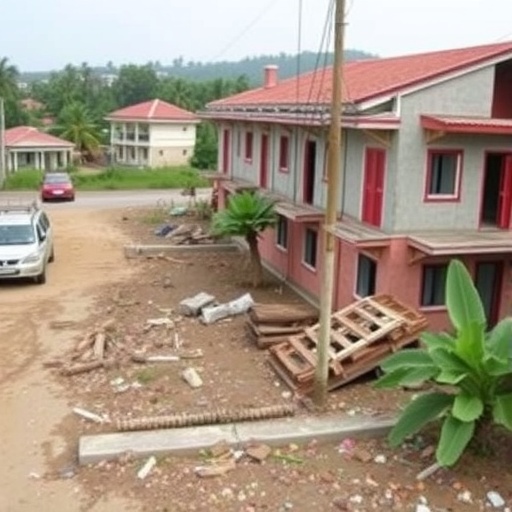
On March 28, 2025, a significant seismic event registered off the coast of Myanmar, measuring a magnitude of 7.9. The earthquake, which has been characterized by geologists and engineers as one of the most devastating in recent history, unleashed a series of geological phenomena that drew immediate concern regarding its implications for both human settlements and natural landscapes. The earthquake’s primary impact was felt in its ability to induce liquefaction, a process that converts saturated soil into a fluid state under seismic stress, enabling catastrophic ground failure and unsettling the structural integrity of buildings and infrastructures in effected regions.
The earthquake struck during daytime hours, when many individuals were present in various structures, adding to the human casualties and injuries that emerged post-event. Reports indicate that urban areas close to the epicenter were substantially impacted, with ground shaking causing widespread panic. Buildings initially designed to withstand seismic activity succumbed to the force of the earthquake, highlighting significant deficiencies in engineering practices and safety regulations that had previously been adhered to.
In particular, the phenomenon of liquefaction played a critical role in the widespread destruction. As the seismic waves traveled through the ground, the energy transferred caused pore water pressure in the soil to rise, leading to a loss of cohesion. Consequently, buildings that were not designed with this possibility in mind experienced a collapse that was almost instantaneous, prompting immediate rescue operations that faced challenges due to the instability of the terrain.
The geographic context of Myanmar is essential to understanding the earthquake’s impact. Situated on the tectonic boundary between the Indian and Eurasian plates, the region is characterized by complex geological features that make it vulnerable to seismic events. Historical records have shown that significant earthquakes have afflicted Myanmar in the past, yet the degree of damage witnessed in 2025 is unprecedented, calling into question existing disaster preparedness strategies and mitigation plans.
In addition to the physical destruction, engineers and scientists are now tasked with evaluating the long-term implications of such seismic events on urban planning and construction standards. A thorough analysis of the ground failure induced by liquefaction is essential. Investigating the material properties of local soils, assessing the water table, and understanding moisture content in the region are crucial steps to formulate future building regulations that prioritize resilience against liquefaction events.
Efforts are underway to articulate systematic guidelines for construction that can withstand future seismic activity and minimize potential liquefaction consequences. These guidelines will address various factors, including the depth of foundations, the incorporation of resilient materials, and the development of drainage systems to mitigate pore water pressure. Urban planners and engineers must collaborate closely to ensure that future developments account for the seismic risks inherent to the region.
Furthermore, the economic repercussions of the earthquake are expected to be massive, necessitating a coordinated response from government and humanitarian organizations. The immediate need for disaster relief is palpable, but the long-term rebuilding process is anticipated to stretch over years and necessitate substantial financial resources. Economic assessments are beginning to consider strategies that integrate resilience into reconstruction; they should not only focus on rebuilding but also on enhancing community resilience to withstand future earthquakes.
Public health officials are also on the ground assessing the secondary health concerns associated with the disaster. Water supply contamination and the potential spread of infectious diseases among the displaced population raise significant concerns in the face of such natural disasters. Aid workers are mobilizing to address immediate health concerns while planning for longer-term health risks associated with the aftermath of the earthquake.
Moreover, community engagement will play a pivotal role in the recovery phase. Understanding local needs, histories, and the socio-economic contexts of affected populations will be critical in building trust and ensuring effective recovery initiatives. Efforts to include community voices in decision-making will ensure that the reconstruction is not only top-down but also emphasizes local participation and empowerment.
The 2025 Myanmar earthquake also brings to light the importance of international collaboration in disaster risk reduction strategies. Neighboring countries and global organizations should lend their expertise in seismic risk management to establish frameworks that bolster the region’s capacity to deal with earthquakes. Sharing knowledge on best practices in urban planning, structural engineering, and public health can go a long way in mitigating the impacts of future seismic events.
As researchers conduct thorough studies on the mechanics of liquefaction and its impacts, findings will contribute immensely to the global understanding of such phenomena. This research not only informs local practices but also provides a canvas for future studies aimed at improving earthquake preparedness worldwide. By employing advanced technologies, including drones and geotechnical measurements, scientists can gather precise data to model and predict liquefaction events more accurately.
Lastly, the earthquake serves as a stark reminder of the unpredictability of natural disasters. As climate change continues to alter our planet, the interplay of geological stresses is likely to evolve. Scientists and engineers must remain vigilant in their pursuit of knowledge while advocating for proactive measures that blend science, engineering, policy-making, and community involvement to fortify our infrastructure and societies against the inevitable seismic shifts of the future.
The ramifications of the March 28, 2025, earthquake extend beyond immediate destruction; they prompt a reevaluation of how societies prepare for and respond to natural disasters. It is a call to action for governments, researchers, and the global community to invest in disaster risk reduction, resilience strategies, and sustainable urban planning that prioritize human safety in the face of nature’s unpredictable forces. Only through coordinated efforts will we build a future where communities can thrive even in the shadow of seismic threats.
Subject of Research: Seismic hazard and liquefaction impact assessment post-earthquake.
Article Title: Liquefaction-induced ground failure and structural damage following the March 28, 2025 M 7.9 Myanmar earthquake.
Article References:
Chen, L., Gan, S., Xiao, L. et al. Liquefaction-induced ground failure and structural damage following the March 28, 2025 M 7.9 Myanmar earthquake.
Earthq. Eng. Eng. Vib. 24, 875–889 (2025). https://doi.org/10.1007/s11803-025-2343-3
Image Credits: AI Generated
DOI:
Keywords: Liquefaction, seismic activity, Myanmar earthquake, ground failure, structural damage, disaster preparedness.


