


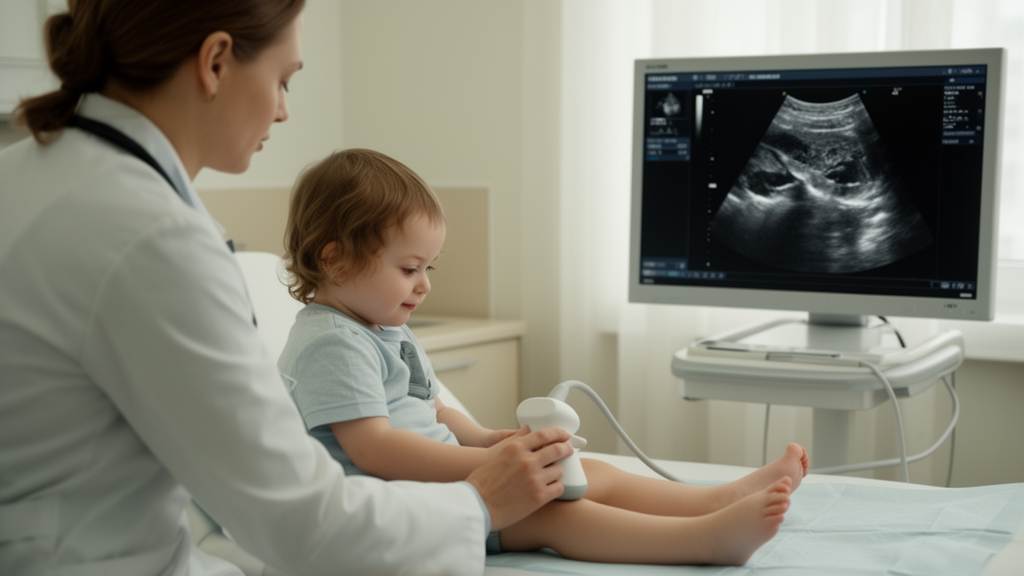
A systematic review of 67 studies involving 2,558 children aged one day to 18 years found that shear-wave elastography is being investigated across muscles, tendons, nerves and other musculoskeletal structures, with the clearest research applications in cerebral palsy, Duchenne muscular dystrophy, scoliosis and congenital muscular torticollis. The studies suggest that the ultrasound method can distinguish some affected children from controls and detect some changes during treatment, but substantial differences in equipment, positioning and measurement protocols prevented quantitative pooling and did not establish routine clinical use. Shear-wave elastography, or SWE, assesses tissue elasticity through the shear modulus, a measure linked to the relationship between applied force and deformation.
In musculoskeletal studies, results are commonly reported either as shear modulus in kilopascals or as shear-wave speed in metres per second. The review stresses that these units describe related biomechanical properties but cannot be treated as interchangeable when comparing results from different studies or devices. SWE is non-invasive and provides real-time assessment of anatomical structures, allowing researchers to investigate how the mechanical properties of musculoskeletal tissue vary with health, movement, training, injury and treatment.
The researchers registered the review protocol in PROSPERO as CRD42023468863 and followed PRISMA 2020 reporting guidance. They searched PubMed/MEDLINE, Scopus, Web of Science and selected resources accessed through Ovid SP and EBSCOhost, beginning in October and November 2023 and updating the search in May 2026. Two reviewers independently screened titles, abstracts and full texts, extracted study data and assessed risk of bias with tools selected for randomised, non-randomised and diagnostic studies.
Of 1,834 records identified, 99 underwent full-text assessment and 67 met the eligibility criteria. The included publications dated from 2012 to 2026, with most appearing between 2021 and 2023. Skeletal muscle was by far the most frequently examined tissue, while smaller numbers of studies investigated tendons, nerves, the temporomandibular joint disc, annulus fibrosus, adipose tissue, deep fascia and skin.
The most common participant groups were children with cerebral palsy, typically developing children, athletes, children with Duchenne muscular dystrophy and infants with congenital muscular torticollis. Other populations included children with scoliosis, Osgood–Schlatter disease, Fukuyama muscular dystrophy, bruxism, juvenile idiopathic arthritis, intoeing gait, paediatric carpal tunnel syndrome associated with mucopolysaccharidosis, nocturnal enuresis and type 1 diabetes. The range of applications demonstrates broad exploration, but the evidence varies considerably in depth and quality across conditions and anatomical sites.
Twenty-two studies assessed the reliability of SWE, reporting intraclass correlation coefficients that ranged from near zero to approximately 0.99. Reliability therefore extended from poor to excellent and depended on the structure and examination conditions. Sonographer experience was associated with measurement consistency, while probe compression, movements of adjacent organs or the chest, patient positioning, anatomical location and transducer orientation could affect results.
The review notes that increasing probe pressure can increase measured muscle stiffness. To improve repeatability, the authors advise standardising the anatomical site, patient position and acquisition procedure, averaging multiple measurements from the same structure, and maintaining the same system, transducer and protocol during longitudinal comparisons whenever possible. Among children with cerebral palsy, several studies reported higher gastrocnemius or soleus stiffness than in typically developing peers, although findings varied by muscle, resting state and passive stretching.
One investigation found higher lateral gastrocnemius shear modulus across all tested ankle positions, while another detected higher medial gastrocnemius shear-wave velocity but no significant soleus difference. A further study found no group difference at rest but higher medial gastrocnemius stiffness during passive stretching. SWE measurements were also associated with the Modified Ashworth Scale, Modified Tardieu Scale, ankle range of motion and Reimers’ hip migration index.
These findings show potential for complementary quantitative assessment, but the review concludes that evidence remains insufficient to support routine SWE use in managing paediatric neurological disease. Duchenne muscular dystrophy was another major focus of the evidence. Comparisons with healthy controls commonly showed higher muscle stiffness in affected children, with the most consistent differences involving the gastrocnemius, rectus femoris and vastus lateralis.
One study reported significantly higher shear modulus in tibialis anterior, gastrocnemius medialis, vastus lateralis, biceps brachii and triceps brachii in children with Duchenne muscular dystrophy, while another found higher shear-wave velocity in both rectus femoris and medial gastrocnemius muscles. Findings for tibialis anterior were less consistent. The included studies interpreted variations in muscle elasticity as potentially reflecting a mixture of fibrosis and fatty degeneration, but only one study followed children for one year.
A proposal that SWE may detect early elasticity changes more sensitively than magnetic resonance imaging remains unconfirmed. Intervention studies showed that SWE can register some changes over time, although several effects were short-lived. After botulinum toxin injections for spastic cerebral palsy, studies most often reported lower gastrocnemius shear modulus at early follow-up around three weeks or one month; these changes commonly diminished or became non-significant by three months.
One study also found lower tibialis anterior shear modulus after a gastrocnemius injection. Extracorporeal shockwave therapy was associated with decreased soleus shear modulus, with the largest predicted effect around the thirteenth week, while a very small study linked anti-gravity treadmill training with changes in contrast, entropy and shear-wave velocity. Stretching findings were inconsistent: five minutes of static stretching reduced rectus femoris shear modulus in adolescent athletes but two minutes did not, and a high-intensity passive stretching session improved dorsiflexion without consistently changing gastrocnemius stiffness.
Scoliosis, sports medicine and congenital muscular torticollis supplied additional possible applications. Differences in paraspinal muscle elasticity depended on where the transducer was positioned, while intercostal and lateral abdominal muscles often showed no significant group differences. In congenital muscular torticollis, the affected sternocleidomastoid was generally less elastic than the healthy side or control tissue, and the technique could be used from the earliest days of life.
Athlete studies suggested possible uses for identifying tissue asymmetry and monitoring training or injury-related changes, but small samples and the absence of validated thresholds limited interpretation. The review’s central conclusion is that paediatric SWE has demonstrated research potential rather than an established diagnostic or prognostic role. Only two included studies were randomised, and both raised concerns about bias in outcome assessment.
Many intervention studies lacked control groups, most observational studies had concerns, often involving absent blinding, and samples were frequently small. Long-term observational studies were scarce, while inconsistent terminology, equipment, body and limb positioning, probe orientation and compression limited comparison among results. Robust paediatric reference values that account for age, growth, body size and developmental stage are also unavailable for most structures.
SWE may ultimately provide a complementary quantitative assessment, but current evidence supports further standardization and validation rather than its use as a standalone diagnostic method or direct transfer of measurements between devices, centres or patients.
Subject of Research: Systematic review of paediatric musculoskeletal shear-wave elastography for tissue stiffness assessment and monitoring
Article Title: Musculoskeletal shear-wave elastography in the paediatric population: a systematic review
Article References: Domin, M., Pałac, M., & Linek, P. (2026). Musculoskeletal shear-wave elastography in the paediatric population: a systematic review. Pediatric Radiology. https://doi.org/10.1007/s00247-026-06816-7
Image Credits: AI Generated
DOI: 10.1007/s00247-026-06816-7
Keywords: shear-wave elastography, paediatric ultrasound, muscle stiffness, cerebral palsy, Duchenne muscular dystrophy, adolescent idiopathic scoliosis, congenital muscular torticollis, sports medicine, treatment monitoring, measurement reliability, Musculoskeletal, shear-wave
Cite Scienmag News
Harold Sullivan. (October 21, 2026). Musculoskeletal shear-wave elastography in the paediatric population: a systematic review. Scienmag. https://scienmag.com/musculoskeletal-shear-wave-elastography-in-the-paediatric-population-a-systematic-review/
Harold Sullivan. "Musculoskeletal shear-wave elastography in the paediatric population: a systematic review." Scienmag, 21 October 2026, https://scienmag.com/musculoskeletal-shear-wave-elastography-in-the-paediatric-population-a-systematic-review/. Accessed 21 October 2026.
Harold Sullivan. "Musculoskeletal shear-wave elastography in the paediatric population: a systematic review." Scienmag. October 21, 2026. https://scienmag.com/musculoskeletal-shear-wave-elastography-in-the-paediatric-population-a-systematic-review/


