

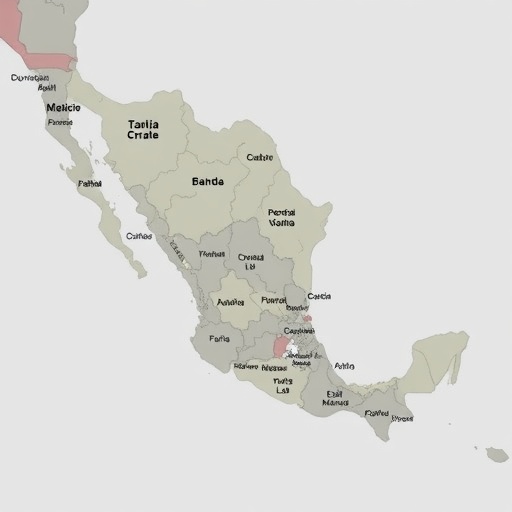
In recent years, the intersection of social determinants and health outcomes has garnered increasing attention within the global scientific community. A groundbreaking study sheds new light on this topic, revealing profound associations between municipal deprivation and cardiometabolic health risks among adults in Mexico. Drawing from comprehensive data collected between 2021 and 2023 by the National Health and Nutrition Survey (ENSANUT), this research provides a granular understanding of how socioeconomic disparities manifest at the municipal level and influence the prevalence of conditions such as obesity, diabetes, hypertension, and cardiovascular disease.
Cardiometabolic health, encompassing a cluster of conditions like insulin resistance, dyslipidemia, elevated blood pressure, and abdominal obesity, represents a critical component of public health worldwide. However, the burden of these diseases is not evenly distributed, with disadvantaged populations bearing a disproportionate share of risk. This study highlights a novel dimension of inequality by focusing on “municipal deprivation,” a complex construct that captures multidimensional socioeconomic disadvantages at the local administrative level within Mexico. By integrating indices that account for income levels, education, housing conditions, employment status, and access to essential services, the study reveals how place-based deprivation exerts powerful influences on cardiometabolic health profiles.
The analytical framework employed by the research team is sophisticated and multifactorial. Utilizing ENSANUT’s expansive dataset, the researchers implemented advanced statistical models to control for individual-level factors such as age, sex, ethnicity, lifestyle behaviors (including diet and physical activity), and genetic predispositions. This rigorous approach isolated the effects attributable specifically to municipal-level deprivation. What emerged was a striking gradient: adults residing in the most deprived municipalities exhibited significantly higher rates of metabolic syndrome components—particularly central obesity and elevated fasting glucose—compared to their counterparts in less deprived areas.
One of the most compelling findings centers on the role of environmental and infrastructural deficits within deprived municipalities. Limited access to healthy foods, recreational spaces, health services, and educational resources creates a synergistic effect that perpetuates unhealthy lifestyle patterns. The study documents lower fruit and vegetable consumption and higher sedentary behavior in these communities, behaviors intimately linked to cardiometabolic risk. Moreover, restricted availability of primary care centers and preventive health programs hampers early detection and management of chronic conditions, exacerbating disease progression.
Beyond lifestyle and healthcare access, the investigation reveals that psychological stress induced by economic hardship and social marginalization may also contribute to cardiometabolic imbalances. Chronic stress influences neuroendocrine pathways that regulate insulin sensitivity, blood pressure, and inflammatory processes. The inclusion of psychological parameters in the models underscores the convergence of biological and sociopsychological mechanisms driving health disparities. This integrative perspective represents a significant advancement over traditional epidemiological studies that often overlook the psychosocial context in which diseases develop.
Interestingly, demographic segmentation unveiled heterogeneity in vulnerability. Women, indigenous populations, and older adults exhibited heightened sensitivity to municipal deprivation’s impact on cardiometabolic health. Cultural factors, gender dynamics, and age-related physiological changes likely mediate this differential susceptibility. The study’s nuanced identification of these subgroups opens avenues for more tailored public health interventions aimed at mitigating risk and promoting equity.
The research findings resonate beyond Mexico, offering implications for many low- and middle-income countries grappling with urbanization, income inequality, and epidemiologic transitions from infectious to noncommunicable diseases. Municipal-level deprivation metrics could serve as vital tools for policymakers and public health practitioners seeking to allocate resources effectively, prioritize interventions, and evaluate program outcomes. The integration of social determinants into cardiovascular and metabolic disease strategies marks a paradigm shift towards health equity.
Despite the comprehensive scope, the authors acknowledge certain limitations inherent in cross-sectional data collection. While associations are robust and suggest causality, longitudinal follow-up would enhance understanding of temporal dynamics between deprivation and cardiometabolic outcomes. Additionally, the complexity of municipal deprivation indices necessitates continual refinement to capture evolving social and economic landscapes accurately, especially amidst changing political and economic conditions.
In conclusion, this study represents a seminal contribution to the literature, elucidating the profound and multifaceted impacts of municipal deprivation on cardiometabolic health in Mexican adults. It emphasizes the urgent need to address social determinants alongside traditional biomedical factors to curb the growing epidemic of metabolic diseases. The findings advocate for integrated approaches encompassing economic development, education, social support, and healthcare system strengthening. Only through such multidisciplinary efforts can societies hope to break the pernicious cycle of deprivation and ill health.
As the global health community aims to achieve sustainable development goals related to health equity, robust evidence such as this underscores where interventions are most critically needed. Researchers and policymakers must collaborate to transform empirical insights into actionable policies that foster environments conducive to healthy living for all citizens, irrespective of their place of residence. The study stands as a clarion call for greater investment in addressing granular, place-based disparities shaping health trajectories worldwide.
Through rigorous scientific inquiry, the work deepens our understanding of how social stratification insidiously influences biological well-being and sets the stage for renewed emphasis on social justice as an integral component of public health success. It invites a reimagining of cardiometabolic disease prevention and control, advocating for a holistic model attentive not only to individual behavior and physiology but to the socio-environmental context—a true embodiment of precision public health.
By building upon the findings from ENSANUT 2021-2023, future research can explore intervention effectiveness across diverse municipal profiles, driving innovation in community-based health promotion and disease prevention. This pioneering analysis sets a benchmark and a roadmap for interdisciplinary endeavors aimed at dismantling health inequities embedded in social and economic fabrics.
Ultimately, the study offers hope that with targeted, evidence-based interventions rooted in a deep understanding of municipal deprivation, Mexico—and by extension, countries facing similar challenges—can achieve breakthroughs in combating cardiometabolic diseases and fulfilling the promise of health equity for all.
Subject of Research: Municipal deprivation and its impact on cardiometabolic health outcomes in Mexican adults.
Article Title: Municipal deprivation and cardiometabolic outcomes in Mexican adults: findings from ENSANUT 2021–2023.
Article References:
Contreras-Loya, D., Romero-Martínez, M., Campos-Rivera, P.A. et al. Municipal deprivation and cardiometabolic outcomes in Mexican adults: findings from ENSANUT 2021–2023. Int J Equity Health (2026). https://doi.org/10.1186/s12939-025-02754-2
Image Credits: AI Generated


