

Wednesday, November 11, 2026
Science
No Result
View All Result
  • Login
  • HOME
  • SCIENCE NEWS
  • CONTACT US
  • HOME
  • SCIENCE NEWS
  • CONTACT US
No Result
View All Result
Scienmag
No Result
View All Result
Home Science News Medicine

Multiomics Model Predicts Psoriasis Treatment Response

November 8, 2026
in Medicine
Ophelia Keating
By Ophelia Keating Scienmag Editorial Profile - Health Services Research
Reading Time: 2 mins read
0
Multiomics Model Predicts Psoriasis Treatment Response

Multiomics Model Predicts Psoriasis Treatment Response

65
SHARES
587
VIEWS
Share on FacebookShare on Twitter
ADVERTISEMENT

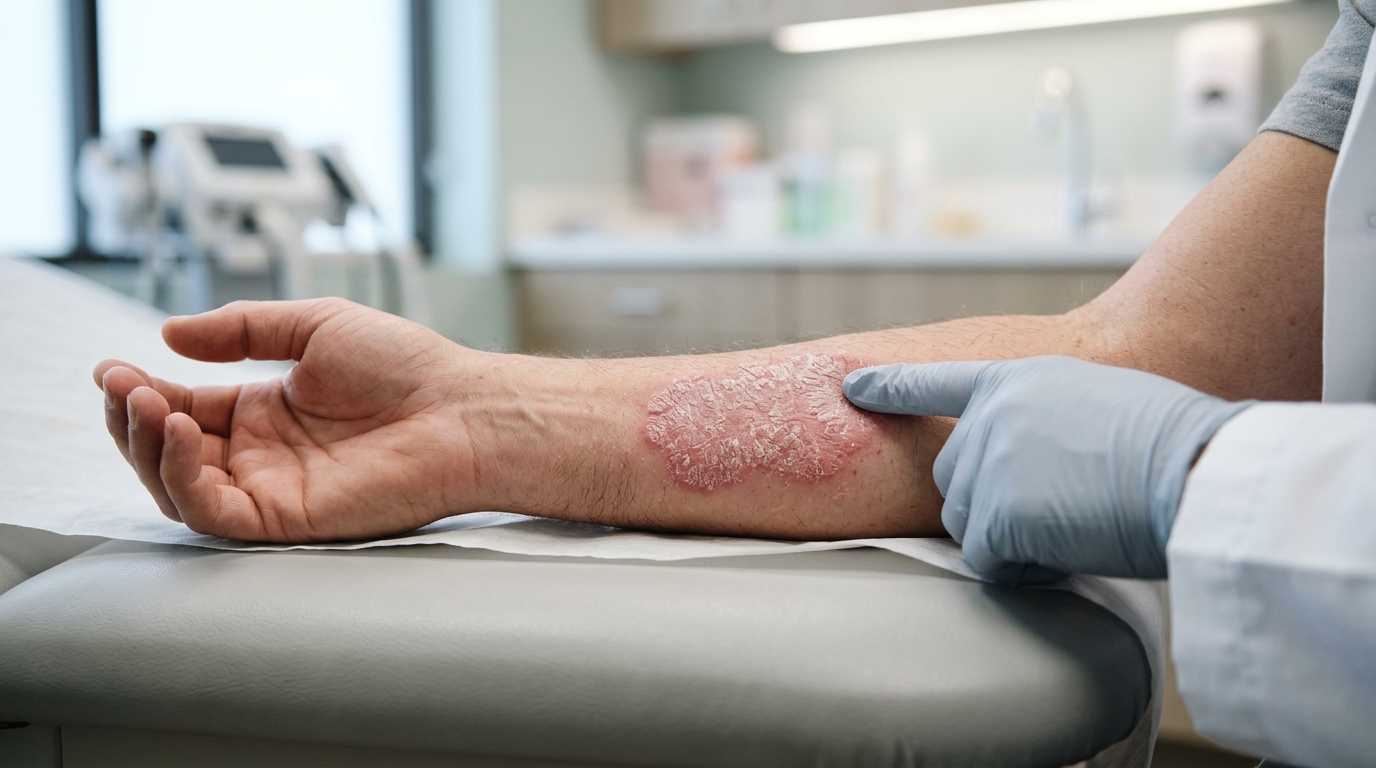
Researchers have developed a multiomics-clinical model designed to predict which patients with psoriasis will achieve a significant reduction in disease severity following biologic therapy. The study, published in BMC Immunology, addresses the clinical challenge of highly variable responses to these treatments by integrating demographic, clinical, and multi-omics variables. By combining genetic and serum markers with traditional clinical data, the model aims to guide personalized treatment decisions in a field where current predictive tools remain an unmet need.

The study was a retrospective analysis involving 342 patients diagnosed with moderate-to-severe plaque psoriasis. To ensure the robustness of the findings, the researchers randomly assigned the participants into two distinct groups: a training set of 240 patients and a validation set of 102 patients. The candidate predictors included a wide range of variables, such as demographic factors, clinical characteristics, and specific multi-omics markers like the HLA-Cw6 genotype and serum levels of interleukin-17 A.

The team first performed univariate screening to narrow down the initial list of variables. Following this selection process, a multivariable logistic regression model was constructed to estimate the probability of achieving the PASI 75 response. The performance of this model was then assessed using several metrics, including the area under the curve, calibration, and decision curve analysis.

The model identified six variables as independent predictors of treatment response. Among these, the HLA-Cw6 genotype and serum IL-17 A levels emerged as the strongest contributors to the model’s predictive power.

In the validation set, the model demonstrated an area under the curve of 0.806, with a 95% confidence interval ranging from 0.683 to 0.919. The model also showed good calibration, as indicated by a Hosmer-Lemeshow test with a P-value greater than 0.05.

The decision curve analysis further supported the clinical utility of the model by demonstrating a net benefit for patients. The odds ratio for the HLA-Cw6 genotype was 3.165, indicating a strong association between this genetic marker and the likelihood of a positive treatment response.

The study highlights the potential of integrating multi-omics data with clinical variables to improve the precision of treatment selection in psoriasis. By identifying specific genetic and serum markers that predict response, the model offers a pathway toward more personalized therapy. However, the authors note that external validation is warranted to confirm the model’s generalizability across different populations and clinical settings. The retrospective nature of the study and the specific cohort of patients with moderate-to-severe plaque psoriasis are important considerations when interpreting the results.

Despite these limitations, the findings provide a promising foundation for the development of predictive tools in dermatology.

Subject of Research: Development and validation of a multiomics-clinical model for predicting PASI 75 treatment response in psoriasis.

Article Title: A multiomics-clinical model to predict treatment response in psoriasis

Article References: Zhou, A., & Tian, W. (2026). A multiomics-clinical model to predict treatment response in psoriasis. BMC Immunology. https://doi.org/10.1186/s12865-026-00901-0

Image Credits: AI Generated

DOI: 10.1186/s12865-026-00901-0

Keywords: psoriasis, multiomics, treatment response, PASI 75, HLA-Cw6, IL-17 A, predictive model, biologic therapy, personalized medicine, dermatology, multiomics-clinical, model

Cite Scienmag News

Ophelia Keating. (November 8, 2026). Multiomics Model Predicts Psoriasis Treatment Response. Scienmag. https://scienmag.com/multiomics-model-predicts-psoriasis-treatment-response/

Ophelia Keating. "Multiomics Model Predicts Psoriasis Treatment Response." Scienmag, 8 November 2026, https://scienmag.com/multiomics-model-predicts-psoriasis-treatment-response/. Accessed 11 November 2026.

Ophelia Keating. "Multiomics Model Predicts Psoriasis Treatment Response." Scienmag. November 8, 2026. https://scienmag.com/multiomics-model-predicts-psoriasis-treatment-response/

Tags: biologic therapydermatologyHLA-Cw6IL-17 Amodelmultiomicsmultiomics-clinicalPASI 75Personalized Medicinepredictive modelPsoriasistreatment response
Share26Tweet16
Previous Post

Response predictors and clonal evolution during thalidomide therapy in myelodysplastic neoplasms with increased blasts

Next Post

Mathematical Analysis of a Reaction-Diffusion Gambling Information Diffusion Model

Related Posts

Klebsiella Pneumoniae Evolves Polymyxin Resistance Within Patients Lacking Prior Drug Exposure
Medicine

Klebsiella Pneumoniae Evolves Polymyxin Resistance Within Patients Lacking Prior Drug Exposure

November 11, 2026
Parasternal Muscle Thickening Drops With Respiratory Support After Phrenic Nerve Injury
Medicine

Parasternal Muscle Thickening Drops With Respiratory Support After Phrenic Nerve Injury

November 11, 2026
Horse-to-Dog Fecal Transplants Linked to Long-Term Remission in Canine Enteropathy
Biology

Horse-to-Dog Fecal Transplants Linked to Long-Term Remission in Canine Enteropathy

November 11, 2026
Machine Learning Models Overstate Dietary Liver Disease Risk Through Circular Calculations
Medicine

Machine Learning Models Overstate Dietary Liver Disease Risk Through Circular Calculations

November 11, 2026
Oncologic Safety Boundaries Reshape Fertility Preservation in Common Gynecologic Cancers
Cancer

Oncologic Safety Boundaries Reshape Fertility Preservation in Common Gynecologic Cancers

November 11, 2026
Smartphone Bilirubin Screen Correlates Strongly With Laboratory Measurements in Newborn Jaundice
Pediatry

Smartphone Bilirubin Screen Correlates Strongly With Laboratory Measurements in Newborn Jaundice

November 11, 2026
Next Post
Mathematical Analysis of a Reaction-Diffusion Gambling Information Diffusion Model

Mathematical Analysis of a Reaction-Diffusion Gambling Information Diffusion Model

  • Mothers who receive childcare support from maternal grandparents show more optimized

    Mothers who receive childcare support from maternal grandparents show more parental warmth, finds NTU Singapore study

    27656 shares
    Share 11059 Tweet 6912
  • University of Seville Breaks 120-Year-Old Mystery, Revises a Key Einstein Concept

    1061 shares
    Share 424 Tweet 265
  • Bee body mass, pathogens and local climate influence heat tolerance

    682 shares
    Share 273 Tweet 171
  • Researchers record first-ever images and data of a shark experiencing a boat strike

    546 shares
    Share 218 Tweet 137
  • Groundbreaking Clinical Trial Reveals Lubiprostone Enhances Kidney Function

    531 shares
    Share 212 Tweet 133
Science

Embark on a thrilling journey of discovery with Scienmag.com—your ultimate source for cutting-edge breakthroughs. Immerse yourself in a world where curiosity knows no limits and tomorrow’s possibilities become today’s reality!

RECENT NEWS

  • Klebsiella Pneumoniae Evolves Polymyxin Resistance Within Patients Lacking Prior Drug Exposure
  • Male Patients Show Higher Psychological Readiness Returning to Sport After ACL Reconstruction
  • Parasternal Muscle Thickening Drops With Respiratory Support After Phrenic Nerve Injury
  • Monophasic Salmonella Typhimurium Surged Among Diarrheal Patients in Zhejiang Province

Categories

  • Agriculture
  • Anthropology
  • Archaeology
  • Athmospheric
  • Biology
  • Biotechnology
  • Blog
  • Bussines
  • Cancer
  • Chemistry
  • Climate
  • Earth Science
  • Editorial Policy
  • Marine
  • Mathematics
  • Medicine
  • Pediatry
  • Policy
  • Psychology & Psychiatry
  • Science Education
  • Science News
  • Social Science
  • Space
  • Technology and Engineering

Subscribe to Blog via Email

Enter your email address to subscribe to this blog and receive notifications of new posts by email.

Join 5,150 other subscribers

© 2026 Scienmag - Science Magazine

Welcome Back!

Login to your account below

Forgotten Password?

Retrieve your password

Please enter your username or email address to reset your password.

Log In
No Result
View All Result
  • HOME
  • SCIENCE NEWS
  • CONTACT US

© 2026 Scienmag - Science Magazine

Discover more from Science

Subscribe now to keep reading and get access to the full archive.

Continue reading

