

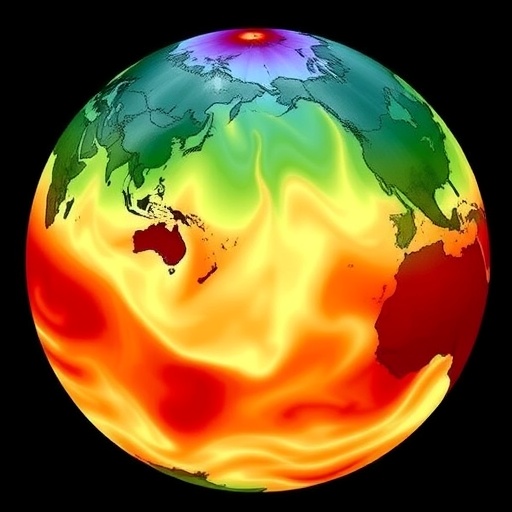
Recent groundbreaking research has unveiled a profound driver of climate variability that may exacerbate warming across Europe in the coming centuries. Spearheaded by Al-Yaari, Swingedouw, Braconnot, and colleagues, the study published in Nature Communications explores the role of multi-centennial internal variability within the North Atlantic Ocean and its potential to amplify regional climate change beyond what current models forecast. This revelation adds a vital, dynamic layer to our understanding of future European climate scenarios and shines a new spotlight on the ocean’s intricate behaviors.
The North Atlantic Ocean, long recognized as a critical player in the global climate system, exhibits complex variability that operates on timescales spanning centuries. Unlike shorter-term fluctuations driven directly by atmospheric conditions, this internal variability arises from the ocean’s intrinsic dynamics—such as circulation patterns, heat storage, and redistribution processes—that unfold independently but interact intricately with external forcings like greenhouse gases. The research team set out to quantify the magnitude and impacts of these deep-rooted natural oscillations, focusing on how they could influence European temperatures decades and centuries hence.
One central oceanic mechanism under scrutiny is the Atlantic Meridional Overturning Circulation (AMOC), a conveyor belt-like system transporting warm surface waters northward and returning colder, denser water southward at depth. Variations in AMOC intensity can drastically affect heat transport, altering climate patterns across the North Atlantic and adjacent continents. The study demonstrates that natural fluctuations in the AMOC operate on multi-centennial scales, creating persistent anomalies that can either mitigate or exacerbate warming trends over Europe depending on their phase.
To capture these slow-moving internal processes, the researchers employed novel high-resolution climate models capable of simulating ocean-atmosphere interactions with unprecedented detail and temporal scope. These models allow the disentanglement of internal variability from externally forced climate trends, highlighting the ocean’s self-sustained fluctuations as a significant modifier of regional climate response. The simulations suggest that ongoing and future AMOC oscillations may strongly influence Europe’s climate trajectory, modulating the regional impacts of global warming.
Importantly, this multi-centennial internal variability stands apart from anthropogenic warming signals. While human-driven greenhouse gas emissions continue to escalate global temperatures, the internal variability embedded in the North Atlantic could either amplify or offset this warming over extended periods. Such nonlinear interactions imply that climate change impacts over Europe might experience pronounced decadal to centennial phases of accelerated warming, interspersed with intervals of relative cooling or stabilization linked to oceanic cycles.
The study’s findings carry profound implications for climate prediction and risk management in Europe. Conventional climate projections often emphasize external forcings and short-term natural variability, potentially overlooking significant modulations by slower oceanic fluctuations. Recognizing and integrating multi-centennial internal variability into climate models enhances predictive skill and confidence, enabling policymakers to better anticipate and prepare for episodic extremes and gradual shifts that affect agriculture, infrastructure, health, and energy systems.
Moreover, the research underscores the importance of preserving and expanding ocean observation networks. Long-term datasets capturing AMOC strength, temperature profiles, salinity, and ocean currents are essential to monitoring internal variability’s current state and validating climate models. Improving our ability to detect shifts in these subtle oceanic patterns could provide early warning signals of impending climate accelerations or decelerations in the North Atlantic sector.
Beyond its regional significance, understanding internal variability in the North Atlantic offers a template for exploring similar processes in other parts of the global ocean. Multi-centennial fluctuations potentially exist in the Pacific, Indian, and Southern Oceans, which likewise influence regional climates and global circulation. The North Atlantic’s behavior thus illuminates a broader phenomenon of natural climate rhythms nested within the larger forced trajectory of global warming.
The study further hints at complex feedback mechanisms linking ocean variability and atmospheric circulation changes. Variations in ocean heat content and circulation patterns impact sea-level pressure distributions, jet stream positions, and storm tracks, directly shaping weather extremes and seasonal climate variability across Europe. These dynamic feedbacks demonstrate how internal ocean processes can have cascading effects that permeate terrestrial climatic conditions.
In addition to modeling evidence, the team also correlated these internal oscillations with paleoclimate records, confirming that such multi-centennial cycles have been a persistent feature of the Earth system for millennia. Ice cores, sediment deposits, and tree rings reveal past phases of North Atlantic variability coinciding with significant climatic shifts, lending credence to the concept that these natural cycles will continue to influence the climate amid anthropogenic change.
As climate projections are refined, incorporating internal variability may reconcile some longstanding discrepancies between observed warming patterns and modeled outcomes. The North Atlantic’s internal oscillations offer a plausible explanation for episodic surface temperature plateaus and rapid warming bursts reported in recent decades. This nuanced understanding encourages a more cautious interpretation of short-term climate signals, advocating for attention to longer temporal horizons.
Scientists also emphasize that this internal variability does not diminish the urgency of mitigating greenhouse gas emissions. Rather, it adds complexity to the climate system that must be acknowledged to develop effective adaptation strategies. If internal patterns intensify regional warming phases, Europe could face heightened climate risks even under moderate emission scenarios, necessitating robust resilience planning and infrastructure investment.
Future research directions identified by the authors aim to refine the quantification of these internal cycles and their interaction with human-induced forcing. This includes enhancing the spatial resolution of climate models, improving parameterizations of key ocean processes, and extending observational records through innovative technologies such as autonomous ocean floats and satellite altimetry. Interdisciplinary collaborations bridging oceanography, atmospheric science, and climate policy will be vital to translating these scientific insights into actionable frameworks.
This landmark study thus transforms our perception of European climate change by spotlighting the North Atlantic’s deep-seated internal variability as a potential driver of additional warming. It invites the scientific community and decision-makers alike to consider both external stimuli and internal oceanic rhythms in shaping future climate realities—a vital step toward more resilient and informed societies in the face of complex, evolving environmental challenges.
Subject of Research:
Multi-centennial internal variability in the North Atlantic Ocean and its influence on regional climate warming over Europe.
Article Title:
Multi-centennial internal variability in the North Atlantic could drive additional warming over Europe.
Article References:
Al-Yaari, A., Swingedouw, D., Braconnot, P. et al. Multi-centennial internal variability in the North Atlantic could drive additional warming over Europe. Nat Commun (2026). https://doi.org/10.1038/s41467-026-69209-2
Image Credits: AI Generated


