

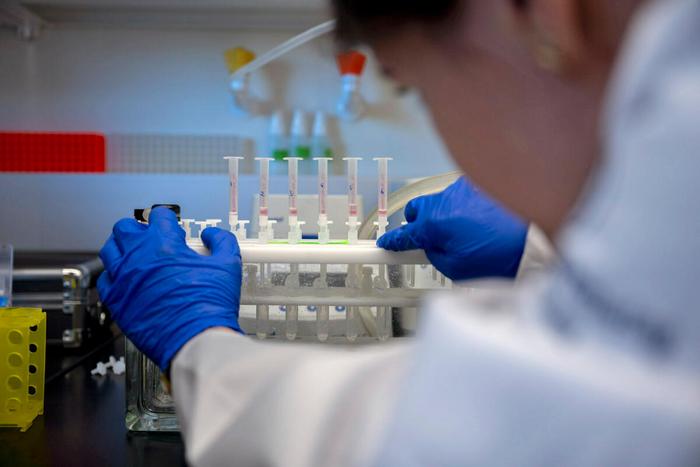
New research from Memorial Sloan Kettering Cancer Center (MSK) uses cryo-electron microscopy to shed new light on the ubiquitin; could help predict the risk of blood clots in cancer patients; reveals why micronuclei burst, accelerating aggressive cancers; and surveys healthcare providers about the benefits and risks of commercial genetic testing.

Credit: Memorial Sloan Kettering Cancer Center
New research from Memorial Sloan Kettering Cancer Center (MSK) uses cryo-electron microscopy to shed new light on the ubiquitin; could help predict the risk of blood clots in cancer patients; reveals why micronuclei burst, accelerating aggressive cancers; and surveys healthcare providers about the benefits and risks of commercial genetic testing.
MSK researchers shed new light on the ubiquitin pathway using cryo-electron microscopy
The ubiquitin pathway is a vital cellular process in all multi-cellular organisms. It involves the attachment of ubiquitin molecules to target proteins, regulating their degradation, localization, or activity — making it essential for biological processes such as protein turnover, DNA repair, cell cycle control, and immune response. And it is emerging as an important player in cancer.
Now researchers at MSK’s Sloan Kettering Institute are shedding new light on the process of transthioesterification, which is important for post-translational modification of proteins in the ubiquitin pathway. The ubiquitin pathway involves enzymes called E1, E2, and E3 ligases that transfer ubiquitin molecules between each other through transthiolation
reactions. In a new study that was a decade in the making, a team overseen by structural biologist Christopher Lima, PhD, and chemical biologist Derek Tan, PhD, and led by Tomasz Kochańczyk, PhD, a postdoctoral fellow in the Lima lab, captured the intermediate structures involved in transthiolation reactions. They used cryo-electron microscopy to determine the structures and conducted biochemical experiments to understand the conformational changes in the enzymes and ubiquitin during the transfer of ubiquitin molecules. The findings shed light on the coordinated structural changes that facilitate the directional transfer of ubiquitin in the ubiquitin pathway.
“After more than a decade of effort with the Tan Lab to develop and refine the chemical probe that made this work possible, Dr. Kochańczyk, was able to use it to capture a continuum of structures that explain how enzymes in the ubiquitin cascade transfer ubiquitin from one enzyme to the next,” Dr. Lima says. “Unexpectedly, this work also resolved decades-old mysteries as to why certain steps are coupled, and it revealed a structural basis for several mutations associated with a newly uncovered inflammatory syndrome called VEXAS. This work sets a new bar for us, using cryo-EM to reveal dynamics rather than a single static structure, an approach that will surely be implemented in related work in the years to come.”
Read more about the probe’s development in Organic Letters. Read the new study in Nature.
MSK-ACCESS liquid biopsy may predict risk of blood clots in cancer patients
Liquid biopsy tests like MSK-ACCESS® increasingly play a role in diagnosing patients’ cancers and monitoring their responses to treatment. These tests allow doctors to use blood samples to detect and study cancer-associated DNA from a solid tumor. Now researchers have learned that these tests can provide other important medical information about patients as well: They can reveal the likelihood that a patient will experience serious blood clots, called venous thromboembolism (VTE). VTE is a common complication in cancer patients and is leading cause of poor treatment outcomes and death in those with advanced cancers.
The team, led by MSK physician-scientist Justin Jee, MD, PhD, and hematologist Simon Mantha, MD, MPH, analyzed blood samples from a total of 6,030 patients being treated for a variety of solid tumors. They then linked these samples to patients’ clinical records. Using data analysis and machine learning, the researchers found that patients with high levels of cancer DNA in their blood had a higher risk of VTE than those with low levels or no cancer DNA in their blood, regardless of other clinical factors that might suggest a higher VTE risk. “This is the first large, pan-cancer study to use MSK-ACCESS data and correlate it with clinical outcomes,” Dr. Jee says. “Further study is needed, but these tests may eventually help us to determine which patients are likely to benefit from blood thinners to prevent VTE.”
The research was done in collaboration with doctors and scientists in Australia. Read more in Nature Medicine.
Why do micronuclei burst, accelerating aggressive cancers? MSK researchers find the answer
An increased rate of chromosomal abnormalities is a hallmark of aggressive cancers, characterized by the presence of micronuclei. These are small pockets of genetic material separate from a cell’s primary nucleus. Micronuclei are prone to burst, and when they do, wayward chromosomal fragments are released into the cell, activating pathways that drive the spread of cancer as well as resistance to treatment.
Now, researchers at MSK have identified what causes micronuclei to burst — opening the door to new therapeutic possibilities. A new study led by Melody Di Bona, PhD, a postdoctoral fellow in the lab of senior study author Samuel Bakhoum, MD, PhD, demonstrated that oxidative stress leads to the breakdown of the outer membranes of micronuclei.
The research further identified micronuclei as a missing link between free radicals (unstable molecules that can damage cells) and cancer progression, the scientists note.
Furthermore, the researchers were able to improve or reduce micronuclei rupture by manipulating the presence of reactive oxygen species (a type of free radical) and a key scaffolding protein called CHMP7.
“By uncovering the molecular mechanisms at work and providing a link with tumor hypoxia — meaning low oxygen levels, which is common in aggressive cancers — we hope to pave the way toward new treatments for chromosomally unstable cancers,” Dr. Di Bona says.
Read more in Science.
Care providers are concerned about risks of commercial genetic testing, survey finds
Direct-to-consumer (DTC) genetic tests are becoming more widespread, and consumers who take them in a spirit of curiosity may experience unintentional risks related to their results. Now a team of researchers at MSK has conducted one of the first surveys of healthcare providers related to their experiences providing counseling for these types of tests. Notably, 94% of the 139 providers surveyed indicated that they had faced at least one of several challenges when counseling patients about their results. The most common challenge reported was psychological distress experienced by people receiving unexpected medical results — such as the discovery of a significant hereditary cancer risk or even information about the true identity of their parents. Genetic test takers also experienced distress trying to self-navigate support and education after receiving results with implications for their health, as well as challenges created by false positives, the survey found. Over 60% of respondents reported instances of incorrect interpretation of results in the DTC reports, or inability to confirm results from DTC raw genomic data. Issues with results-confirmation were more common among oncology providers.
Together, 41% of respondents said the harms of direct-to-consumer genetic testing may outweigh the benefits; nearly as many, 38%, were undecided; and the remaining 21% believe the positives outweigh the negatives. Meanwhile, at MSK, patients are offered genetic testing alongside genetic counseling, with tests performed by MSK laboratories or other labs that are clinically accredited, notes study first author Magan Trottier, a certified senior genetic counselor with MSK’s Clinical Genetics Service. Read more in Molecular Genetics & Genomic Medicine.

