


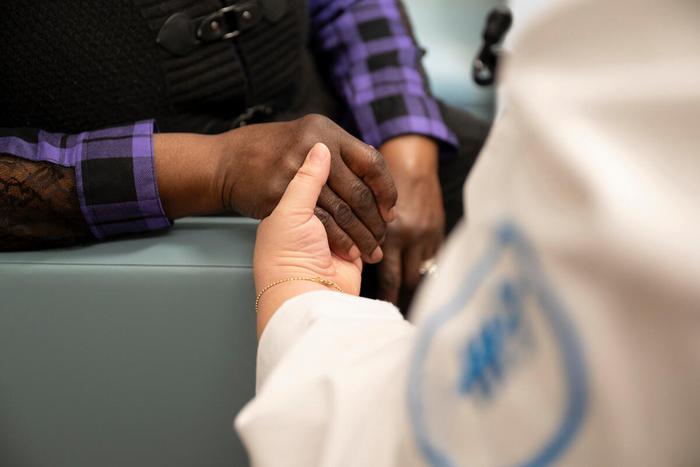
New research from Memorial Sloan Kettering Cancer Center (MSK) measures unscheduled healthcare interactions in multiple myeloma patients receiving T cell redirection therapies; investigates oral bacteria’s link to gut microbiota depletion with implications for cancer patients; and shows how a universal opt-out approach could help more cancer patients quit smoking.

Credit: Memorial Sloan Kettering Cancer Center
New research from Memorial Sloan Kettering Cancer Center (MSK) measures unscheduled healthcare interactions in multiple myeloma patients receiving T cell redirection therapies; investigates oral bacteria’s link to gut microbiota depletion with implications for cancer patients; and shows how a universal opt-out approach could help more cancer patients quit smoking.
Measuring unscheduled healthcare interactions in multiple myeloma patients receiving T cell redirection therapies
Chimeric antigen receptor (CAR) T cell and bispecific antibody therapies have dramatically improved outcomes for people with relapsed or refractory multiple myeloma. However, few studies have evaluated patients’ quality of life and rates of adverse events outside of clinical trials. Metrics for healthcare interactions are also lacking, especially when patient concerns are managed by nurses or advanced practice providers and patients do not require hospitalization.
MSK nurses Anna Howard, RN, and Isabel Concepcion, MSN, FNP-C, and medical oncology fellow Ross Firestone, MD, PhD, led a retrospective cohort study evaluating how often multiple myeloma patients undergoing either CAR T cell or bispecific antibody therapies outside of a clinical trial initiated unscheduled interactions with their care teams — including trips to urgent care or emergency departments, phone calls, and online portal messages to physicians’ offices.
The team found nearly 9 in 10 patients had at least one unscheduled interaction during the study observation period, with an average of 3.7 per patient.
Patients who received bispecific antibody therapy initiated more remote unscheduled interactions and urgent care visits than those in the CAR T cell therapy group. However, the number of emergency department visits and total inpatient days were not significantly different between the two groups. The most common causes for unscheduled interactions were upper respiratory tract infection and cytokine release syndrome. The findings of this study provide insights and guidance to help reduce the rate of unscheduled interactions. Read more in Blood Advances.
Oral bacteria detected in feces linked to gut microbiota depletion with implications for cancer patients
Humans typically swallow more than a trillion oral bacteria per day, though most are killed by the digestive system — making them scarce in the feces of healthy individuals. The abundance of oral bacteria is known to increase, however, in the feces of people with gastrointestinal diseases, including Crohn’s disease, ulcerative colitis, irritable bowel syndrome, and colorectal cancer.
A new study from the labs of Tobias Hohl, MD, PhD, of MSK’s Human Oncology and Pathogenesis Program, and Joao Xavier, PhD, of the Sloan Kettering Institute, sought to understand why this happens — and why high percentages of oral bacteria in feces are associated with worse patient outcomes.
To find the answer, the researchers analyzed a large data set from patients undergoing bone marrow transplantation at MSK alongside mouse model studies to understand the link between oral bacteria in feces and gut health. This dual approach, combining laboratory studies and clinical data, revealed that the increase in oral bacteria is a sign of a reduction in the normal, healthy gut microbiota population — rather than an influx of oral bacteria.
The findings suggest that recovering healthy gut bacteria may be more beneficial than targeting oral bacteria to enhance patient treatment strategies. Read more in Nature Microbiology (along with a Behind the Paper essay).
Universal opt-out approach could help more cancer patients quit smoking, overcome racial inequities
It seems obvious: Helping people diagnosed with cancer to quit smoking can improve clinical outcomes. But there have long been racial disparities in access to tobacco treatment programs and use of them among patients with cancer.
Since 2011, MSK has screened all patients for tobacco use and adopted an opt-out tobacco treatment referral as the standard of care. Now, an MSK analysis of more than 300,000 patients seen between 2018 and 2022 suggests that model can promote equity and help more patients to quit.
The analysis — which was led by study first author Gleneara Bates-Pappas, PhD, LMSW, and senior author Jamie Ostroff, PhD — found tobacco use was 6% overall but varied by race, ranging from 7% among Black patients, to 6% among white patients, to 4% among Asian patients. And when treatment was offered, Black patients had significantly higher use of it (66%) than their Asian (47%) and white counterparts (57%); similar differences were seen between Hispanic (61%) and non-Hispanic patients (54%).
“By normalizing tobacco-use screening and treatment as essential elements of high-quality cancer care, a universal tobacco screening and opt-out referral strategy may mitigate the stigma associated with patient engagement in tobacco treatment,” the authors write. “An opt-out referral model may eliminate clinician referral bias and thereby facilitate equitable access to and use of tobacco treatment services among racially and ethnically diverse patients with cancer.”
Read more in JAMA Network Open.
Cite Scienmag News
Nathaniel Bowman. (May 10, 2024). MSK Research Highlights, May 10, 2024. Scienmag. https://scienmag.com/msk-research-highlights-may-10-2024/
Nathaniel Bowman. "MSK Research Highlights, May 10, 2024." Scienmag, 10 May 2024, https://scienmag.com/msk-research-highlights-may-10-2024/. Accessed 3 September 2026.
Nathaniel Bowman. "MSK Research Highlights, May 10, 2024." Scienmag. May 10, 2024. https://scienmag.com/msk-research-highlights-may-10-2024/

