


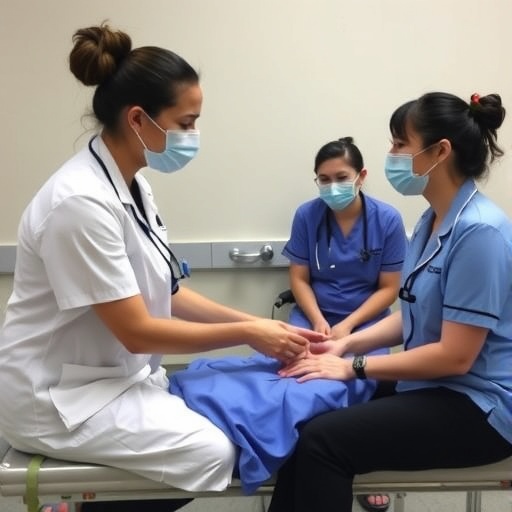
In recent years, the demand for comprehensive and effective training methods in nursing education has surged. One innovative approach that has garnered significant attention is moulage-based simulation. This method, which involves the application of realistic simulations depicting various medical conditions, has proved instrumental in enhancing nursing students’ skills and competence. The latest research by Uysal Yalçın and colleagues takess this concept a step further by investigating its specific impact on recognizing physical violence, a critical yet often overlooked aspect of nursing training.
Physical violence against individuals, including patients, can manifest in various healthcare settings, and recognizing such incidents is vital for the safety and well-being of both patients and healthcare professionals. The study conducted by Uysal Yalçın et al. presents a randomized controlled trial focusing on nursing students’ abilities to identify signs of physical violence after exposure to moulage-based simulation scenarios. This groundbreaking work addresses the pressing need for improved educational strategies in nursing that better prepare future healthcare workers for real-world challenges.
The randomized controlled trial set out to determine whether the incorporation of moulage-based simulations significantly enhances nursing students’ competencies in recognizing signs of physical violence compared to traditional instructional methods. The research design included two groups of nursing students, with one group receiving conventional education on the subject, while the other engaged with immersive moulage simulations designed to mimic real-life scenarios in which physical violence might occur.
Results from the study presented compelling evidence that students exposed to the moulage-based simulations showed significantly improved recognition of physical violence indicators. This finding supports the hypothesis that realistic simulation enhances observational skills and critical thinking in complex situations. Traditional teaching methods, though valuable, may not effectively convey the subtleties of recognizing and responding to such critical incidents in a fast-paced healthcare environment.
An essential aspect of the research was the meticulous planning and execution of the simulation scenarios. The moulage utilized was not merely decorative; it was intricately designed to represent realistic injuries and conditions that would prompt students to recognize physical violence. This attention to detail in the simulations likely played a crucial role in the heightened awareness and sensitivity of the nursing students, allowing them to practice their skills in a safe yet impactful way.
The findings from this trial could have far-reaching implications for nursing education practices worldwide. By incorporating moulage-based simulation techniques into the curriculum, nursing programs may significantly enhance the preparedness of their students to handle scenarios involving physical violence. The value of such training cannot be understated, as healthcare professionals are often on the front lines of dealing with the aftermath of violence in various forms.
Further, the leadership in nursing education must be encouraged to adopt and implement evidence-based strategies that prioritize innovative teaching methods like moulage-based simulation. As healthcare environments continue to evolve, the need for educators to stay ahead of challenges is more crucial than ever. By understanding and applying the results of Uysal Yalçın’s study, educators can design curricula that not only fulfill academic requirements but also meet the real-world needs of the healthcare workforce.
This study also opens the door for further research into various dimensions of nursing education and the effects of simulation. Exploring different types of scenarios—beyond physical violence—could provide invaluable insights into how nursing students can respond to emotional and psychological cases of violence. This could refine training methodologies further, ensuring they address the multifaceted nature of violence that healthcare professionals may encounter.
The broader implications of this research extend beyond nursing education; they also highlight the critical need for systemic changes within healthcare institutions. Recognizing and responding to violence in any form is paramount to improving patient care and safeguarding healthcare providers. Therefore, holistic training programs that embrace innovative simulations could play a significant role in molding competent, responsive healthcare professionals.
The study’s impact is likely to drive a shift in how nursing schools view simulation as a pedagogical tool. Uysal Yalçın et al.’s research underscores the necessity of fostering environments where future nurses are equipped to identify and manage violence effectively. Consequently, as nursing education embraces these innovative approaches, it may also inspire other disciplines within healthcare to develop similar training methods that enhance recognition and management of critical issues.
Moreover, there is potential to integrate technology into moulage-based simulations, enabling virtual reality experiences that offer equally immersive learning opportunities. This convergence of technology and education could redefine training paradigms and result in a generation of healthcare professionals adept at handling various complexities within the healthcare system.
In conclusion, the randomized controlled trial conducted by Uysal Yalçın and colleagues is a significant step forward in nursing education. The evidence clearly demonstrates that moulage-based simulation can enhance nursing students’ recognition of physical violence, thus preparing them better for real-world healthcare environments. As nursing programs consider adopting these findings, the potential for comprehensive improvements in patient care and safety hinges on the pursuit of innovative educational strategies.
The research presented has opened a crucial dialogue about the importance of preparing healthcare professionals for recognizing and addressing violence in various forms. This work not only represents a methodological improvement within nursing education but also contributes to the broader goal of enhancing safety and care quality in healthcare settings.
Cite Scienmag News
Ophelia Keating. (October 3, 2025). Moulage Simulation Enhances Nursing Students’ Violence Recognition. Scienmag. https://scienmag.com/moulage-simulation-enhances-nursing-students-violence-recognition/
Ophelia Keating. "Moulage Simulation Enhances Nursing Students’ Violence Recognition." Scienmag, 3 October 2025, https://scienmag.com/moulage-simulation-enhances-nursing-students-violence-recognition/. Accessed 5 September 2026.
Ophelia Keating. "Moulage Simulation Enhances Nursing Students’ Violence Recognition." Scienmag. October 3, 2025. https://scienmag.com/moulage-simulation-enhances-nursing-students-violence-recognition/


