


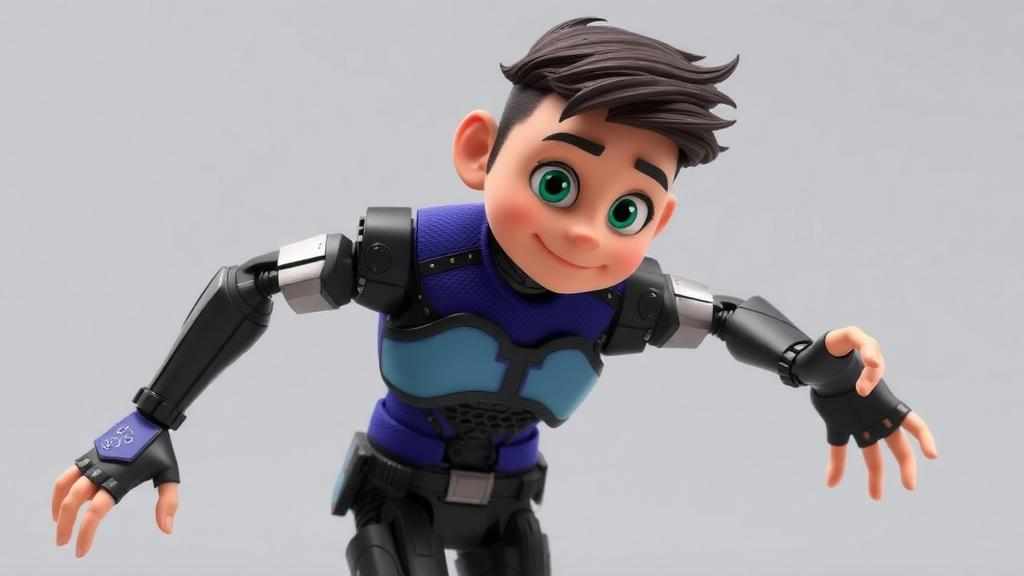
Anyone who has watched the making-of featurette for a beloved animated film or a blockbuster video game knows that character movement is never accidental. Every slumped shoulder, every exuberant skip, every weary shuffle is the product of countless hours of adjustment, review, and refinement. Directors routinely ask for a performance to be dialed up or dialed down: make the walk a little happier, make the victory dance a bit less theatrical, make the exhaustion read more strongly without tipping into parody. In the era of AI-assisted animation, however, that seemingly simple request has been surprisingly difficult to fulfill. A new framework called the Motion Style Slider, developed by researchers at Institute of Science Tokyo together with collaborators at the Japanese game company Cygames, promises to change that by giving artists continuous, intuitive control over the intensity of stylized human motion, and it does so with a remarkably light data requirement.
The research, presented at the European Conference on Computer Vision 2026 (ECCV 2026) on September 10, 2026, addresses a persistent gap between what commercial AI animation tools can do and what creative professionals actually need. Current systems can transform a neutral motion, such as an ordinary walk, into a stylized one, such as a joyful or angry walk. That binary transformation is useful, but it is coarse. Most existing tools offer only fixed versions of a given emotion or expression, with no mechanism to increase or reduce how strongly the style comes through. The result is an all-or-nothing choice that forces animators to either accept the single stylized output or fall back on laborious manual editing, undermining the very efficiency that AI generation is supposed to provide.
The root of the problem lies in how these AI systems are trained. Motion-generation models typically learn from paired examples: a neutral motion and a fully stylized version of the same action, both captured through motion-capture technology. To teach a model what a half-stylized or quarter-stylized walk looks like, one would need to record actors performing the same movement at many intermediate levels of expression. That would demand multiple long, expensive motion-capture sessions for every action and every style, an approach that is costly and impractical for real-world production pipelines where time and budget are always under pressure. The Science Tokyo team, led by Specially Appointed Assistant Professor Chen-Chieh Liao and Professor Hideki Koike of the School of Computing, set out to eliminate that dependency entirely.
Their solution is elegant in its economy. The Motion Style Slider learns from only two endpoints: a neutral motion and a stylized version of the same action, for example neutral walking and happy walking. From this minimal pair, the model generates a continuous family of motions controlled by a user-defined scalar value called the style intensity, denoted alpha. Values such as 0, 0.5, 1.0, and 1.5 correspond to low, medium, and high style intensities, and the slider can be set anywhere along that continuum. Crucially, the range extends beyond 1.0, meaning the system can extrapolate into stronger, more exaggerated reactions that were never demonstrated in the input data. As Liao explains, this type of control matches the way artists and directors naturally ask for a motion to be a little more or a little less expressive, translating subjective creative direction into a precise numerical dial.
Under the hood, the framework builds on diffusion-based motion generation, the same family of generative techniques that has transformed image and video synthesis. Rather than relying on fixed style labels, the system learns a direction in a learned motion-style embedding space along which motion changes between the neutral and stylized endpoints. In practical terms, the model discovers the abstract axis that separates an ordinary walk from a happy walk, and then lets users travel along that axis by any desired amount. Information representing this style-change direction is combined with information about the motion content and the user-specified slider value before being fed into a pretrained motion-generation model. This architecture separates what the character is doing from how expressively they are doing it, allowing the two factors to be manipulated independently without retraining the underlying generator.
Evaluating a system that promises smooth, continuous style control requires more than a single qualitative demo. The team tested their method on multiple benchmark motion datasets and created an additional dataset specifically designed to assess performance on styles beyond those seen during training, a rigorous test of generalization. They compared their approach against established techniques, including the Multi-condition Motion Latent Diffusion Model and DeepMotionEditing. According to Liao, the proposed strategy achieved favorable results in the consistent control of style intensity, smooth transitions between intensity levels, and extrapolation to highly expressive motion. In other words, the slider does not just produce plausible intermediate motions; it produces them in a predictable order, so that increasing the value reliably increases the expressive intensity rather than jumping unpredictably between different performances.
Consistency and smoothness matter enormously in production. An animator who sets the slider to 0.5 needs to trust that the result sits meaningfully between the neutral and fully stylized endpoints, and that nudging the value to 0.6 will produce a correspondingly subtle change rather than a jarring shift in the character’s demeanor. Without that monotonic relationship between the slider and the perceived intensity, the control interface would be meaningless no matter how technically sophisticated the underlying model. The endpoint-supervised design directly encodes this expectation into the learning process, which is what distinguishes the Motion Style Slider from prior style-transfer approaches that treat stylization as a single, indivisible transformation.
To validate that the outputs actually read as intended to human eyes, the researchers conducted a user study using a Likert-scale questionnaire with 11 university participants. The participants rated the differences in style intensity among motions generated by the Motion Style Slider as clearly distinguishable, while the naturalness of the motions remained comparable across intensity levels. This second finding is just as important as the first. A system that achieves fine-grained intensity control at the cost of robotic or unnatural movement at intermediate settings would be of little use to animators, since fixing unnatural motion would reintroduce exactly the manual labor the tool is meant to eliminate. The study suggests the framework preserves motion quality across the entire slider range.
The practical implications extend across the entertainment industry. In video game development, where characters must perform countless actions under tight production schedules, the ability to derive a full spectrum of expressive variants from just two captured motions could dramatically reduce motion-capture budgets and iteration time. In film and virtual production, directors could fine-tune a character’s emotional delivery in real time during review sessions, asking the system for slightly more restraint or slightly more energy and seeing the adjustment immediately. Beyond games and film, the same technology could benefit virtual influencers, social VR platforms, embodied agents, and any application where digital humans need performances that feel tailored rather than templated.
There is also a broader conceptual significance to the work. The Motion Style Slider demonstrates that meaningful continuous control can be extracted from sparse, endpoint-only supervision, challenging the assumption that fine-grained generative control requires densely labeled training data. By learning a direction in an embedding space rather than memorizing discrete style categories, the approach points toward generative systems that behave less like black-box oracles and more like creative instruments with responsive, understandable controls. For a field often criticized for producing outputs that artists cannot steer, that shift in philosophy may prove as influential as the specific technical achievement. As AI-generated animation becomes an ever-larger part of games, films, and virtual content, tools like this one suggest a future in which the expressive nuances of digital characters obey the creative vision of the people directing them, one slider position at a time.
Subject of Research: Continuous AI-based control of stylized human motion intensity for character animation
Article Title: Motion Style Slider: novel framework enabling fine control of nuances in character motion
Article References: Motion Style Slider: novel framework enabling fine control of nuances in character motion. (n.d.). Original publication
Image Credits: AI Generated
DOI: Not provided
Keywords: Motion Style Slider, character animation, motion generation, diffusion models, style transfer, motion capture, ECCV 2026, Science Tokyo, Cygames, computer graphics, AI animation, style intensity control
Cite Scienmag News
Denise Maddox. (October 11, 2026). Motion Style Slider Gives Animators Precise Control Over AI Character Movement. Scienmag. https://scienmag.com/motion-style-slider-gives-animators-precise-control-over-ai-character-movement/
Denise Maddox. "Motion Style Slider Gives Animators Precise Control Over AI Character Movement." Scienmag, 11 October 2026, https://scienmag.com/motion-style-slider-gives-animators-precise-control-over-ai-character-movement/. Accessed 11 October 2026.
Denise Maddox. "Motion Style Slider Gives Animators Precise Control Over AI Character Movement." Scienmag. October 11, 2026. https://scienmag.com/motion-style-slider-gives-animators-precise-control-over-ai-character-movement/


