
Saturday, February 28, 2026
Science
No Result
View All Result
  • Login
  • HOME
  • SCIENCE NEWS
  • CONTACT US
  • HOME
  • SCIENCE NEWS
  • CONTACT US
No Result
View All Result
Scienmag
No Result
View All Result
Home Science News Bussines

Most executives already using generative AI tools, INSEAD survey shows

April 22, 2024
in Bussines
Reading Time: 3 mins read
0
INSEAD AI survey news
65
SHARES
595
VIEWS
Share on FacebookShare on Twitter
ADVERTISEMENT

Despite popular concern about generative AI making jobs redundant, a new survey by INSEAD shows employees and business leaders alike are enthusiastic about the transformative technology. In fact, two out of three respondents are already using it in their personal and professional lives.  

INSEAD AI survey news

Credit: INSEAD

Despite popular concern about generative AI making jobs redundant, a new survey by INSEAD shows employees and business leaders alike are enthusiastic about the transformative technology. In fact, two out of three respondents are already using it in their personal and professional lives.  

Conducted last summer, the survey of more than 1,200 INSEAD alumni across industries and continents highlights how concerns on the ground about AI’s potential negative impact are not necessarily in line with popular misgivings. For one thing, respondents’ top worry was not that AI would kill jobs but its potential misuse, with associated ethical and safety implications.

Indeed, more respondents said generative AI, or GenAI, will benefit employees more than top leaders, as opposed to those who indicated the opposite. This likely reflects a belief that AI will democratise access to information and improve efficiency for a wide range of jobs. 

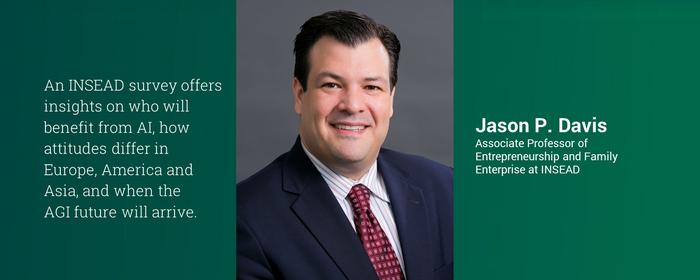
“The survey offers an early view of leaders’ views on AI technology,” says Jason P. Davis, Associate Professor of Entrepreneurship and Family Enterprise at INSEAD. Knowing how people are using GenAI and their attitudes towards the technology, he explains, could help us anticipate its trajectory across industries and continents.

INSEAD alumni – unique across top business schools for their global representation – provided the scope for Davis’s team to delve into perceptions across industries and geographies. Slightly over half of the survey’s respondents said their organisations were already using generative technologies. This points to a significant uptake and integration of GenAI in business operations. Another 27 percent of organisations planned to start using GenAI within the next year or beyond. Only 21 percent of organisations had no plans to engage.

Other interesting findings from the survey include variations in attitudes across industries and geographies. While respondents worldwide were enthusiastic about GenAI, those based in Europe were more inclined to see organisations as benefitting more than individuals.

This group was also less likely to be using generative tools than counterparts in North America and Asia, perhaps reflecting a higher scepticism regarding new technologies and concern about digital privacy in Europe.

Interestingly, respondents in this part of the world tended to see AGI happening faster than those in North America, although this may reflect less interaction with GenAI in personal and professional contexts.

The researchers also found that in sectors like communication services, financials and materials, a significant portion of respondents believed organisations will benefit more than individuals from GenAI. By comparison, a majority in the healthcare and utilities sectors think that individuals and organisations will benefit equally.

To find out more, read What Business Leaders Really Think About Generative AI by Davis on INSEAD Knowledge.

For any queries, please reach out to news@insead.edu. 



Share26Tweet16
Previous Post

KIER accelerates international cooperation on ‘clean energy’ with Europe’s largest research institute

Next Post

Genetically engineering a treatment for incurable brain tumors

Related Posts

blank
Bussines

Modeling Study Reveals Lower International Donor Funding Increases Household Economic Burden of Tuberculosis in Low- and Middle-Income Countries

February 27, 2026
blank
Bussines

New Study Uncovers Why Global IT Strategies Adapt Locally—and How Leaders Can Navigate the Shift

February 26, 2026
blank
Bussines

Telemedicine Visits Cost Five Times Less Than In-Person Appointments, Study Finds

February 26, 2026
blank
Bussines

As Healthcare Embraces Digitalization, Patients Struggle to Keep Up

February 25, 2026
blank
Bussines

New Study Reveals Smarter Shelf Strategies Could Increase Retail Profits and Slash Food Waste by Over 20%

February 25, 2026
blank
Bussines

Introducing Vote3D-AD: A Breakthrough Framework for Unsupervised Anomaly Detection in Point Clouds

February 25, 2026
Next Post
Sandro Matosevic Purdue University

Genetically engineering a treatment for incurable brain tumors

  • Mothers who receive childcare support from maternal grandparents show more parental warmth, finds NTU Singapore study

    Mothers who receive childcare support from maternal grandparents show more parental warmth, finds NTU Singapore study

    27618 shares
    Share 11044 Tweet 6902
  • University of Seville Breaks 120-Year-Old Mystery, Revises a Key Einstein Concept

    1022 shares
    Share 409 Tweet 256
  • Bee body mass, pathogens and local climate influence heat tolerance

    665 shares
    Share 266 Tweet 166
  • Researchers record first-ever images and data of a shark experiencing a boat strike

    532 shares
    Share 213 Tweet 133
  • Groundbreaking Clinical Trial Reveals Lubiprostone Enhances Kidney Function

    517 shares
    Share 207 Tweet 129
Science

Embark on a thrilling journey of discovery with Scienmag.com—your ultimate source for cutting-edge breakthroughs. Immerse yourself in a world where curiosity knows no limits and tomorrow’s possibilities become today’s reality!

RECENT NEWS

  • Creating Effective Fall Programs for Older Adults
  • Spinal Cord Organoids Reveal Injury and Therapy Insights
  • In-Memory Wireless Neural Networks Enhance Communication
  • Pediatric Viral Myocarditis: Causes, Models, and Gaps

Categories

  • Agriculture
  • Anthropology
  • Archaeology
  • Athmospheric
  • Biology
  • Biotechnology
  • Blog
  • Bussines
  • Cancer
  • Chemistry
  • Climate
  • Earth Science
  • Editorial Policy
  • Marine
  • Mathematics
  • Medicine
  • Pediatry
  • Policy
  • Psychology & Psychiatry
  • Science Education
  • Social Science
  • Space
  • Technology and Engineering

Subscribe to Blog via Email

Enter your email address to subscribe to this blog and receive notifications of new posts by email.

Join 5,190 other subscribers

© 2025 Scienmag - Science Magazine

Welcome Back!

Login to your account below

Forgotten Password?

Retrieve your password

Please enter your username or email address to reset your password.

Log In
No Result
View All Result
  • HOME
  • SCIENCE NEWS
  • CONTACT US

© 2025 Scienmag - Science Magazine

Discover more from Science

Subscribe now to keep reading and get access to the full archive.

Continue reading