


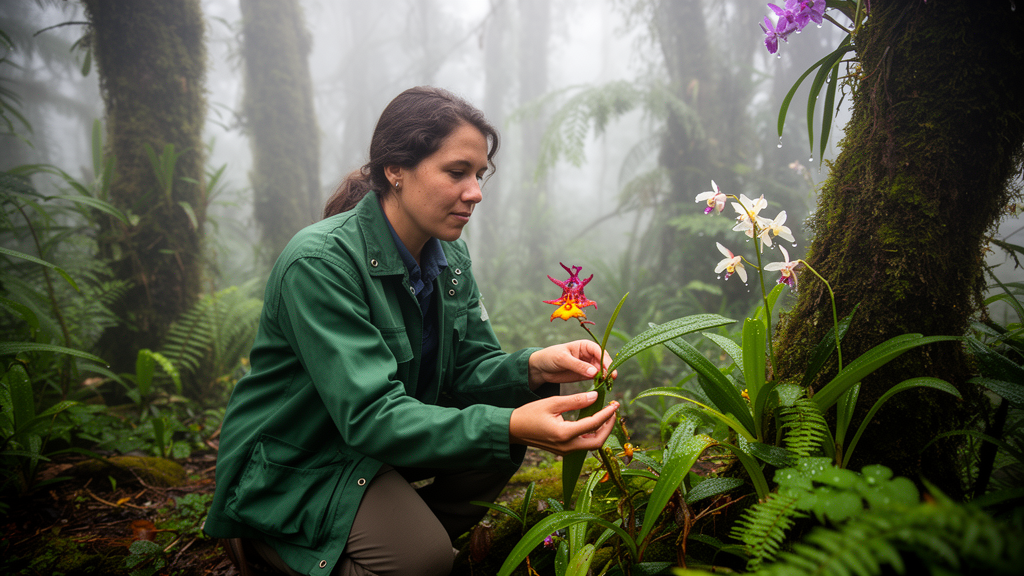
Botanists have formally described two previously undescribed species of the Gesneriaceae genus Besleria from the Mesenia-Paramillo Nature Reserve in Colombia’s Cordillera Occidental. The new species, Besleria purpureovenosa J.L.Clark and Besleria roseocalyx J.L.Clark & Clavijo, were distinguished through field collections, preserved specimens, digital images and detailed comparisons with related plants. Both species are currently known only from Mesenia-Paramillo, a 3,700-hectare protected area managed by Fundación Bioconservancy.
The reserve lies near Jardín at the junction of the Antioquia, Caldas and Risaralda departments and spans elevations from 1,560 to 3,167 meters along the continental divide between the Tumbes-Chocó-Magdalena and Tropical Andes biodiversity hotspots. Its primary montane cloud forest, abundant precipitation, rich epiphytes and strong elevational gradients support a mixture of lowland Chocó and montane Andean plant communities. This was a morphological taxonomic study rather than an ecological or population analysis.
The authors examined living plants, herbarium specimens, alcohol-preserved material and field photographs. Images of living plants were taken with a Nikon DSLR camera equipped with a 105 mm macro lens and SB-29S ring flash, while digital images were analyzed using ImageJ. The descriptions were based on the type material and additional specimens collected during expeditions in 2012, 2022 and 2026.
Besleria purpureovenosa is an unbranched terrestrial subshrub reaching 90 centimeters tall. Its diagnostic feature is the prominent dark purple to nearly black primary and secondary venation on the lower surface of its green leaves. The coriaceous, narrowly oblong to ovate blades measure 7–8.5 by 2.7–3.3 centimeters and bear six to eight pairs of secondary veins.
Their upper surfaces are uniformly hispid, while the lower surfaces are pilose along the veins and hispid between them. Leaves are evenly spaced along elongate, subwoody shoots, a feature unusual among the genus’s commonly terminally clustered leaves. The flowers of B. purpureovenosa occur in reduced axillary clusters of two to five.
Its calyx lobes are green or suffused with red and have irregularly fimbriate margins, while its narrowly tubular corolla is uniformly orange and measures 1.2–1.5 centimeters long. The fruit is a globose, indehiscent white berry approximately 0.5 by 0.5 centimeters, with pinkish-red seeds. The type specimen was collected near Alto de Las Ranas at 3,000–3,158 meters, where the plant was recorded with flowers and fruits in March 2026.
The authors distinguished B. purpureovenosa from Besleria reticulata var. venosa by its coriaceous leaves, conspicuous dark purple venation and evenly spaced leaves on elongate shoots. The name purpureovenosa refers to the purple primary and secondary veins, which remain visible even in dried herbarium specimens. Besleria roseocalyx is also an unbranched terrestrial subshrub, but it can reach 1.3 meters tall.
Its stems are glabrous and reddish to purple. The membranaceous, oblong to ovate leaves measure 10–18 by 4–7 centimeters and are glabrous above, with the lower surface glabrous to sparsely pilose along the veins. Inflorescences are reduced to clusters of three to eight axillary flowers, and the mature fruit is another globose, indehiscent white berry, about 0.5 centimeters across, containing brown ellipsoid seeds.
The most conspicuous feature of B. roseocalyx is the combination of reddish-pink calyx lobes and uniformly yellow, translucent tubular corollas. Most Besleria species have green calyces and orange corolla tubes, making this color combination rare within the genus. It differs from B. densiflora through its glabrous stems, reddish-pink calyx and pilose ovary; from B. leucocarpa through its yellow rather than orange-red corolla and glabrous rather than pubescent calyx; and from B. floribunda through its reduced axillary flower clusters rather than well-developed branched inflorescences.
It also has terete rather than quadrangular stems and yellow rather than orange corolla tubes, distinguishing it from B. nubigena. Flowering in B. roseocalyx was recorded in March, May and August, while fruiting occurred in March and May. Its type material was collected in 2012 at 2,200–2,500 meters in the municipality of Mistrató, and additional specimens were gathered in 2022 and 2026.
The available evidence establishes occurrence within the reserve but does not provide measurements of population size, abundance or habitat breadth, nor does it establish a formal conservation category. The species name roseocalyx refers to the rose-colored calyx, which contrasts with the yellow corolla. Besleria contains approximately 180 species of perennial herbs, shrubs and small trees found in rainforest understories from sea level to about 3,500 meters, with its center of diversity in the tropical Andes, particularly Colombia and Ecuador.
A modern comprehensive revision remains lacking: the major monograph was published in 1939 and recognized 141 species, while subsequent molecular phylogenetic studies indicate that its infrageneric sections and subsections do not reflect evolutionary relationships. Geographic distribution was more informative than morphology for predicting phylogenetic placement in those analyses, which placed the lineage most likely to include the two new species in a North Andes clade.
Subject of Research: Morphological description of two new Besleria species from a Colombian Andean cloud-forest reserve
Article Title: Two new species of Besleria ( Gesneriaceae ) from Reserva Natural Mesenia-Paramillo in Colombia’s Cordillera Occidental
Article References: Clark, J. L., Clavijo, L., Hoyos-Gómez, S. E., Vieira-Uribe, S., Rendón, U., Mazariegos, L. A., & Wahlert, G. A. (2026). Two new species of Besleria (Gesneriaceae) from Reserva Natural Mesenia-Paramillo in Colombia’s Cordillera Occidental. PhytoKeys, 279, 17-26. https://doi.org/10.3897/phytokeys.279.199372
Image Credits: AI Generated
DOI: 10.3897/phytokeys.279.199372
Keywords: Besleria, Gesneriaceae, plant taxonomy, new species, Colombia, Cordillera Occidental, Mesenia-Paramillo, cloud forest, morphology, species, Reserva, Natural
Cite Scienmag News
Margaret Porter. (October 20, 2026). Morphological taxonomy study describes two new Besleria species in a Colombian cloud-forest reserve. Scienmag. https://scienmag.com/morphological-taxonomy-study-describes-two-new-besleria-species-in-a-colombian-cloud-forest-reserve/
Margaret Porter. "Morphological taxonomy study describes two new Besleria species in a Colombian cloud-forest reserve." Scienmag, 20 October 2026, https://scienmag.com/morphological-taxonomy-study-describes-two-new-besleria-species-in-a-colombian-cloud-forest-reserve/. Accessed 20 October 2026.
Margaret Porter. "Morphological taxonomy study describes two new Besleria species in a Colombian cloud-forest reserve." Scienmag. October 20, 2026. https://scienmag.com/morphological-taxonomy-study-describes-two-new-besleria-species-in-a-colombian-cloud-forest-reserve/


