


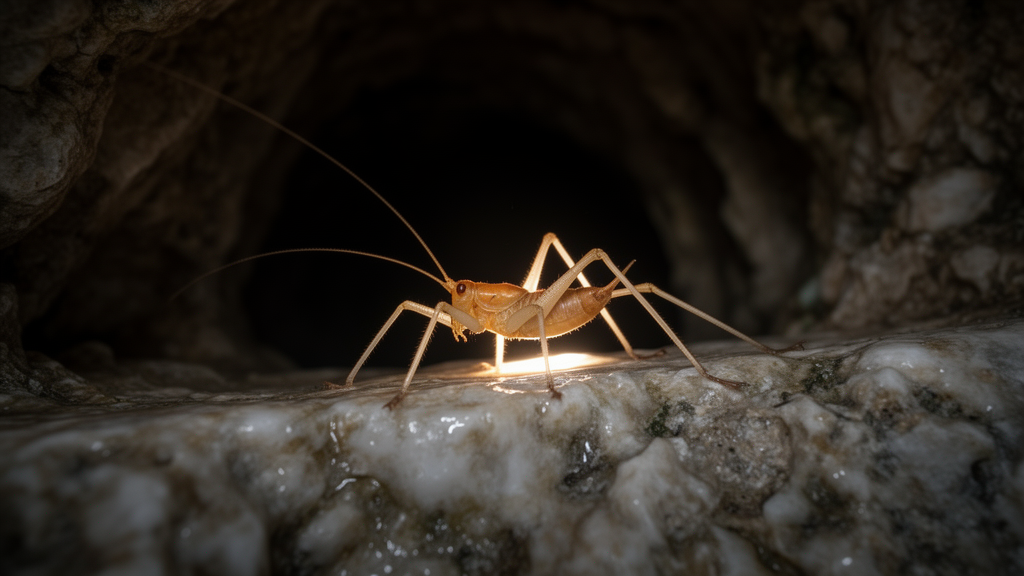
A descriptive taxonomic study combining external anatomy and mitochondrial DNA analysis identified Dolichopoda balrogi sp. nov. as a distinct cave-cricket species inhabiting an artificial tunnel on Kastellorizo Island in Greece’s Dodecanese. The discovery raises the number of recognized species in the genus Dolichopoda to 68, including 41 recorded in Greece. The researchers found the crickets in a tunnel on Mount Vigla at an elevation of approximately 242 meters.
Two research groups independently encountered the animals on 17 October and 15–16 November 2025. The tunnel is approximately 25 meters deep, 1.5 meters wide and between 1.80 and 2.5 meters high, extending through rocky calcareous terrain with low maquis and phrygana vegetation. Its internal temperature was approximately 17 °C, and natural light reached only the entrance.
On 16 November 2025, the researchers observed 37 Dolichopoda individuals scattered along the tunnel walls, comprising seven males, 10 females and 20 juveniles. Adults were collected by hand, preserved in 97% ethanol and stored at −18 °C. The holotype and paratypes were deposited at the Korinthian Museum of Natural History in Greece and the Museum of Zoology of the University “La Sapienza” in Rome.
For the morphological analysis, the researchers examined six external characters: the shape of the male tenth tergite, the median process and overall shape of the epiphallus, hind-tibial spinulation, the female subgenital plate and the ovipositor. These features were photographed with a BMS 133 Zoom Trino stereomicroscope. The holotype measured 16.2 mm in body length, with fore, middle and hind femora measuring 17.0, 16.0 and 26.0 mm, respectively.
The species was assigned to Dolichopoda because its fore and middle femora are unarmed, and to the subgenus Dolichopoda because all femora lack spines, the fore tibiae bear spines and the epiphallus has a non-bifurcated median process. In males, the tenth tergite has only traces of lateral lobes, while the epiphallus median process is short and trapezoidal. D. balrogi most closely resembles D. sbordonii , a species endemic to the adjacent Anatolian coast.
The two differ in the male tenth tergite, which has traces rather than distinct lateral lobes in D. balrogi , and in the epiphallus median process, which is trapezoidal rather than triangular. The female ovipositor of D. balrogi is longer and has more denticles. The new species also resembles D. lycia , but D. lycia has a bilobed epiphallus median process and lacks styli on the male subgenital plate.
The plica dorsalis could not be assessed because it was damaged during stereoscopic examination and no additional well-preserved specimens were available. The authors nevertheless considered the species delimitation robust because it was supported by multiple diagnostic characters in both sexes and by molecular evidence. The damage therefore limited one part of the morphological assessment but did not prevent the authors from distinguishing the species from the taxa they compared.
For the molecular analysis, researchers extracted genomic DNA from the femora of four adults, comprising two males and two females. They amplified and sequenced a partial mitochondrial cytochrome c oxidase I, or COI, fragment, producing four barcodes 632–683 base pairs long. The complete phylogenetic dataset contained 53 COI sequences from 20 Dolichopoda species in Greece and Turkey, including the four sequences generated in the study.
The Western Mediterranean species D. linderii served as the outgroup. After alignment and manual inspection for positional homology, the researchers performed maximum-likelihood inference under a general time-reversible model with gamma-distributed rates and invariant sites, as well as Bayesian Markov chain Monte Carlo inference. Both analyses produced the same overall topology.
The four Kastellorizo samples formed a distinct, well-supported lineage that did not cluster within any previously described species. It was sister to the southwestern Anatolian taxa D. sbordonii and D. lycia with high Bayesian posterior probability, while remaining separate from the represented Aegean, mainland Greek and Caucasian groups. The combined morphological and molecular evidence places D. balrogi within an Anatolian-associated lineage rather than the morphologically homogeneous Aegean species complex.
According to the authors, it is the first European representative of that lineage. Its collection exclusively from a human-made tunnel is notable because Kastellorizo lacks extensive natural cave systems, and the authors state that the cave-adapted cricket might otherwise have remained undetected without human excavation. Interpretation of the broader evolutionary history remains limited by incomplete taxon sampling because several described species from Anatolia and the eastern Aegean had not been sequenced.
The mitochondrial analysis also recovered D. noctivaga as paraphyletic, a pattern the authors present as consistent with a possible species complex requiring further resolution. The authors call for specialized surveys of the island’s inaccessible cliff caves to determine whether other populations are present and for conservation planning for the known population.
Subject of Research: Taxonomic description of a cave cricket from a Greek island artificial tunnel
Article Title: Delving too deep: Morphological and molecular description of the cave-dwelling Dolichopoda balrogi sp. nov. ( Orthoptera , Rhaphidophoridae ) from Kastellorizo Island, Greece
Article References: Kalaentzis, K., Alexiou, S., Christopoulos, A., Minoudi, S., Koutsogiannopoulos, D., Kotselis, C., & Triantafyllidis, A. (2026). Delving too deep: Morphological and molecular description of the cave-dwelling Dolichopoda balrogi sp. nov. (Orthoptera, Rhaphidophoridae) from Kastellorizo Island, Greece. Journal of Orthoptera Research, 35(2), 259-266. https://doi.org/10.3897/jor.35.187943
Image Credits: AI Generated
Keywords: Dolichopoda balrogi, cave cricket, taxonomy, Kastellorizo, Greece, morphology, mitochondrial DNA, COI barcoding, phylogenetics, subterranean biodiversity, Delving, deep
Cite Scienmag News
Gavin Prescott. (October 20, 2026). Morphological and mitochondrial DNA study identifies new cave cricket species in Greek island tunnel. Scienmag. https://scienmag.com/morphological-and-mitochondrial-dna-study-identifies-new-cave-cricket-species-in-greek-island-tunnel/
Gavin Prescott. "Morphological and mitochondrial DNA study identifies new cave cricket species in Greek island tunnel." Scienmag, 20 October 2026, https://scienmag.com/morphological-and-mitochondrial-dna-study-identifies-new-cave-cricket-species-in-greek-island-tunnel/. Accessed 20 October 2026.
Gavin Prescott. "Morphological and mitochondrial DNA study identifies new cave cricket species in Greek island tunnel." Scienmag. October 20, 2026. https://scienmag.com/morphological-and-mitochondrial-dna-study-identifies-new-cave-cricket-species-in-greek-island-tunnel/


