


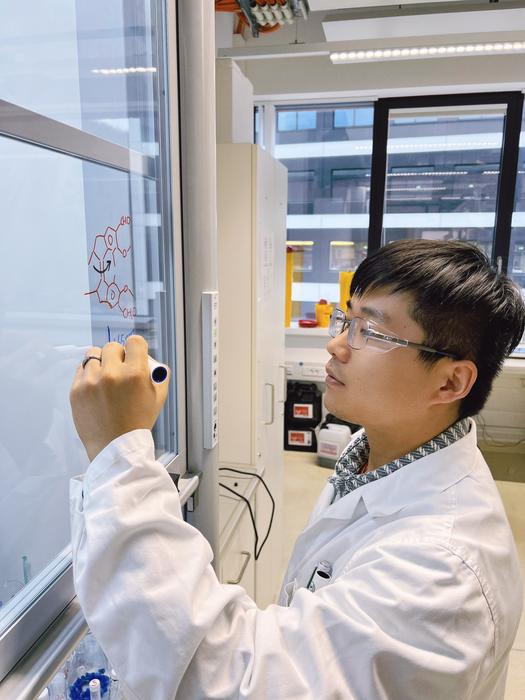
Light-driven molecular motors were first developed nearly 25 years ago at the University of Groningen, the Netherlands. This resulted in a shared Nobel Prize for Chemistry for Professor Ben Feringa in 2016. However, making these motors do actual work proved to be a challenge. A new paper from the Feringa lab, published in Nature Chemistry on 26 April, describes a combination of improvements that brings real-life applications closer.

Credit: J. Sheng / University of Groningen
Light-driven molecular motors were first developed nearly 25 years ago at the University of Groningen, the Netherlands. This resulted in a shared Nobel Prize for Chemistry for Professor Ben Feringa in 2016. However, making these motors do actual work proved to be a challenge. A new paper from the Feringa lab, published in Nature Chemistry on 26 April, describes a combination of improvements that brings real-life applications closer.
First author Jinyu Sheng, now a postdoctoral researcher at the Institute of Science and Technology Austria (ISTA), adapted a ‘first generation’ light-driven molecular motor during his PhD studies in the Feringa laboratory. His main focus was to increase the efficiency of the motor molecule. ‘It is very fast, but only 2% of the photons that the molecule absorbs drive the rotary movement.’
Increased efficiency
This poor efficiency can get in the way of real-life applications. ‘Besides, increased efficiency would give us better control of the motion,’ adds Sheng. The rotary motion of Feringa’s molecular motor takes place in four steps: two of them are photochemical, while two are temperature-driven. The latter are unidirectional, but the photochemical steps cause an isomerization of the molecule that is usually reversible.
Sheng set out to improve the percentage of absorbed photons that drive rotary motion. ‘It is very difficult to predict how this can be done and, in the end, we accidently discovered a method that worked.’ Sheng added an aldehyde functional group to the motor molecule, as a first step in further transformation. ‘However, I decided to test the motor function of this intermediate version and found it to be very efficient in a way that we had never seen before.’
For this, he cooperated with the Molecular Photonics group at the University of Amsterdam’s Van ‘t Hoff Institute for Molecular Sciences. Using advanced laser spectroscopy and quantum chemical calculations the electronic decay pathways were mapped, providing detailed insight in the working of the molecular motor.
Rotation cycle
Furthermore, it became clear that the adaption indeed gave Sheng better control of the molecule’s rotary movement. As mentioned before, the molecular motor rotates in four discrete steps. Sheng: ‘Previously, if we irradiated a batch of motors with light, we would get a mixture of motors at different stages of the rotation cycle. After the modification, it was possible to synchronize all motors and control them at each stage.’
This opens up all kinds of possibilities. For example, the motors could be used as a chiral dopant in liquid crystals, where the different positions would create different reflection colours. In the Nature Chemistry paper, Sheng and his colleagues present an example of this. Other applications could, for example, be the control of molecular self-assembly.
Applications
The addition of an aldehyde group to the motor molecule also has another interesting effect: it shifts the absorption of light to a longer wavelength. Since longer wavelengths penetrate further into living tissue or bulk material, this means that the motors could work much more efficiently in medical applications and materials science because more light will reach the motor molecule, while this will also use the photons more efficiently.
‘A number of our colleagues are now working with us on this new molecular motor for different applications,’ says Sheng. He expects more papers on this topic in the near future. Meanwhile, there is another challenge for the Feringa lab: ‘The molecular motor is now more efficient but we don’t exactly know why the modification causes this effect. We are currently working on it!’
Reference: Jinyu Sheng et al., Formylation boosts the performance of light-driven overcrowded alkene-derived rotary molecular motors, Nature Chemistry 26 April 2024.
Journal
Nature Chemistry
Method of Research
Experimental study
Subject of Research
Not applicable
Article Title
Formylation boosts the performance of light-driven overcrowded alkene-derived rotary molecular motors
Article Publication Date
26-Apr-2024
COI Statement
None
Cite Scienmag News
Bethany Barker. (April 26, 2024). More efficient molecular motor widens potential applications. Scienmag. https://scienmag.com/more-efficient-molecular-motor-widens-potential-applications/
Bethany Barker. "More efficient molecular motor widens potential applications." Scienmag, 26 April 2024, https://scienmag.com/more-efficient-molecular-motor-widens-potential-applications/. Accessed 4 September 2026.
Bethany Barker. "More efficient molecular motor widens potential applications." Scienmag. April 26, 2024. https://scienmag.com/more-efficient-molecular-motor-widens-potential-applications/

