


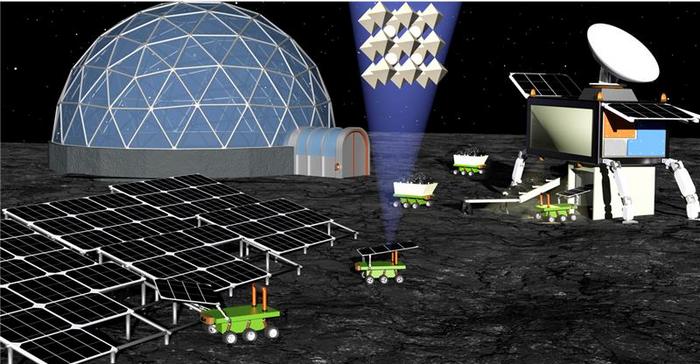
In a groundbreaking study unveiled on April 3 in the esteemed journal Device, researchers from the University of Potsdam have developed solar cells utilizing simulated Moon dust, a project that promises to revolutionize energy production on the lunar surface. The essence of this work addresses a fundamental challenge in space exploration: the creation of reliable and sustainable energy sources, crucial for long-term human presence on the Moon and beyond. As humanity progresses towards lunar colonization and exploration of Mars, the need for effective energy solutions cannot be overstated, making this innovation particularly timely.
Lead researcher Felix Lang emphasized the current limitations of solar cells deployed in space, which, although highly efficient, come with prohibitive costs and significant weight. The best solar technology available today achieves efficiencies ranging from 30% to 40%, yet relies heavily on complex and expensive materials, such as glass and robust foil coverings. This poses a dilemma for space missions, where every gram of payload counts. It becomes clear that relying on Earth-sourced solar cells for future lunar bases would not be practical or sustainable.
Instead of transporting bulky and heavy solar panels from Earth, Lang and his team propose an innovative approach: manufacturing solar cells directly on the Moon using locally sourced materials. By leveraging lunar regolith—the Moon’s loose surface dust—as a primary component, they aim to develop moonglass, a form of glass designed specifically from lunar materials. This methodology has the potential to reduce the weight of the solar cells significantly, trimming spacecraft launch masses by as much as 99.4% and slashing transportation costs by nearly 99%. Such drastic reductions would make the establishment of permanent lunar habitats not only feasible but economically viable.
To scrutinize their approach, the researchers experimented by melting simulated lunar regolith into moonglass, which they then integrated with perovskite—a class of materials known for their remarkable efficiency and cost-effectiveness in solar technology. This combination is especially appealing because it allows engineers to greatly enhance energy output. The study revealed that these new solar panels could generate up to 100 times more energy per gram compared to traditional Earth-based solar cells, a staggering improvement that could redefine energy generation on the Moon.
One of the standout features of this new approach is the exceptional radiation resilience of the moonglass solar cells. When subjected to space-grade radiation—a significant hazard for any materials deployed outside the protective confines of Earth—the moonglass proved superior to conventional glass. Traditional solar panels, made from Earth-sourced materials, tend to degrade under radiation exposure, which eventually impairs their efficiency. Conversely, the natural impurities found within lunar regolith afford moonglass its distinct stabilizing properties, preventing degradation and ensuring long-term functionality.
The simplicity of fabricating moonglass is another crucial advantage. The researchers noted that the process does not necessitate elaborate purification techniques, which are often energy-intensive and costly. Instead, solar energy itself can provide the extreme temperatures needed to melt regolith into glass. Through a meticulous adjustment of the moonglass’s thickness and the precise formulation of the solar cell components, the team achieved an impressive initial efficiency of 10%. With further optimization, they speculate that it may be possible to attain efficiencies upwards of 23%.
Nevertheless, the challenges of implementing this technology on the Moon are daunting. The unique environmental conditions, including lower gravity and extreme temperature fluctuations, could drastically influence the formation and effectiveness of moonglass. Additionally, the solvents typically used in the fabrication of perovskite solar cells may not perform adequately in the Moon’s vacuum environment. As these hurdles present potential setbacks, the research team plans to conduct a small-scale experiment on the lunar surface to validate their solar cells under genuine extraterrestrial conditions.
Lang expressed optimism about the implications of their research, noting that the ability to convert lunar dust into functional solar cells could serve as a cornerstone for future lunar colonies. He highlighted that scientists have been exploring various applications for lunar regolith, from producing water for fuel to constructing buildings through in-situ resource utilization. Integrating energy solutions into this framework represents a significant step forward in creating a self-sustaining lunar habitat.
As technological advancements drive exploration further from Earth, harnessing local resources sustainably will be key to establishing robust human outposts on other celestial bodies. These moonglass solar cells may well serve as a prototype for innovative energy solutions that can enable future missions to Mars and beyond.
This research is a testament to the potential of interdisciplinary collaboration within the scientific community, demonstrating how insights from geology, materials science, and renewable energy can converge to tackle the challenges of space exploration. By utilizing locally available materials, this approach paves the way for a future where energy independence on the Moon is not just a lofty ideal, but a tangible reality.
The findings of this study highlight not only the feasibility of lunar manufacturing but also the importance of developing technologies that can thrive in the harsh environments of space. As we gaze toward the Moon, and hopefully Mars, it is the ingenuity and creativity of scientists like Lang and his team that will define our success in establishing a multi-planetary species.
In summary, this innovative leap into utilizing lunar regolith for solar energy production marks a crucial milestone in space exploration. The implications of successfully deploying moonglass solar cells on the Moon extend well beyond immediate energy needs; they represent a fundamental shift in how humanity approaches extraterrestrial habitation and resource utilization. The journey to the stars may be fraught with challenges, but with research like this paving the way, a brighter future awaits all those who dare to explore the cosmos.
News Publication Date:
3-April-2025.
Web References:
Cell Press Device Journal
Research Article Link
References:
- Ortiz et al., “Moon photovoltaics utilizing lunar regolith and halide perovskites.” Device.
- Research supported by the Volkswagen Foundation, Freigeist Q14 Program.
Keywords
lunar regolith, solar cells, Moon, moonglass, perovskite, sustainable energy, space exploration, extraterrestrial colonization, renewable energy, in-situ resource utilization.
Cite Scienmag News
Grant Pearson. (April 3, 2025). Moon Dust Solar Cells: Pioneering Sustainable Energy for Future Space Exploration. Scienmag. https://scienmag.com/moon-dust-solar-cells-pioneering-sustainable-energy-for-future-space-exploration/
Grant Pearson. "Moon Dust Solar Cells: Pioneering Sustainable Energy for Future Space Exploration." Scienmag, 3 April 2025, https://scienmag.com/moon-dust-solar-cells-pioneering-sustainable-energy-for-future-space-exploration/. Accessed 5 September 2026.
Grant Pearson. "Moon Dust Solar Cells: Pioneering Sustainable Energy for Future Space Exploration." Scienmag. April 3, 2025. https://scienmag.com/moon-dust-solar-cells-pioneering-sustainable-energy-for-future-space-exploration/


