


Some quantum systems are so complicated that even the most powerful supercomputers on Earth cannot fully simulate their behavior. The number of possible configurations of interacting particles grows exponentially with system size, and classical machines quickly run out of memory and processing power. One way around this bottleneck is quantum simulation: instead of calculating how a quantum system behaves, researchers build a controllable quantum system in the laboratory and tune it to mimic the one they want to understand. Among the leading platforms for this approach are trapped-ion simulators, in which a row of individual charged atoms is suspended in space by carefully shaped electric fields, then manipulated with lasers so that the ions interact in ways that reproduce the physics of a target system. By measuring the information encoded in the ions, scientists can extract properties of the simulated model that would otherwise remain out of reach.
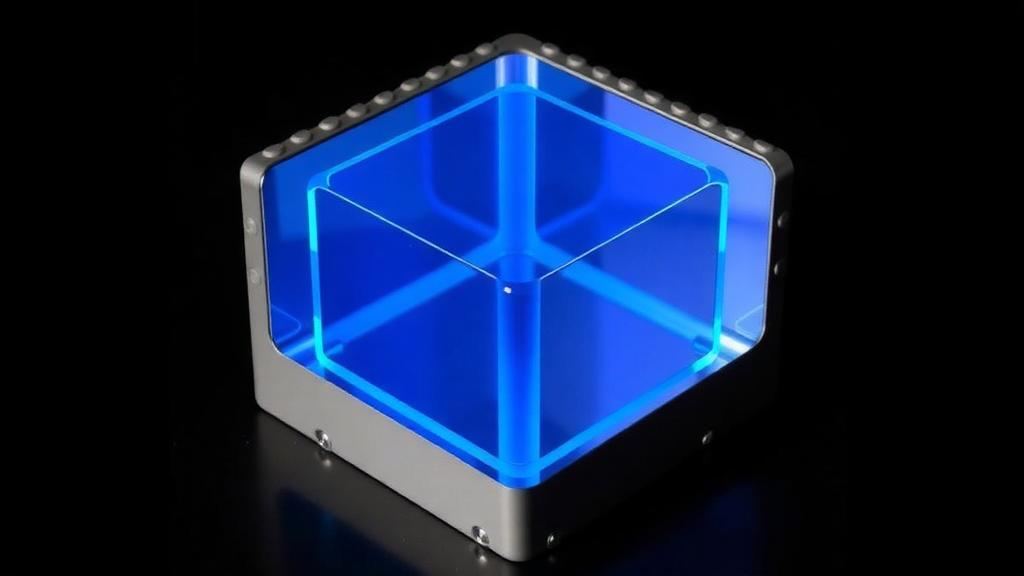
Now a team at Rice University, working with collaborators at Duke University and the glass-microfabrication company Translume Inc., has unveiled a new device that could make this powerful technique far more accessible. Writing in the journal Physical Review Applied, the researchers describe a monolithic segmented three-dimensional ion trap, a single microfabricated structure that combines the strengths of two long-standing trap designs while, for the first time in this class of devices, supporting the use of heavy ions such as ytterbium. The work was led by Guido Pagano, associate professor of physics and astronomy at Rice, with graduate student Abhishek Menon serving as corresponding author and Roman Zhuravel, an assistant research professor in the Pagano lab, as a senior author.
To appreciate why the new trap matters, it helps to understand the two design families it draws from. Ion traps that use radio-frequency voltages have traditionally fallen into two camps. Blade-style traps, built from precisely machined metal electrodes arranged around the trapping region, deliver excellent performance, but their geometry is limited in precision and each device must be assembled by hand, making them difficult to reproduce at scale. Microfabricated chip traps, by contrast, are typically planar, two-dimensional structures produced with lithographic techniques. They offer superior geometric precision, high modularity, and easy reproducibility, which makes them attractive for laboratories that cannot devote years of engineering effort to trap construction. In many performance metrics, however, chip traps have lagged behind their blade-style counterparts.
Monolithic three-dimensional ion traps were conceived as a way to capture the best of both worlds: the high performance of blade traps and the scalability and modularity of chip traps, all in a single block of material. Until now, though, devices of this type had only been demonstrated with light ions such as calcium. That limitation mattered, because heavier ionic species like ytterbium are widely used in quantum simulation and quantum information experiments, with well-developed laser-cooling schemes and mature optical access. Extending monolithic three-dimensional architecture to heavy ions would open the platform to a much broader community of researchers.
That is precisely the gap the Rice-led team set out to close. In their monolithic ion trap, the researchers aimed to combine the high-performance features and accessibility of the blade trap with the scalability and modularity of the chip trap in a way that was compatible with heavier ions, as Menon explained. Solving the harder engineering problems associated with trapping heavier ionic species, he noted, also simplifies the trapping of lighter species and broadens the trap’s usefulness across a variety of quantum technologies. The design process began with a block of fusilica glass. Using lasers and chemical processes, the team marked out and created channels for the ions and trenches for the electrodes that had to be installed before the entire structure was coated with sputtered gold.
Those trenches proved to be a crucial element of the design. By isolating the electrodes from one another by construction, they prevented the electrodes from shorting together during the gold sputtering process, and they also protected the device from dielectric breakdown under the high-voltage conditions the trap experiences in vacuum. In a radio-frequency ion trap, voltages applied to the electrodes create a rapidly oscillating electric field that confines charged particles near a point where the field averages to zero. Any unintended electrical contact or breakdown between electrodes would destroy the carefully shaped fields that hold the ions in place, so the isolation strategy was essential to making a robust, high-voltage device in a compact monolithic package.
The path to a working device was anything but smooth. Menon described the development as an iterative process in which the first generation of the trap failed, although in a promising and informative way: it suffered from a significant thermal and electrical management problem, and the trap began to glow visibly when the desired high radio-frequency voltage was applied in vacuum. That glow was a sign that electrical energy was being dissipated somewhere it should not have been, heating the structure and threatening the stability of the trapping fields. The second generation fixed the first generation’s major flaws, but it introduced new problems, including considerable axial micromotion, an unwanted oscillation of the trapped ions driven by imperfections in the electric field, and high ion-heating rates that would degrade the quality of quantum simulations.
Only with the third generation did the team arrive at a viable trap. The final design incorporated a better heat sink to draw heat away from the trap structure, addressing the thermal failures of earlier versions. It minimized the axial micromotion of the ions, improving the precision with which the ions could be held and manipulated. And it employed a plasma-based surface treatment of the electrode surfaces, a technique known to reduce the anomalous heating that occurs when electric-field noise from contaminated or rough surfaces jostles the trapped ions. Beyond these fixes, the design had to balance several competing requirements: greater spacing between the ions in the chain, lower voltages in the system, and appropriate ion-heating rates, all without sacrificing the qualities that made the ion trap useful in the laboratory.
Once the design was finalized, the Pagano lab, together with collaborators at Duke University, individually tested the ion traps. The devices were confirmed to work as intended, and their measured performance agreed with computer simulations that had been run before fabrication. That agreement between model and experiment is an important validation for a microfabricated device, because it means future iterations can be designed and refined with confidence in the simulation tools, shortening the development cycle. It also means that other laboratories adopting the platform can expect reproducible behavior from trap to trap, one of the key promises of monolithic microfabrication.
The implications extend well beyond the device itself. As Zhuravel pointed out, the monolithic trap makes trapped-ion simulators more accessible to academic labs, allowing researchers to simplify challenging quantum problems into ones they can solve and then map those solutions onto bigger, more complex problems. Applications could include understanding charge transfer in photosynthesis, a process Pagano highlighted as an example of the complex phenomena these simulators can illuminate. The work was supported by the U.S. Department of Energy Office of Science, the Welch Foundation, the Office of Naval Research, the National Science Foundation, the Army Research Office, and the U.S. Army Research Laboratory. With a reproducible, high-performance, heavy-ion-compatible trap now demonstrated, quantum simulation with trapped ions may be poised to move from a handful of specialized laboratories to a much wider scientific community.
Subject of Research: Monolithic segmented three-dimensional ion traps for trapped-ion quantum simulation with heavy ions
Article Title: New monolithic ion trap developed for accessible quantum simulations
Article References: New monolithic ion trap developed for accessible quantum simulations. (n.d.). Original publication
Image Credits: AI Generated
DOI: Not provided
Keywords: quantum simulation, ion trap, trapped ions, ytterbium, microfabrication, Rice University, Physical Review Applied, radio-frequency trap, ion heating, quantum technology, blade trap, chip trap
Cite Scienmag News
Katie Riggs. (October 13, 2026). Monolithic 3D Ion Trap Brings Heavy-Ion Quantum Simulators Within Reach of More Labs. Scienmag. https://scienmag.com/monolithic-3d-ion-trap-brings-heavy-ion-quantum-simulators-within-reach-of-more-labs/
Katie Riggs. "Monolithic 3D Ion Trap Brings Heavy-Ion Quantum Simulators Within Reach of More Labs." Scienmag, 13 October 2026, https://scienmag.com/monolithic-3d-ion-trap-brings-heavy-ion-quantum-simulators-within-reach-of-more-labs/. Accessed 13 October 2026.
Katie Riggs. "Monolithic 3D Ion Trap Brings Heavy-Ion Quantum Simulators Within Reach of More Labs." Scienmag. October 13, 2026. https://scienmag.com/monolithic-3d-ion-trap-brings-heavy-ion-quantum-simulators-within-reach-of-more-labs/


