


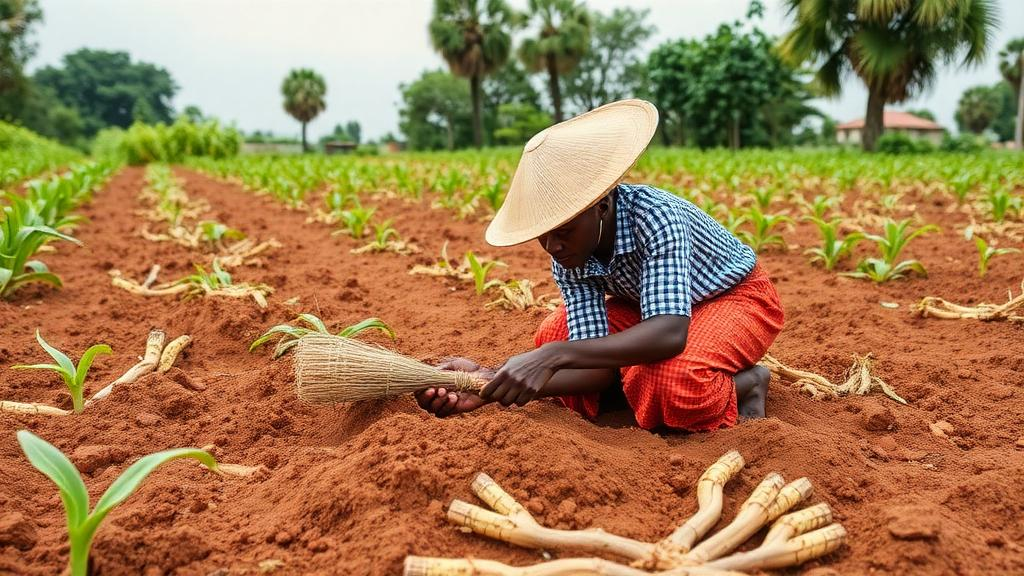
Across the dry savannahs of northern Ghana, smallholder farmers are being asked to transform the way they grow food in the face of a climate that is turning increasingly hostile. Projections for the country suggest temperatures could rise by as much as 3.9 degrees Celsius by 2080, while rainfall may fall by nearly 19 percent across all agroecological zones. For the roughly 60 percent of Ghana’s rural labour force that works in agriculture, these are not abstract statistics but a direct threat to household income and food security. A new study published in BMC Environmental Science offers one of the clearest pictures yet of why so many farmers in the region have been slow to embrace climate-smart agriculture, and the answer turns out to hinge on a deceptively simple question: what does each practice actually cost in land, labour or money?
Climate-smart agriculture, promoted by governments and development agencies worldwide, is a package of farming practices designed to sustainably raise productivity, build resilience to climate shocks and, where possible, reduce greenhouse gas emissions from farming itself. Ghana has even built the approach into national policy through its Climate-Smart Agriculture and Food Security Action Plan. Yet adoption among smallholder farmers remains stubbornly low. Previous research pointed to the heavy investments in land, labour and financial capital that many of these practices demand, but few studies had systematically sorted practices by their dominant resource requirement and then traced how that requirement shapes who adopts what.
Jonathan Atta-Aidoo and Philip Antwi-Agyei, both of Kwame Nkrumah University of Science and Technology, tackled that gap with a survey of 350 smallholder farmers in seven communities across the North East and Upper East Regions of Ghana, an area within the Sudan Savannah agroecological zone where a single rainy season runs from May or June to September or October. The districts chosen, West Mamprusi Municipality, Bongo District and Bolgatanga Municipality, are highly exposed to droughts and floods and depend heavily on rain-fed farming. Interviews, conducted in the local Gurne and Mumprusi languages between August and September 2021, lasted about 50 minutes each and covered household characteristics, farm features, institutional access, experience of climatic shocks, behavioural measures and the use of twelve distinct climate-smart practices.
The analytical core of the study is a typology. The researchers assigned each of the twelve practices to the single most essential resource without which adoption would be impossible, producing three categories: land-intensive practices that require farmers to expand their cultivated area, labour-intensive practices that demand additional hands, and finance-intensive practices that call for extra capital. The authors acknowledge the limitation of forcing each practice into one box, since many practices carry multiple resource demands, but argue that identifying the binding constraint is what matters for policy.
To model adoption, the team turned to econometric tools built for interdependent decisions. Because farmers can and do adopt practices from several categories at once, a univariate approach would discard information about how choices move together. The multivariate probit model allowed the researchers to estimate the factors driving adoption of each resource-based category simultaneously, while a multivariate ordered probit model, estimated through a composite marginal likelihood approach, captured how deeply farmers engage within each category, from adopting a single practice to adopting three or more. Positive correlations among the error terms across categories revealed that farmers treat the three typologies as complements rather than substitutes, mixing practices to maximise their synergistic effects.
The headline numbers are striking. About 80 percent of surveyed farmers had adopted at least one labour-intensive practice, roughly 73 percent had taken up at least one land-intensive practice, but only around 55 percent had adopted any finance-intensive practice. The depth of adoption tells an even sharper story: roughly 23 percent of farmers had adopted all four labour-intensive practices, compared with about 3 percent for land-intensive practices and less than 1 percent for finance-intensive ones. In other words, farmers in these communities will happily invest sweat, and will often find ways to work more land, but they balk when a practice demands cash.
Gender emerged as a decisive fault line, but only where money was concerned. The study found that gender played no significant role in the adoption of land-intensive or labour-intensive practices, a result that challenges assumptions that women’s limited control over land automatically blocks their uptake of land-hungry techniques. Women, despite shouldering heavy domestic workloads, evidently find ways to supply the labour these practices require. Finance-intensive practices were a different matter: female farmers were about 36 percent less likely to adopt them than their male counterparts, a disparity the authors attribute to women’s weaker control over financial resources. Education partially offset this gap, with women who had completed primary school or more being substantially more likely to invest in capital-hungry practices.
Institutional factors ran through the results like a common thread. Access to extension services raised the likelihood of adopting land-intensive practices by about 81 percent and finance-intensive practices by a similar margin, suggesting that expert advice reduces the perceived risk of committing scarce resources. Access to input markets boosted adoption across all three categories, and secure land tenure increased the odds of adopting labour-intensive practices by about 39 percent, apparently because farmers want assurance that their investments will not be lost before committing extra money to hired labour. Membership in farmer-based organisations helped women in particular, since such groups often organise rotational labour-sharing arrangements that ease the burden of labour-intensive techniques.
Climate shocks shaped behaviour in ways that varied by shock type and by gender. Farmers who had experienced drought were about 52 percent more likely to adopt land-intensive practices and about 67 percent more likely to adopt finance-intensive ones, with the effect especially strong among women, plausibly because technologies such as drip irrigation and drought-tolerant crops promise output even when rain fails. Flooding told the opposite story for some practices: women who had experienced floods were about 51 percent less likely to adopt finance-intensive practices, reflecting risk aversion about losing farm investments, while expanding farmland in flood-prone areas raises the very exposure farmers fear. Intriguingly, subjective norms, the social pressure farmers feel from their communities, reduced male farmers’ likelihood of adopting finance-intensive practices by about 37 percent, indicating that peer pressure can backfire rather than nudge men toward new technologies.
The study’s policy implications are concrete. The authors recommend expanding extension services, potentially through mobile delivery, pursuing land reforms that remove cultural tenure insecurities, and organising agricultural fairs that connect input dealers directly with farmers. Most pointedly, they call for gender-specific interventions, including credit facilities and extension services tailored to women, to close the resource gap that keeps female farmers out of finance-intensive practices. District-level differences also mattered, with farmers in the more urbanised municipalities adopting at higher rates than those in rural Bongo, hinting that infrastructure and market proximity shape who can respond to climate change. As climate projections darken for West Africa, the lesson from northern Ghana is that helping farmers adapt is less about inventing new practices than about matching support to the specific resource, whether land, labour or capital, that each practice demands.
Subject of Research: Determinants of climate-smart agriculture adoption by resource requirement among smallholder farmers in rural Ghana
Article Title: Climate-smart agriculture adoption in rural Ghana: do resource requirements matter?
Article References: Atta-Aidoo, J., & Antwi-Agyei, P. (2025). Climate-smart agriculture adoption in rural Ghana: do resource requirements matter?. BMC Environmental Science, 2(1), Article 4. https://doi.org/10.1186/s44329-025-00018-6
Image Credits: AI Generated
DOI: 10.1186/s44329-025-00018-6
Keywords: climate-smart agriculture, smallholder farmers, Ghana, Sudan Savannah, gender disparities, land tenure security, extension services, climate shocks, multivariate probit, adoption determinants, food security, resource requirements
Cite Scienmag News
Sloane Callahan. (October 4, 2026). Money, Not Land or Labour, Is the Biggest Barrier to Climate-Smart Farming in Ghana. Scienmag. https://scienmag.com/money-not-land-or-labour-is-the-biggest-barrier-to-climate-smart-farming-in-ghana/
Sloane Callahan. "Money, Not Land or Labour, Is the Biggest Barrier to Climate-Smart Farming in Ghana." Scienmag, 4 October 2026, https://scienmag.com/money-not-land-or-labour-is-the-biggest-barrier-to-climate-smart-farming-in-ghana/. Accessed 4 October 2026.
Sloane Callahan. "Money, Not Land or Labour, Is the Biggest Barrier to Climate-Smart Farming in Ghana." Scienmag. October 4, 2026. https://scienmag.com/money-not-land-or-labour-is-the-biggest-barrier-to-climate-smart-farming-in-ghana/


