


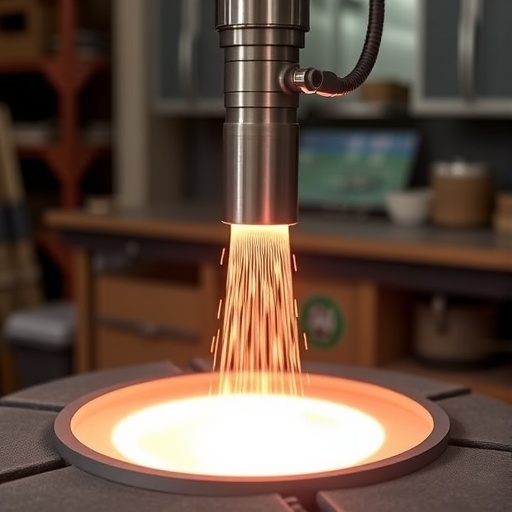
In a groundbreaking study that promises to revolutionize the material science field, researchers have published innovative findings on the synthesis of titanium-aluminum alloy. The research, conducted by a team led by experts Jin, M., Zhao, S., and Cai, Y., explores an advanced technique for alloy synthesis through molten salt electrolytic deoxidation. This method not only enhances the quality of the alloy but also presents an environmentally friendly alternative to traditional methods, echoing the global shift towards sustainable technologies in materials engineering.
Titanium alloys are known for their exceptional strength-to-weight ratio, excellent corrosion resistance, and biocompatibility. These attributes render them ideal for various applications, particularly in aerospace and biomedical fields. However, the existing synthesis methods often involve complex processing steps or chemicals that can negatively impact the environment. The new approach presented in the research aims to mitigate these issues, offering a cleaner and more efficient path to fabricating titanium-aluminum alloys.
The molten salt electrolytic deoxidation method is a fascinating electrochemical technique that utilizes molten salts as the medium for the reaction. This approach allows for significant control over the deoxidation process, which is critical in determining the purity and desired properties of the final alloy. By leveraging the unique properties of molten salts, the researchers were able to achieve a higher yield and improved mechanical properties in the resulting titanium-aluminum alloys compared to traditional methods.
One of the key aspects of the research is its focus on the electrochemical mechanisms at play during the deoxidation process. Through detailed analyses, the team investigated how different parameters, such as temperature and electrolyte composition, affect the efficiency and outcomes of the synthesis. This careful examination helps in understanding not just the “how” but also the “why” behind the improvements observed in alloy production, creating a pathway for further innovations in alloy technology.
Moreover, the study presents an in-depth exploration of the implications of using molten salts in alloy synthesis. Unlike conventional reagents, molten salts offer a low-cost and efficient option for reducing metal oxides to their metallic forms. The researchers emphasized how the use of these salts minimizes waste generation and lowers greenhouse gas emissions, aligning the new synthesis process with modern sustainable practices.
Essential to their findings is the characterization of the titanium-aluminum alloy produced. The researchers employed advanced characterization techniques, such as scanning electron microscopy (SEM) and X-ray diffraction (XRD), to analyze the microstructure and phase composition of the synthesized alloys. Their results indicated a promising homogeneity in the alloy structure, which is vital for achieving consistent mechanical properties across various applications.
In addition to mechanical properties, the study also addresses the corrosion resistance of the titanium-aluminum alloys produced via this method. Corrosion is often a significant concern in materials used for demanding applications. The research outlines methods to quantify corrosion rates and resistance mechanisms, providing vital insights that could lead to the development of superior materials for long-lasting applications.
Assiduously, the researchers discuss the scalability of their findings. While laboratory-scale experiments are promising, they also contemplate the industrial-scale application of this new synthesis technique. The transition from laboratory to large-scale production requires an assessment of economic viability and technological adaptability. The team’s foresight into these considerations adds a valuable dimension to their research findings.
Of great significance is how these innovative techniques can benefit the aerospace and medical industries. In aerospace applications, the lightweight yet sturdy nature of titanium alloys is crucial. The aerospace sector continuously seeks materials that can enhance fuel efficiency and performance while maintaining safety standards. Meanwhile, in the medical field, titanium alloys are favored for implants due to their biocompatibility, and the research findings suggest a way to produce these alloys more sustainably.
In our rapidly changing world, the implications of these advancements are vast. The development of environmentally friendly and efficient methods for titanium alloy synthesis opens opportunities for further exploration into other alloy systems beyond titanium-aluminum. Moreover, it may encourage collaborative efforts among researchers to innovate and synthesize alloys that meet the rigorous demands of various high-tech applications.
The study also resonates with the broader appeal for sustainability and resource efficiency in material production. With a growing emphasis on minimizing environmental impact, the research could inspire new community-based initiatives focusing on green metallurgy. Educating and involving industries and communities in adopting these methods could catalyze a substantial shift in how materials are produced and utilized in technology.
In conclusion, Jin, M., Zhao, S., and Cai, Y. have made significant strides in the synthesis of titanium-aluminum alloys through molten salt electrolytic deoxidation. The potential for enhanced mechanical performance coupled with reduced environmental impact presents a compelling case for the adoption of this method in both academia and industry. As this research progresses, it stands as a testament to the power of innovation in addressing contemporary challenges in materials science.
Jin, M., Zhao, S., Cai, Y. et al. Synthesis of titanium-aluminum alloy by molten salt electrolytic deoxidation.
Ionics (2025). https://doi.org/10.1007/s11581-025-06580-y
Cite Scienmag News
Neil Sanderson. (September 24, 2025). Molten Salt Method Creates Titanium-Aluminum Alloy. Scienmag. https://scienmag.com/molten-salt-method-creates-titanium-aluminum-alloy/
Neil Sanderson. "Molten Salt Method Creates Titanium-Aluminum Alloy." Scienmag, 24 September 2025, https://scienmag.com/molten-salt-method-creates-titanium-aluminum-alloy/. Accessed 6 September 2026.
Neil Sanderson. "Molten Salt Method Creates Titanium-Aluminum Alloy." Scienmag. September 24, 2025. https://scienmag.com/molten-salt-method-creates-titanium-aluminum-alloy/


