


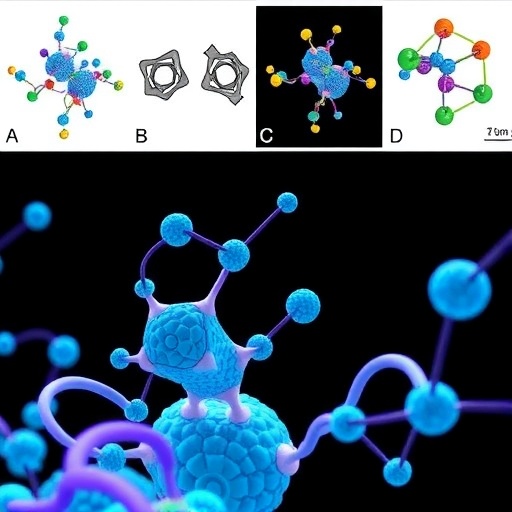
In a pioneering advancement set to redefine the capabilities of structural chemistry, researchers have introduced an innovative molecular catcher system utilizing a pillar[5]arene-incorporated metal–organic framework (MOF) that addresses the long-standing challenge of characterizing crystal structures of long alkyl chain-containing compounds. Traditionally, the determination of molecular structures through single-crystal X-ray diffraction demands the growth of high-quality single crystals—a feat notoriously difficult with natural products and many drugs featuring elongated alkyl chains, primarily due to their structural complexity and crystallization resistance. This novel approach propels the field forward by enabling rapid, precise structural analysis without the painstaking necessity of growing single crystals of the target molecules themselves.
At the heart of this breakthrough lies the concept of the molecular catcher—an advanced MOF system synthesized by integrating a pillar[5]arene derivative with a zinc-based coordination network. Pillar[5]arenes, known for their versatile and predefined cavity structures, serve as the pivotal host entities within the MOF scaffold, capturing guest molecules by non-covalent interactions tailored to the long alkyl chains. By preforming these MOF crystals and immersing them into a solution containing the target compounds, the molecular catcher efficiently entraps the guests within its cavity, thus circumventing traditional crystallization hurdles. Upon guest inclusion, these MOF crystals, now hosting the target molecules, become amenable to X-ray diffraction analysis, allowing direct elucidation of the otherwise elusive crystal structures.
The synthetic route to these pillar[5]arene-containing MOF crystals is both methodical and accessible, representing a significant convenience for structural chemists. The process begins with the in-house synthesis of the specialized pillar[5]arene derivative connected to a commercially available tetraphenyl ethylene compound. The assembly occurs within an N,N-dimethylformamide (DMF) medium, alongside zinc nitrate hexahydrate as the metal node source to form the crystalline MOF network. Post-synthesis, the resultant crystals undergo thorough washing with fresh DMF to eliminate residual starting materials, without the need for complex post-synthetic solvent exchange procedures. This careful yet straightforward preparation sets the foundation for consistent crystal quality, a cornerstone for successful guest inclusion.
One of the critical challenges in this methodology is selecting MOF crystals with appropriate size and crystal perfection to function effectively as molecular catchers. Optical microscopy serves as a vital tool for this preliminary screening, enabling researchers to assess crystal size homogeneity and identify defects that might impede guest uptake or compromise diffraction quality. This step cannot be overstated, as the integrity of the host MOF crystals directly influences the efficiency of guest encapsulation and subsequent structural determination.
Once suitable MOF crystals are selected, the inclusion of guest molecules proceeds via a simple immersion of the crystals into a dilute solution of the target compound. This soaking step capitalizes on the guest-host affinity driven by the structural complementarity within the MOF, prompting the guest molecules to reside stably within the molecular catcher cavities. The process is remarkably swift; the whole sequence from MOF synthesis through guest inclusion and structural characterization can be accomplished within a rapid ten-day timeframe—dramatically accelerating the workflow for chemists dealing with recalcitrant compounds.
The structural insights gained through this approach are tremendous, particularly for drug discovery and natural product chemistry, where understanding precise molecular conformations is crucial. The detailed atomic-level information retrieved from these guest-included MOF crystals provides pivotal data for rational drug design, enabling chemists to visualize long-chain alkyl molecules in their bound states—data previously unattainable through conventional crystallographic strategies.
Furthermore, by leveraging the modularity of pillar[5]arene units and the tunability of the MOF framework, this method promises extensibility. Future iterations could customize host frameworks to accommodate a broader range of molecular sizes and functionalities, potentially revolutionizing the field of structural analysis for an even wider class of chemistry challenges. The concept of encapsulating challenging molecules within a stable crystalline matrix, followed by direct diffraction studies, opens novel avenues for materials science as well.
The ingenuity of this technique also rests in its practicality. Unlike traditional crystallization methods that often require extensive trial-and-error and time-consuming optimization, the molecular catcher strategy relies on straightforward solution-phase inclusion steps. This advantage reduces the barrier to structural determination, democratizing access for laboratories that may lack specialized crystallization expertise yet require critical structural information rapidly.
Importantly, this protocol maintains stringent analytical rigor, ensuring that the encapsulated guests maintain their chemical integrity and adopt native conformations within the host MOF. Such fidelity is paramount, as any alteration introduced during inclusion could obscure accurate structural interpretation. The validated protocol addresses these concerns through controlled synthesis parameters and optimized soaking conditions designed to preserve molecular authenticity.
This advance also underscores the growing synergy between supramolecular chemistry and crystallography, demonstrating how host-guest chemistry principles can solve intractable problems in molecular structure determination. By harnessing the selective binding properties of pillar[5]arenes within robust MOFs, researchers showcase the power of molecular recognition in facilitating structural science breakthroughs.
Additionally, the widespread applicability of this molecular catcher system extends beyond purely academic interests. In pharmaceutical development, where long alkyl chains often modulate drug bioavailability and membrane permeability, precise structural knowledge guides formulation strategies and mechanistic studies. Natural products, often featuring complex alkyl-rich motifs, stand to benefit immensely from accurate structural characterizations made feasible through this method.
As research groups worldwide adopt this technique, its impact could ripple through diverse scientific domains, from catalysis to materials engineering, wherever the elucidation of difficult-to-crystallize compounds impedes progress. Coupling molecular catcher technology with advancements in synchrotron X-ray sources and computational crystallography could further enhance resolution and throughput, fostering an era of rapid, accurate structural analysis.
In sum, the development of a pillar[5]arene-incorporated MOF as a molecular catcher paves a transformative path in structural chemistry. This novel approach surmounts the critical limitations imposed by challenging crystal growth of long alkyl chain molecules, offering a pragmatic yet sophisticated solution grounded in elegant supramolecular design. The ability to expedite crystal structure determination, with high fidelity and minimal procedural complexity, heralds a paradigm shift likely to inspire extensive future innovation across chemistry and allied fields.
This work is a testament to interdisciplinary ingenuity, blending synthetic chemistry, materials science, and crystallography to address a fundamental bottleneck in molecular science. The research team’s detailed protocols provide a robust framework for widespread adoption, empowering scientists to unlock molecular mysteries previously out of reach. The molecular catcher concept may well become a staple tool in laboratories focused on complex molecule characterization, demonstrating how thoughtful design can transform scientific challenges into routine success.
As this technology matures, further modifications and tailored host architectures might extend its utility to encompass a wider range of molecular classes, perhaps incorporating stimuli-responsive features or real-time monitoring capabilities. The possibilities opened by this molecular catcher approach not only enhance structural determination but also enrich our understanding of host-guest dynamics within crystalline environments, contributing valuable insights to supramolecular chemistry itself.
The rapid structural insights offered by this technique will undoubtedly catalyze new directions in drug discovery, natural product research, and materials development—enabling more informed molecular design and accelerating innovation cycles. With its robust foundation and clear practical advantages, the pillar[5]arene-based molecular catcher stands poised to redefine how chemists approach challenging crystallographic problems well into the future.
Cite Scienmag News
Ophelia Keating. (May 27, 2026). Molecular Catchers Enable Precise Structure Determination. Scienmag. https://scienmag.com/molecular-catchers-enable-precise-structure-determination/
Ophelia Keating. "Molecular Catchers Enable Precise Structure Determination." Scienmag, 27 May 2026, https://scienmag.com/molecular-catchers-enable-precise-structure-determination/. Accessed 3 September 2026.
Ophelia Keating. "Molecular Catchers Enable Precise Structure Determination." Scienmag. May 27, 2026. https://scienmag.com/molecular-catchers-enable-precise-structure-determination/


