

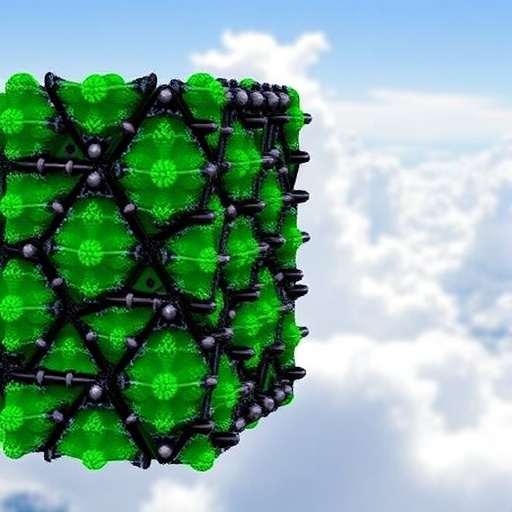
Over the last hundred years, the concentration of carbon dioxide (CO₂) in Earth’s atmosphere has witnessed an alarming increase, significantly contributing to the global warming crisis. This escalation has led to adverse environmental impacts, including erratic weather patterns, intensified drought conditions, and widespread ecological disruptions. The need to develop efficient carbon capture techniques has become more urgent than ever, as humanity strives to mitigate the accelerating damage inflicted upon our planet’s delicate ecosystems. Capturing CO₂ directly from the air, known as direct air capture (DAC), offers a promising pathway to reduce atmospheric carbon at scale, but it demands materials and methods that are both energy-efficient and scalable.
In a groundbreaking study, a team led by Petra Fromme, Paul V. Galvin Professor at Arizona State University’s School of Molecular Sciences (SMS) and Director of the Biodesign Institute’s Center for Applied Structural Discovery, has made significant strides toward enhancing the capability of materials used in moisture-driven DAC technology. This cutting-edge approach harnesses humidity changes to capture and release CO₂ with minimal energy input, representing a sustainable alternative to conventional carbon capture systems. Fromme’s multidisciplinary team undertook a thorough structural investigation of two commercially available charged polymers, Fumasep FAA-3 and IRA-900, seeking to unravel the relationship between their molecular architecture and carbon capture performance.
Unlike traditional DAC methods that often rely heavily on heat or chemical reactions, moisture-swing capture exploits natural humidity fluctuations to reversibly adsorb and release CO₂. This low-energy method offers a promising route to scale carbon capture without the prohibitive energy penalties associated with sorbent regeneration. To unlock the full potential of this technology, researchers must understand how polymeric sorbents’ internal structures affect water and CO₂ transport and adsorption kinetics. To this end, the ASU team employed a suite of advanced characterization techniques to probe the materials across spatial scales—from atomic-level frameworks to macroscopic porosity.
Through X-ray diffraction, small- and wide-angle X-ray scattering (SAXS/WAXS), atomic force microscopy (AFM), focused ion beam scanning electron microscopy (FIB-SEM), and transmission electron microscopy (TEM), the researchers generated a comprehensive structural profile of these charged polymers. The combination of these methods enabled the delineation of molecular ordering, pore architecture, and hydration dynamics, offering unprecedented insight into how subtle physical features govern sorbent behavior during moisture-swing cycles. Alongside these imaging modalities, functional studies measured CO₂ adsorption and desorption capacities under variable humidity conditions, directly linking structural attributes to macroscopic performance.
The comparative analysis revealed that both FAA-3 and IRA-900 exhibited similar water uptake and release characteristics, indicating that hydration is primarily influenced by their molecular structures rather than pore size. However, critical differences emerged in carbon capture performance: IRA-900’s larger and more open pore network facilitated faster and greater CO₂ adsorption, underscoring the role of pore architecture in enhancing sorption kinetics. Furthermore, IRA-900’s higher density of ionic charge sites contributed to its superior capture efficiency by providing more active locations for CO₂ binding.
Surface analyses further elucidated the presence of structural features such as clustering, porosity, and swelling phenomena within these polymers, all of which influence their dynamic behavior in humid environments. The interplay of these factors modulates the sorbent’s ability to adsorb CO₂ during dry conditions and release it upon moisture exposure, encapsulating the mechanics of the moisture-swing process. By linking these nanoscale observations to macroscopic uptake capacities, the study lays a foundation for rational materials design aimed at optimizing both energy use and capture rates.
This research not only advances fundamental understanding of moisture-driven DAC materials but also bridges critical gaps toward practical deployment of low-energy carbon capture technologies. The insights gained from this comprehensive structural characterization empower scientists to tailor polymers at the molecular and architectural levels, thereby improving sorbent durability, selectivity, and scalability. Such advancements are imperative in meeting global carbon reduction targets and combating climate change within economically viable frameworks.
Petra Fromme and her collaborators emphasize that the ability to visualize and quantify molecular order, pore connectivity, and hydration behavior through integrated X-ray and electron microscopy techniques represents a quantum leap in DAC material science. The multidimensional perspective provided by this approach enables the dissection of complex phenomena underlying moisture-swing adsorption mechanisms, transforming empirical observations into actionable design principles. This synergy between structural analysis and functional testing opens new avenues toward next-generation sorbents with unprecedented performance metrics.
First author Gayathri Yogaganeshan, a doctoral researcher in Fromme’s group, highlights the urgent environmental relevance of this work: “Our investigation into these charged polymers targets the core challenge of extracting CO₂ from ambient air with minimal energy input. Moisture-swing DAC represents a scalable carbon removal technology that could complement existing carbon management strategies, offering hope for sustainable atmospheric remediation.” Their collaborative paper, recently published in Materials Today Chemistry, showcases this transformative study conducted at the intersection of polymer chemistry, materials engineering, and environmental science.
Many current carbon dioxide mitigation strategies focus on sequestration or biological remediation, including reforestation, soil carbon management, mineral carbonation, and bioenergy with carbon capture and storage (BECCS). However, each approach faces inherent limitations related to permanence, scalability, and land-use conflicts. Direct Air Capture circumvents some of these issues by actively extracting CO₂ from dispersed sources, but its widespread adoption hinges on innovations that minimize energetic costs. The findings from ASU’s interdisciplinary team mark a pivotal contribution toward identifying practical, low-energy materials capable of cyclic CO₂ capture and release.
The comprehensive methodology adopted by the researchers, intertwining detailed structural characterization with sorption trials under controlled humidity, underscores the complexity of moisture-swing DAC systems. It also affirms the critical balance required between molecular-scale features—such as charge site placement and polymer chain ordering—and macroscale morphological traits including pore size distribution and connectivity. By unraveling these intertwined factors, the study offers a holistic portrait of how tailored polymeric sorbents can be optimized for heightened CO₂ uptake rates and capacities.
Moving forward, these insights enable the strategic engineering of enhanced charged polymers and composite materials that marry functional precision with manufacturing viability. The implications extend beyond DAC alone, influencing allied fields like gas separation, humidity control, and energy storage where moisture-responsive materials are invaluable. As the climate challenge grows ever more urgent, such pioneering research paves the way for scalable carbon removal technologies poised to transform atmospheric chemistry and stabilize Earth’s environmental future.
This study exemplifies the power of convergent research combining molecular science, materials design, and environmental technology. As direct air capture gains momentum as a realistic climate intervention, innovations rooted in fundamental structural understanding will be crucial for achieving breakthroughs in efficiency and cost-effectiveness. The collaborative work of Petra Fromme, Gayathri Yogaganeshan, and their colleagues thus represents a beacon of progress, illuminating the path toward sustainable, energy-conscious carbon capture solutions capable of mitigating the planet’s carbon crisis.
Subject of Research:
Not applicable
Article Title:
Comprehensive structural characterization of charged polymers involved in moisture-driven direct air capture
News Publication Date:
6-Mar-2026
Web References:
https://doi.org/10.1016/j.mtchem.2026.103465
Keywords:
Direct air capture, carbon dioxide removal, moisture-swing adsorption, charged polymers, Fumasep FAA-3, IRA-900, X-ray diffraction, electron microscopy, pore architecture, molecular structure, hydration dynamics, low-energy carbon capture


