


A groundbreaking study led by Associate Professor Chenjie Xu from Hangzhou Normal University’s School of Public Health reveals intricate connections between physical activity and brain aging, leveraging an unprecedented dataset and advanced neuroimaging techniques. Published in the esteemed journal Health Data Science, this research overturns simplistic notions about exercise by demonstrating that moderate physical activity—not excessive or insufficient levels—plays a crucial role in slowing brain aging, as measured through cutting-edge brain age prediction models.
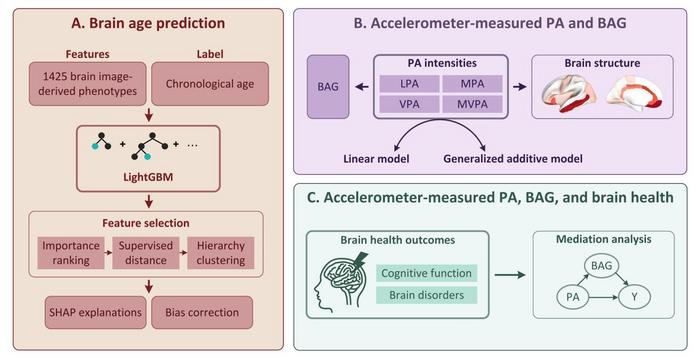
The research team analyzed a vast cohort of 16,972 UK Biobank participants, capitalizing on long-term accelerometer data that objectively quantified participants’ physical activity over a full week. This method overcame limitations of self-reported exercise data commonly used in prior studies, which often suffer from recall biases and inaccuracies. Harnessing state-of-the-art machine learning algorithms, specifically the powerful Light Gradient Boosting Machine (LightGBM), researchers deciphered the complex nonlinear relationship between physical activity intensity and brain health, using over 1,400 image-derived phenotypes (IDPs) extracted from T1-weighted magnetic resonance imaging (MRI) scans.
Central to this research was the construction of a brain age prediction model that estimates “brain age” from neuroimaging data, adjusting for the confounding effect of chronological age. This brain age gap (BAG)—the difference between predicted brain age and actual age—serves as a quantifiable biomarker for neural aging and neurodegeneration. Leveraging LightGBM algorithms trained on hierarchical clusters of features selected through tree-based feature importance and SHAP (SHapley Additive exPlanations) values, the team achieved a refined model architecture minimizing redundancy while maximizing interpretability.
Their analyses uncovered a striking U-shaped association between physical activity intensity and BAG: both low and high intensities corresponded with accelerated brain aging, while moderate physical activity was neuroprotective. More specifically, moderate and vigorous physical activity (MPA and VPA respectively) correlated with meaningful reductions in BAG—VPA, for example, demonstrated a beta coefficient (β) of –0.27, indicating an inverse relationship with accelerated brain aging. This nuanced finding challenges the simplistic “more is better” dogma surrounding exercise, emphasizing balanced activity levels as pivotal for maintaining brain health.
To quantify physical activity, participants wore wrist accelerometers over seven consecutive days, allowing researchers to objectively categorize activity levels into light (LPA), moderate (MPA), vigorous (VPA), and moderate-to-vigorous physical activity (MVPA). Such precise measurement techniques ensured high-fidelity data acquisition, circumventing biases of subjective reporting and enhancing the clinical relevance of findings to public health guidelines.
An essential facet of this investigation was mediation analysis, which revealed that BAG partially mediates the beneficial effects of physical activity on cognitive functions, such as reaction time, and on brain-related disorders including dementia and depression. This mechanistic insight bridges behavioral activity with neurological outcomes, illustrating how modifiable lifestyle factors translate to tangible brain health metrics.
Neuroanatomical correlates uncovered by this study further elucidate the biological substrates underpinning these associations. Participants engaged in moderate physical activity exhibited reduced white matter hyperintensities—lesions often related to aging and cerebrovascular disease—alongside preserved gray matter volume in key subcortical regions including the cingulate cortex, caudate nuclei, and putamen. These brain areas are pivotal for cerebrovascular integrity and cortico-striatal circuitry, which underlie executive function and motor control, suggesting that exercise confers protection across multiple critical neural systems.
Associate Professor Xu emphasized the implications of these results: “Our study does not merely affirm a nonlinear relationship between objectively measured physical activity and brain aging at the population scale but also delivers a crucial public health message—more exercise isn’t always better. Finding the right intensity balance might be the key to preserving brain integrity and delaying neurodegeneration.”
Given the scale and rigor of this analysis, combining multimodal imaging with accelerometer-based activity quantification and advanced machine learning, this study sets a new benchmark in neuroscientific epidemiology. Moreover, it offers a template for integrating large-scale data analytics with longitudinal patient monitoring, an approach increasingly vital for precision medicine.
The research team’s future trajectory promises even deeper insights into aging biology. Plans are underway to develop a multi-scale aging framework integrating data on sleep patterns, sedentary behavior, diverse neuroimaging modalities, and omics (genomics, proteomics) profiles. This comprehensive approach aims to unravel complex interactions between lifestyle, brain structure and function, and molecular pathways that regulate aging.
Longitudinal intervention studies are also on the horizon to test how targeted behavioral changes might modulate brain aging trajectories. By combining genome-wide analyses with proteomic signatures, researchers hope to identify biomarkers predictive of individual responses to physical activity interventions, potentially guiding personalized exercise prescriptions to mitigate age-related cognitive decline and neurodegenerative diseases.
This pioneering study not only advances our understanding of the neurobiological benefits of moderate exercise but also challenges public perception around physical activity, urging a paradigm shift from indiscriminate intensity escalation to balanced, sustainable regimens that optimize brain health across the lifespan.
News Publication Date: 2-May-2025
Web References: DOI: 10.34133/hds.0257
Cite Scienmag News
Cassandra Pierce. (June 4, 2025). Moderate Exercise Slows Brain Aging: New Study Finds U-Shaped Link Using Accelerometer Data. Scienmag. https://scienmag.com/moderate-exercise-slows-brain-aging-new-study-finds-u-shaped-link-using-accelerometer-data/
Cassandra Pierce. "Moderate Exercise Slows Brain Aging: New Study Finds U-Shaped Link Using Accelerometer Data." Scienmag, 4 June 2025, https://scienmag.com/moderate-exercise-slows-brain-aging-new-study-finds-u-shaped-link-using-accelerometer-data/. Accessed 4 September 2026.
Cassandra Pierce. "Moderate Exercise Slows Brain Aging: New Study Finds U-Shaped Link Using Accelerometer Data." Scienmag. June 4, 2025. https://scienmag.com/moderate-exercise-slows-brain-aging-new-study-finds-u-shaped-link-using-accelerometer-data/


