


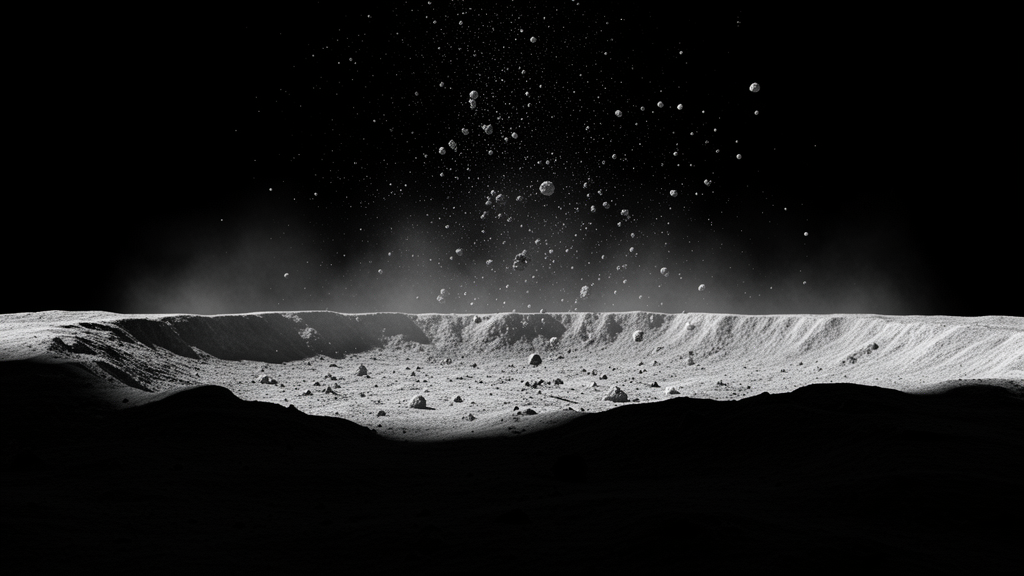
A study published in Astrophysics and Space Science models the linear instability of dust-electron plasma within a specific patch of the lunar terminator region. The research, conducted by S. R. Rajesh, S. B. Rakesh Chandran, Arunima Ajay, and Nishant K. Singh, addresses a topic that remains only partially explored: the response of this specific lunar boundary zone to various energetic events.
The theoretical framework assumes a situation where the mean horizontal electric field across the terminator fluctuates. These fluctuations are proposed to trigger instability within the dust-electron plasma system. The study specifically examines the linear instability existing in this modeled system, providing a mathematical description of how the plasma responds to these field variations. This approach allows the researchers to identify the conditions under which the system becomes unstable and how it subsequently seeks equilibrium.
The findings indicate that the system is unstable for moderate values of the electron Mach number. Under these conditions, the instability creates a dynamical equilibrium through the exchange of matter and energy across the terminator. The role of the electron Mach number is critical in determining the nature of this instability and the resulting equilibrium state.
In contrast, the study finds that for very high values of the electron Mach number, resonance instabilities appear. The emergence of resonance instabilities at high Mach numbers provides additional insight into the complex behavior of the lunar terminator plasma.
The authors note that these instabilities can provide more insight into the response of the lunar terminator region to phenomena such as Solar Energetic Particle (SEP) events.
Subject of Research: Linear instability of dust-electron plasma at the lunar terminator
Article Title: Linear instability of dust-electron plasma at lunar terminator
Article References: Rajesh, S. R., Rakesh Chandran, S. B., Ajay, A., & Singh, N. K. (2026). Linear instability of dust-electron plasma at lunar terminator. Astrophysics and Space Science, 371(11), Article 136. https://doi.org/10.1007/s10509-026-04668-z
Image Credits: AI Generated
DOI: 10.1007/s10509-026-04668-z
Keywords: lunar terminator, dust-electron plasma, linear instability, electron Mach number, SEP events, plasma physics, Astrophysics and Space Science, lunar environment, Linear, instability, dust-electron, plasma
Cite Scienmag News
Katie Riggs. (November 9, 2026). Modeling Dust-Electron Plasma Instability at Lunar Terminator. Scienmag. https://scienmag.com/modeling-dust-electron-plasma-instability-at-lunar-terminator/
Katie Riggs. "Modeling Dust-Electron Plasma Instability at Lunar Terminator." Scienmag, 9 November 2026, https://scienmag.com/modeling-dust-electron-plasma-instability-at-lunar-terminator/. Accessed 21 November 2026.
Katie Riggs. "Modeling Dust-Electron Plasma Instability at Lunar Terminator." Scienmag. November 9, 2026. https://scienmag.com/modeling-dust-electron-plasma-instability-at-lunar-terminator/




