


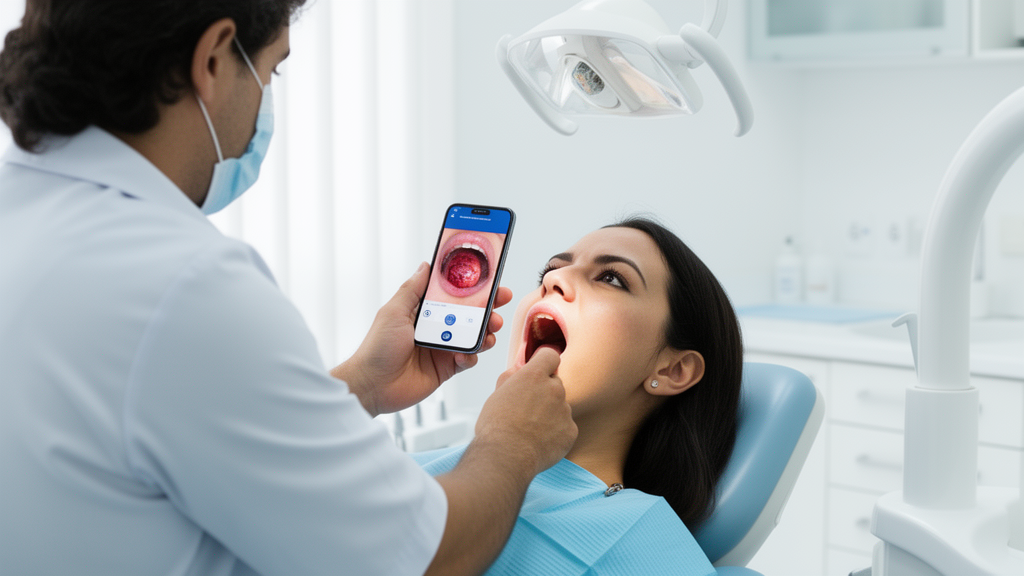
A modeled comparison found that app-based teleconsultation between primary care dentists and oral medicine specialists was associated with lower costs and slightly greater effectiveness than conventional in-person referral for diagnosing malignant and potentially malignant oral lesions in Brazil’s Unified Health System, or SUS. For each patient, the model estimated savings of R$128.36 and an incremental gain of 0.0011 quality-adjusted life years, or QALYs, classifying the teleconsultation strategy as economically dominant. These are simulated estimates rather than outcomes measured in a clinical trial, so they describe the performance of the two pathways under the study’s assumptions rather than demonstrated savings or health gains in treated patients.
The cost-effectiveness analysis modeled a hypothetical cohort of 1,000 people aged 40 years and older from the perspective of SUS. Investigators combined a decision tree with a Markov model to cover both the diagnosis of suspicious oral lesions and long-term disease progression over a lifetime horizon. Costs were measured in Brazilian reais, and health outcomes were expressed in QALYs. Model inputs were drawn from Brazilian official databases and published literature, providing the parameters used to compare app-supported professional consultation with the conventional in-person pathway within the public health system.
Oral cavity cancer is a major public health challenge, particularly in low- and middle-income countries where access to specialized diagnostic services is often limited. The study’s background notes that early diagnosis is associated with improved clinical outcomes and reduced treatment burden. It therefore examined whether primary care dentists could use an app-based teleconsultation with oral medicine specialists to support diagnosis of malignant and potentially malignant oral lesions instead of relying solely on conventional in-person referral. Within the model, the app-based strategy produced lower projected costs and marginally higher effectiveness than in-person care.
The researchers examined how robust those estimates were to uncertainty in the model parameters through deterministic and probabilistic sensitivity analyses. The sensitivity of the conventional in-person examination had the greatest influence on the results. In the probabilistic analysis, which comprised 1,000 Monte Carlo simulations, the teleconsultation strategy was dominant in 96% of runs, showing lower costs and slightly greater effectiveness in nearly all sampled cases. The incremental QALY advantage was modest in the base case at 0.0011 QALYs per patient, while the modeled cost saving was R$128.36 per patient. The analysis therefore identified the teleconsultation pathway as dominant without establishing a large difference in health outcomes between the strategies.
For SUS planners, the findings suggest that professional teleconsultation could be a scalable way to organize oral lesion diagnosis and allocate specialist resources, but the analysis did not directly test the app in routine clinical practice. Its conclusions depended on assumptions from official data and published literature, and they were especially sensitive to assumptions about the performance of conventional in-person examinations. Because the modeled cohort was hypothetical and the evidence came from a decision-tree and Markov analysis, the results do not by themselves establish real-world clinical benefit or financial savings. They instead indicate that app-based consultation between primary care dentists and oral medicine specialists could provide a cost-saving diagnostic option in the Brazilian public health system, with a small added modeled health benefit and a consistent cost-effectiveness advantage across most probabilistic simulations.
Subject of Research: Modeled cost-effectiveness of app-based teleconsultation for diagnosing malignant and potentially malignant oral lesions in Brazil.
Article Title: Cost-effectiveness of app-based teleconsultation between professionals versus in-person care for the diagnosis of malignant and potentially malignant oral lesions in the Brazilian Unified Health System
Article References: Dourado, A. D. S., Oliveira, E. F. D., Maia, J. P., Costa, N. S. S. D., Pereira, P. P. D. S., Marques, Y. A., De-Carli, A. D., & Probst, L. F. (2026). Cost-effectiveness of app-based teleconsultation between professionals versus in-person care for the diagnosis of malignant and potentially malignant oral lesions in the Brazilian Unified Health System. BMC Health Services Research. https://doi.org/10.1186/s12913-026-15563-2
Image Credits: AI Generated
DOI: 10.1186/s12913-026-15563-2
Keywords: oral lesions, oral cancer, teleconsultation, cost-effectiveness, Brazilian SUS, Markov model, decision tree, quality-adjusted life years, digital health, app-based, between, professionals
Cite Scienmag News
Ophelia Keating. (October 26, 2026). Modeled App-Based Oral Lesion Diagnosis Saves Costs in Brazil. Scienmag. https://scienmag.com/modeled-app-based-oral-lesion-diagnosis-saves-costs-in-brazil/
Ophelia Keating. "Modeled App-Based Oral Lesion Diagnosis Saves Costs in Brazil." Scienmag, 26 October 2026, https://scienmag.com/modeled-app-based-oral-lesion-diagnosis-saves-costs-in-brazil/. Accessed 26 October 2026.
Ophelia Keating. "Modeled App-Based Oral Lesion Diagnosis Saves Costs in Brazil." Scienmag. October 26, 2026. https://scienmag.com/modeled-app-based-oral-lesion-diagnosis-saves-costs-in-brazil/


