

Tuesday, May 26, 2026
Science
No Result
View All Result
  • Login
  • HOME
  • SCIENCE NEWS
  • CONTACT US
  • HOME
  • SCIENCE NEWS
  • CONTACT US
No Result
View All Result
Scienmag
No Result
View All Result
Home Science News Chemistry

Model shows how plankton survive in a turbulent world

June 25, 2024
in Chemistry
Reading Time: 2 mins read
0
Counter-current swimming
67
SHARES
607
VIEWS
Share on FacebookShare on Twitter
ADVERTISEMENT

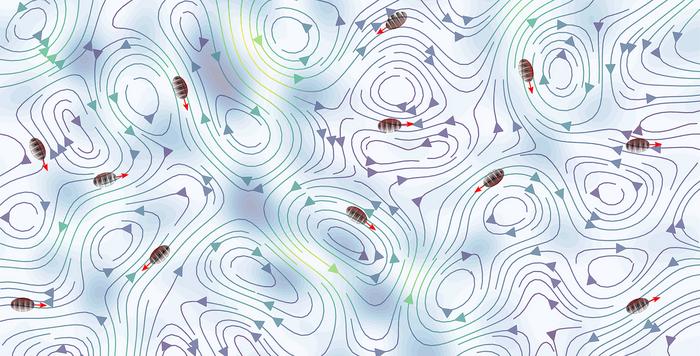
How do particles move in turbulent fluids? The answer to this question can be found in a new model presented in a thesis from the University of Gothenburg. The model could help speed up the development of new drugs.

Counter-current swimming

Credit: Illustration: Navid Mousavi

How do particles move in turbulent fluids? The answer to this question can be found in a new model presented in a thesis from the University of Gothenburg. The model could help speed up the development of new drugs.

When you stir a glass of water, it is easy to think that any particles in the water will end up in chaos and move completely randomly. But this is not always the case. For example, the so-called active micro-swimmers can move through flow on their own. Navid Mousavi, a PhD student at the University of Gothenburg, has created a model including various hydrodynamic factors to study how these particles handle and even utilise turbulence.

Micro-swimmers can be biological, such as plankton, or engineered particles such as nanomotors. Plankton contribute to global ecosystems by producing oxygen and they form the basis of the ocean food web. 

Free-riding in the current

Navid Mousavi has created new methods for modelling and studying the navigation of micro-swimmers by combining active matter physics with machine learning principles. The thesis finds optimal behaviours for plankton to survive in their turbulent habitat.

“In the model, plankton use local information for navigation, reflecting the real-world conditions that these small swimmers encounter. Unlike previous models where navigation was based on global information,” says Navid Mousavi.

The research also showed that micro-swimmers can utilise the flow to move faster than they can on their own, which is an important insight for both biological and artificial applications.

Another exciting result of the study is the discovery of optimal behavior to avoid high turbulent strain. Surprisingly, it is observed that micro-swimmers tend to swim against the current to keep their position in low-strain regions.

“This behaviour seems to be crucial for survival and allows plankton to avoid predators and stay in nutrient-rich zones,” says Navid Mousavi.

Important knowledge for medicine development

All the strategies found were shown to work effectively in several different scenarios, meaning they can be applied to real-life situations.

The results of the study provide important knowledge that has several applications. An example is in medicine, where it could help develop smart micro-swimmers that can deliver drugs directly to specific areas of the body, making treatments more effective. Environmentally, these tiny swimmers could help clean up microplastics from our oceans and contribute to a healthier planet.

“In the future, we will need to validate the model in experiments, both with natural plankton and artificial micro-swimmers,” says Navid Mousavi.

The researchers also plan to investigate more complex models that deals with energy efficiency and the collective behaviour of multiple swimmers.


Method of Research

Computational simulation/modeling

Article Title

Microswimmer Navigation in Turbulence

Share27Tweet17
Previous Post

Beyond work: Employment affects identity in late 20-somethings

Next Post

Scientists identify safe havens we must preserve to prevent ‘the sixth great extinction of life on Earth’

Related Posts

Lanthanide Nanocrystals Unlock Room-Temperature Organic Phosphorescence — Chemistry
Chemistry

Lanthanide Nanocrystals Unlock Room-Temperature Organic Phosphorescence

May 25, 2026
Study Reveals How Valproate Affects Early Brain Development: Insights into the Antiepileptic Drug’s Impact — Chemistry
Chemistry

Study Reveals How Valproate Affects Early Brain Development: Insights into the Antiepileptic Drug’s Impact

May 22, 2026
Sustainable Chemistry: Iron Replaces Noble Metals in Catalytic Reactions — Chemistry
Chemistry

Sustainable Chemistry: Iron Replaces Noble Metals in Catalytic Reactions

May 22, 2026
Simple Adjustment in 3D Printing Enhances Fit of Dental Crowns — Chemistry
Chemistry

Simple Adjustment in 3D Printing Enhances Fit of Dental Crowns

May 22, 2026
Advancing Thin-Film Device Manufacturing with Imaging Ellipsometry for Enhanced Process Control — Chemistry
Chemistry

Advancing Thin-Film Device Manufacturing with Imaging Ellipsometry for Enhanced Process Control

May 22, 2026
Tropical Primary Forest Plants Boost Root Exudation to Cope with Prolonged High Nitrogen Deposition — Chemistry
Chemistry

Tropical Primary Forest Plants Boost Root Exudation to Cope with Prolonged High Nitrogen Deposition

May 22, 2026
Next Post
Protecting 1.22% of land would help save the most threatened species from extinction

Scientists identify safe havens we must preserve to prevent ‘the sixth great extinction of life on Earth’

  • Mothers who receive childcare support from maternal grandparents show more parental warmth, finds NTU Singapore study

    Mothers who receive childcare support from maternal grandparents show more parental warmth, finds NTU Singapore study

    27649 shares
    Share 11056 Tweet 6910
  • University of Seville Breaks 120-Year-Old Mystery, Revises a Key Einstein Concept

    1052 shares
    Share 421 Tweet 263
  • Bee body mass, pathogens and local climate influence heat tolerance

    680 shares
    Share 272 Tweet 170
  • Researchers record first-ever images and data of a shark experiencing a boat strike

    543 shares
    Share 217 Tweet 136
  • Groundbreaking Clinical Trial Reveals Lubiprostone Enhances Kidney Function

    529 shares
    Share 212 Tweet 132
Science

Embark on a thrilling journey of discovery with Scienmag.com—your ultimate source for cutting-edge breakthroughs. Immerse yourself in a world where curiosity knows no limits and tomorrow’s possibilities become today’s reality!

RECENT NEWS

  • Quality of Life Predictors in Zoroastrian Elders
  • Corrosion-Blast Impact on Buried Cast Iron Damage
  • Advances and Strategies in Antibody-Oligonucleotide Conjugates
  • Cuproptosis Disrupts Mitochondria, Arrests Oocyte Meiosis

Categories

  • Agriculture
  • Anthropology
  • Archaeology
  • Athmospheric
  • Biology
  • Biotechnology
  • Blog
  • Bussines
  • Cancer
  • Chemistry
  • Climate
  • Earth Science
  • Editorial Policy
  • Marine
  • Mathematics
  • Medicine
  • Pediatry
  • Policy
  • Psychology & Psychiatry
  • Science Education
  • Social Science
  • Space
  • Technology and Engineering

Subscribe to Blog via Email

Success! An email was just sent to confirm your subscription. Please find the email now and click 'Confirm Follow' to start subscribing.

Join 5,146 other subscribers

© 2025 Scienmag - Science Magazine

Welcome Back!

Login to your account below

Forgotten Password?

Retrieve your password

Please enter your username or email address to reset your password.

Log In
No Result
View All Result
  • HOME
  • SCIENCE NEWS
  • CONTACT US

© 2025 Scienmag - Science Magazine
