


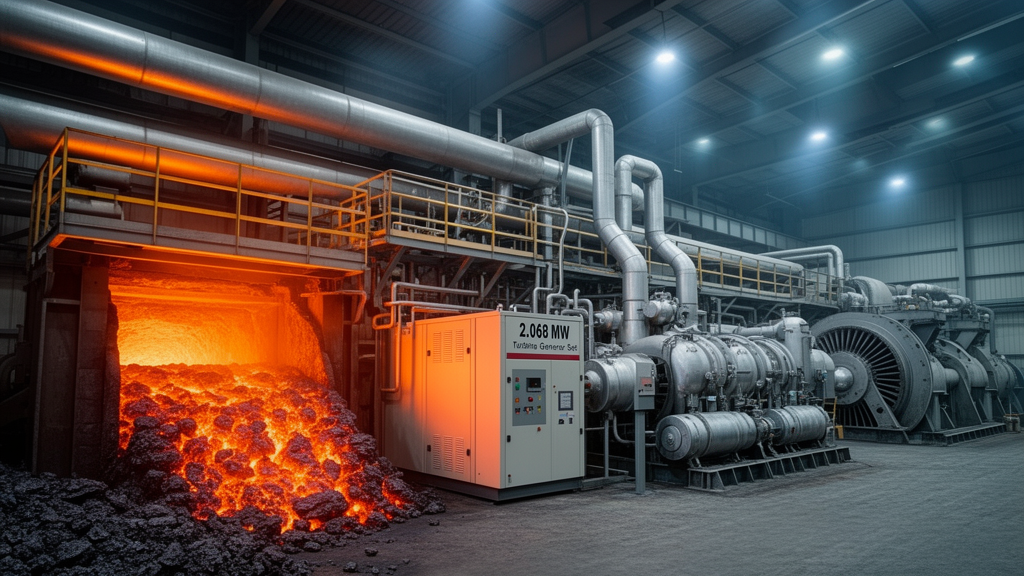
A modeled system that couples radiative heat recovery from steel-slag cooling to a steam Rankine cycle produced 2.068 MW of cycle power and a thermal efficiency of 20.4% at the selected steady-state design point. The same study found that, in a proof-of-concept water-treatment series, sodium phosphate reduced measured equivalent hardness by 95.2% under ambient conditions. The power and efficiency figures are model predictions, not measurements from an operating pilot plant, while the hardness result came from laboratory preparations that did not include independent treatment replicates.
Steel slag can emerge from steelmaking at temperatures as high as 1,600 °C, but recovering its heat is difficult because the material is highly viscous and difficult to handle. In the roller-crushing and hot-disintegration process examined by the researchers, molten slag is first crushed and cooled in a semi-open roller-crushing area and then transferred to a closed hot-disintegration tank. Intermittent water spraying triggers exothermic hydration of free calcium and magnesium oxides, promoting internal cracking, particle-size reduction and stabilization of the slag for later use. This treatment produces saturated steam, but the study noted that a substantial portion of the high-temperature sensible heat released during crushing was not recovered.
The proposed configuration attempts to connect two stages that operate at different heat levels. Radiative heating surfaces positioned around and above the roller-crushing region recover high-temperature heat, while hot disintegration supplies saturated steam. Part of the recovered heat preheats feedwater in a water-wall economizer, and the remainder superheats the steam before it enters the turbine. A steam drum provides steam-water separation and a location for chemical dosing and bottom blowdown. The researchers modeled a direct-steam Rankine cycle because the recovered steam can serve as the cycle working fluid; this avoided the additional heat-transfer stage and separate organic-fluid loop that would be required if an organic Rankine cycle were supplied with the steam.
To evaluate the enclosure geometry, the team built a MATLAB model of diffuse-gray surfaces exchanging radiation. The radiation network represented the slag, top surface and aggregated side walls, with slag emissivity set at 0.90 and receiver emissivity at 0.80. The top and side temperatures were prescribed at 120 °C and 25 °C in the main comparison, while convection, radiation involving participating gases or particles, and direct contact heat transfer were excluded. The rectangular enclosure measured 16 by 5 by 4 metres, whereas the cylindrical design had a radius of 5.744 metres and a height of 4 metres. Both provided about 248 m² of combined top-plus-side receiver area, but they did not have identical slag footprints: the idealized slag-emitting area increased from 80 m² in the rectangle to 103.64 m² in the cylinder.
For an idealized 30,000-kilogram slag batch with a constant heat capacity of 1.2 kJ per kilogram per kelvin, the rectangular configuration had a modeled cooling-time mean radiative heat-transfer rate of 13.83 MW, compared with 17.54 MW for the cylindrical configuration. The cylinder’s result was approximately 27% higher under the prescribed surface-radiation conditions. Because the slag-emitting area and view factors changed along with the enclosure shape, this was a comparison of the selected geometries rather than an isolated view-factor gain or a matched-footprint comparison. Sensitivity calculations also showed that lowering slag emissivity from 0.90 to 0.75 reduced the mean rates to 11.66 MW for the rectangle and 14.84 MW for the cylinder. Lowering receiver emissivity from 0.80 to 0.60 changed the modeled cylinder-to-rectangle difference from 26.85% to 23.43%. These calculations describe model sensitivity, not measured uncertainty, and the effects of evolving slag surfaces, enclosure gases, dust, deposits and fouling were not quantified.
The integrated-cycle analysis used Aspen Plus V11 with IAPWS-IF97 water properties and represented the superheater, economizer, steam drum, condenser, pump and turbine. In the selected case, 10,400 kg/h of feedwater entered the flowsheet: 2,400 kg/h passed through the economizer and 8,000 kg/h entered the hot-disintegration heat-recovery section. Their modeled heat duties were 7.247 MW for hot disintegration, 0.267 MW for feedwater preheating and 2.613 MW for steam superheating, giving a total cycle heat input of 10.127 MW. Saturated steam from the drum reached 556.8 °C at 0.2 MPa before entering the expander. The model then calculated 2.068 MW of expander shaft output and a cycle thermal efficiency of 20.4%. The reported cycle power subtracts the represented feed-pump demand from expander shaft output; it is not net exported electricity because generator losses and plant auxiliaries were outside the model boundary.
A literature benchmark tested the baseline calculation without heat supplied by the crushing enclosure. At a hot-disintegration steam pressure of 0.2 MPa and a flow of 2,600 kg/h, the model generated 291.5 kW of expander shaft output, close to the reference value of approximately 300 kW and representing a deviation of about −2.8%. Its modeled efficiency was 15.5%, however, above the literature-reported range of 10–12%, a difference attributed to calculations that did not share fully equivalent component assumptions or efficiency boundaries. The comparison therefore served as a numerical benchmark rather than experimental validation of the integrated design.
The modeled superheating increased the physical exergy carried by the steam entering the expander. Specific physical exergy rose from 586 kJ/kg at 120 °C to 1,031 kJ/kg at 557 °C, an increase of 76%. As steam flow increased from 2,600 to 10,400 kg/h, the inlet-steam physical-exergy rate rose from 0.42 to 2.98 MW and modeled cycle power increased from 291.3 to 2,067.7 kW. The ratio of modeled cycle power to inlet-steam physical exergy remained near 69% in the two cases. This ratio describes conversion within the modeled cycle, not the exergy efficiency of the complete slag-recovery system, because losses in individual recovery sections, slag exergy, generator losses and auxiliary inputs were not included.
Intermittent steam production remains unresolved. Hot disintegration depends on periodic spraying and hydration reactions, whereas the thermodynamic model assumes a steady, time-averaged supply and does not resolve batch-scale transients or water accumulation in the drum. A simplified estimate for a drum containing 20,000 kg of water at 0.2 MPa suggested a characteristic buffering time of approximately 118 seconds, or about two minutes, during an allowable transient pressure decrease to 0.15 MPa. That estimate does not demonstrate that one drum could smooth a complete batch of intermittent production. Staggered operation of multiple hot-disintegration tanks was proposed as a possible way to reduce aggregate flow fluctuations, but measured single-tank steam profiles and plant scheduling records were unavailable, so the arrangement remains an operating assumption. A preliminary cost screen estimated the added equipment at RMB 4.5 million and compared it with an indicative annual electricity value of about RMB 5.33 million at 6,000 operating hours and RMB 0.50/kWh. The resulting ratio of roughly one year is not a definitive payback because installation, civil work, generator and auxiliary consumption, maintenance, downtime, financing, taxation and electricity-price changes were excluded.
Water chemistry presents a separate constraint. Condensate collected from hot-disintegration steam at Henan Jiyuan Iron and Steel Group in China initially contained total calcium and magnesium concentrations of 1.18 and 0.80 mmol/L. In the proof-of-concept dosage series, adding sodium phosphate caused calcium and magnesium to decline sharply before varying non-monotonically. At a sodium phosphate dosage of 5.53 mmol/L, total calcium and magnesium measured 0.009 and 0.085 mmol/L, and equivalent hardness reached 0.188 ± 0.011 mmol/L, 95.2% below the untreated value of 3.944 mmol/L. Visual MINTEQ equilibrium simulations at 15 °C reproduced the general concentration trend and identified hydroxyapatite and magnesium phosphate as possible precipitating solids, but the calculations assumed chemical equilibrium and did not resolve nucleation or precipitation kinetics. Together, the radiation and cycle models and the preliminary water tests support the feasibility of the proposed integration under the studied conditions. They do not establish continuous turbine operation, industrial-scale hardness compliance or long-term chemical stability, which require dynamic pilot testing, independent treatment replicates, long-term scaling studies and validation of turbine control, blowdown, steam purity and auxiliary power.
Subject of Research: Modeled steel-slag waste-heat recovery and preliminary phosphate treatment for Rankine-cycle power generation
Article Title: An integrated waste heat recovery system for Rankine cycle power generation from the steel slag hot disintegration process
Article References: Wu, H., Zhou, T., Bai, R., Xu, Z., Li, Y., Xia, B., Zhang, M., & Yang, H. (2026). An integrated waste heat recovery system for Rankine cycle power generation from the steel slag hot disintegration process. Frontiers in Energy Research, 14, Article 1965673. https://doi.org/10.3389/fenrg.2026.1965673
Image Credits: AI Generated
DOI: 10.3389/fenrg.2026.1965673
Keywords: steel slag, waste-heat recovery, Rankine cycle, hot disintegration, radiative heat transfer, steam superheating, power generation, water hardness, phosphate treatment, steel industry, integrated, waste
Cite Scienmag News
Denise Maddox. (October 21, 2026). Model links steel-slag waste-heat recovery to 2.068 MW Rankine-cycle power. Scienmag. https://scienmag.com/model-links-steel-slag-waste-heat-recovery-to-2-068-mw-rankine-cycle-power/
Denise Maddox. "Model links steel-slag waste-heat recovery to 2.068 MW Rankine-cycle power." Scienmag, 21 October 2026, https://scienmag.com/model-links-steel-slag-waste-heat-recovery-to-2-068-mw-rankine-cycle-power/. Accessed 21 October 2026.
Denise Maddox. "Model links steel-slag waste-heat recovery to 2.068 MW Rankine-cycle power." Scienmag. October 21, 2026. https://scienmag.com/model-links-steel-slag-waste-heat-recovery-to-2-068-mw-rankine-cycle-power/


