


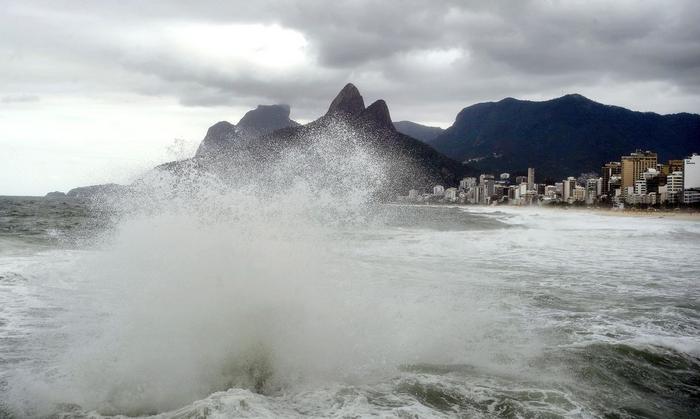
Predicting extreme events is essential to the preparation and protection of vulnerable regions, especially at a time of climate change. The city of Santos on the coast of São Paulo state (Brazil) is Latin America’s largest port and has been the focus for significant case studies, not least because of the storm surges that threaten its infrastructure and the local ecosystems.

Credit: Tânia Rego/Agência Brasil
Predicting extreme events is essential to the preparation and protection of vulnerable regions, especially at a time of climate change. The city of Santos on the coast of São Paulo state (Brazil) is Latin America’s largest port and has been the focus for significant case studies, not least because of the storm surges that threaten its infrastructure and the local ecosystems.
An article reporting the results of a study that focused on a critical part of Santos and used advanced machine learning tools to optimize existing extreme event prediction systems has recently been published in Proceedings of the AAAI Conference on Artificial Intelligence. It mobilized a large number of researchers and was coordinated by Anna Helena Reali Costa, full professor at the University of São Paulo’s Engineering School (POLI-USP). The first author is Marcel Barros, a researcher in POLI-USP’s Department of Computer Engineering and Digital Systems.
The models used to predict sea surface heights, high tides, wave heights and so on are based on differential equations comprising temporal and spatial information such as astronomic tide (determined by the relative positions of the Sun, Moon and Earth), wind regime, current velocity and salinity, among many others.
These models are successful in several areas but they are complex and depend on a number of simplifications and hypotheses. Moreover, new measurements and other data sources cannot always be integrated into them to make forecasts more reliable.
Although modelers are increasingly using machine learning methods capable of identifying patterns in data and extrapolating to new situations, a great many examples are required to train the algorithms that perform complex tasks such as those involved in weather forecasting and storm tide prediction.
“Our study combined the two worlds to develop a model based on machine learning that uses physical models as a starting point but refines them by adding measured data. This research field is known as physics-informed machine learning, or PIML,” Barros explained.
Harmonization of these two sources of information is fundamental to develop more precise and accurate forecasts. However, the use of sensor data faces significant technical challenges, owing especially to its irregular nature and problems such as missing data, temporal displacements, and variations in sampling frequencies. Sensors that fail can take days to be brought back online, but the mechanisms for predicting storm tides must be capable of operating continuously without the missing data.
“To address situations with highly irregular data, we developed an innovative technique to represent the passing of time in neural networks. This representation lets the model be told the position and size of the missing data windows, so that it considers them in its predictions of tide and wave heights,” Barros said.
The innovation permits better modeling of complex natural phenomena and can also be used to model other phenomena that involve irregular time series, such as health data, sensor networks in manufacturing, or financial indicators.
“Furthermore, our model combines different kinds of neural networks so as to integrate multimodal data, such as satellite images, tables and forecasts from numerical models, with possible future integration of other types of data, such as text and audio. This approach is an important step toward more robust and adaptable forecasting systems that can handle the complexity and variability of the data associated with extreme weather events,” Reali Costa said.
The model has three key virtues, she added: it combines physical and numerical models; it represents time in neural networks in a new way; and it works with data in different formats by means of multimodal architecture. “The study offers a methodology that can improve the accuracy of predictions of extreme events, such as storm tides in Santos. At the same time, it highlights the challenges and potential solutions for the integration of physical models and sensor data in complex contexts,” she said.
The study was supported by FAPESP via the Center for Artificial Intelligence (C4AI), an Engineering Research Center (ERC) set up by FAPESP and IBM Brazil, and hosted by POLI-USP.
About São Paulo Research Foundation (FAPESP)
The São Paulo Research Foundation (FAPESP) is a public institution with the mission of supporting scientific research in all fields of knowledge by awarding scholarships, fellowships and grants to investigators linked with higher education and research institutions in the State of São Paulo, Brazil. FAPESP is aware that the very best research can only be done by working with the best researchers internationally. Therefore, it has established partnerships with funding agencies, higher education, private companies, and research organizations in other countries known for the quality of their research and has been encouraging scientists funded by its grants to further develop their international collaboration. You can learn more about FAPESP at www.fapesp.br/en and visit FAPESP news agency at www.agencia.fapesp.br/en to keep updated with the latest scientific breakthroughs FAPESP helps achieve through its many programs, awards and research centers. You may also subscribe to FAPESP news agency at http://agencia.fapesp.br/subscribe.
Journal
Proceedings of the AAAI Conference on Artificial Intelligence
Article Title
Early Detection of Extreme Storm Tide Events Using Multimodal Data Processing
Article Publication Date
24-Mar-2024
Cite Scienmag News
Blake Davidson. (June 23, 2024). Model combines physical parameters and machine learning to predict storm tides. Scienmag. https://scienmag.com/model-combines-physical-parameters-and-machine-learning-to-predict-storm-tides/
Blake Davidson. "Model combines physical parameters and machine learning to predict storm tides." Scienmag, 23 June 2024, https://scienmag.com/model-combines-physical-parameters-and-machine-learning-to-predict-storm-tides/. Accessed 5 September 2026.
Blake Davidson. "Model combines physical parameters and machine learning to predict storm tides." Scienmag. June 23, 2024. https://scienmag.com/model-combines-physical-parameters-and-machine-learning-to-predict-storm-tides/

