

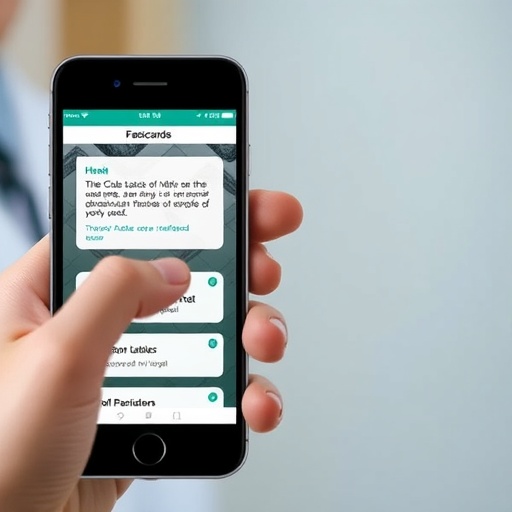
In a groundbreaking study poised to revolutionize medical education, researchers have explored the efficacy of electronic adaptive flashcards on mobile devices as a teaching tool for infectiology among medical residents. This innovative approach, evaluated through a randomized controlled trial, could provide invaluable insights into how technology can enhance learning and retention of complex medical information. The research underscores the pressing need for effective educational strategies that accommodate the rapidly evolving landscape of medical training.
The traditional methods of teaching medical residents, often heavily reliant on lectures and textbooks, have faced criticism for lacking engagement and interactivity. The emergence of mobile technology has opened new avenues for adopting more adaptive learning methods, which can better cater to the unique learning styles and needs of individual students. By focusing on infectiology, a field fraught with information that changes quickly, this study highlights the adaptability of electronic flashcards for grasping essential concepts and clinical applications.
The randomized controlled trial involved medical residents from various stages of their training, assessing the effectiveness of interactive flashcards in comparison to standard teaching methods. Participants engaged with the flashcards on their mobile devices, allowing them to learn in a manner that fit their schedules and lifestyles. This adaptability not only catered to their time constraints but also aimed to deepen their understanding of critical topics in infectiology, a subject that is vital for contemporary medical practice.
Results from the trial have indicated that residents using the electronic adaptive flashcards reported higher engagement levels and better retention of information. These findings resonate with a broader trend in medical education, where the incorporation of technology has shown to facilitate deeper learning experiences. By integrating quizzes and immediate feedback mechanisms, the flashcards allowed students to identify their knowledge gaps, leading to improved academic performance. The ability to review material at their own pace also appeared to contribute significantly to their learning outcomes.
As the medical community grapples with the challenges of teaching increasingly complex subjects, the impact of electronic learning tools cannot be overstated. The study’s authors argue for the necessity of evolving pedagogical strategies to incorporate technology that resonates with the current generation of learners. Furthermore, the dynamic nature of mobile applications means that updates and changes can be rapidly deployed, allowing the curriculum to stay aligned with current medical standards and practice.
The study’s findings suggest that moving away from static learning methods could be imperative for fostering a more robust educational framework. Cognitive science points towards active learning as a key driver of understanding and long-term retention. By using interactive media, medical education can leverage students’ natural affinity for technology. This approach not only enhances engagement but also prepares future healthcare professionals for utilizing digital tools in their clinical practice.
With the rapid advancement of medical knowledge and practice, continuous learning is essential for the success of healthcare providers. Engaging with adaptive learning technology can better equip medical residents to keep pace with evolving treatment protocols and infectious disease management strategies. As the findings indicate, the integration of electronic flashcards into medical education could bridge the gap between traditional teachings and modern requirements of medical expertise.
The implications of this research extend beyond simply improving grades; they highlight a potential shift in how future physicians are trained. As the medical field continues to evolve, the necessity for flexibility and adaptability in learning will only increase. The study emphasizes that teaching methods must keep up with advancements in technology to ensure that practitioners are not only competent but also confident in their knowledge and abilities.
While the study explored the use of electronic flashcards within the context of infectiology, the implications of its findings can easily be translated to other medical disciplines. Each specialty presents its own challenges, requiring unique strategies that foster effective learning. The use of adaptive technology can be tailored across various domains, enabling a personalized education experience devoid of one-size-fits-all methodologies.
The positive reception of electronic adaptive flashcards among medical residents signals a growing trend in educational technology. As evidence mounts around their effectiveness, institutions may increasingly adopt these tools as core components of their curricula. The ability to learn in a way that is both personalized and engaging could very well redefine the future of medical education.
This groundbreaking research highlights not only the feasibility of integrating technology into medical education but also its desirability. As educators and institutions explore ways to adapt to new generations of learners, the lessons drawn from this study could serve as a model for other areas of professional training. In an era where access to continuous information is paramount, the potential for medical residents to strengthen their learning through innovative tools is illuminated.
Ultimately, this study invites us to reconsider the structures in place within medical training and the potential for technological adaptations. As healthcare demands evolve, aligning education with these changes will be critical in ensuring that medical professionals are well-equipped to handle the complexities of patient care. The dawn of a new age in medical education, where electronic adaptive learning tools play an integral role, appears to be on the horizon.
In conclusion, the integration of electronic adaptive flashcards into infectiology education marks a significant leap forward in how medical residency programs approach learning. As this research unfolds and other specialties consider adopting similar methods, the potential for widespread impact on medical education and patient care is immense. The implications of such innovations underscore the importance of embracing technology in an effort to cultivate skilled, knowledgeable, and adaptable healthcare providers.
Subject of Research: Innovative Teaching Methods in Medical Education
Article Title: Teaching infectiology through electronic adaptative flashcards on mobile phones to medical residents: randomized controlled trial.
Article References:
Vaillant, T., Compère, V., Chaumont, C. et al. Teaching infectiology through electronic adaptative flashcards on mobile phones to medical residents: randomized controlled trial.
BMC Med Educ (2025). https://doi.org/10.1186/s12909-025-08055-0
Image Credits: AI Generated
DOI: 10.1186/s12909-025-08055-0
Keywords: Medical Education, Electronic Learning, Mobile Technology, Adaptive Learning, Infectiology, Medical Residents.


