


A laboratory study of a newly synthesized orthophosphate compound, Ba(SbV0.5AlIII0.5)(PO4)2, found a combination of dielectric, optical and corrosion-inhibiting properties. The material was prepared by solid-state reaction at 850 °C and identified as a monoclinic yavapaiite-type phase. In corrosion tests conducted in 1 M HCl, its corrosion-inhibition efficiency exceeded 70% at a concentration of 10−3 M. The results support the compound as a candidate for insulating, photonic and protective-coating applications, within the conditions investigated.
Powder X-ray diffraction followed by Rietveld refinement confirmed the proposed structure, including the C2/m space group and unit-cell parameters of a = 8.155(1) Å, b = 5.198(3) Å, c = 7.826(7) Å and β = 93.53°. The refined unit-cell volume was 331(1) Å3. Raman and infrared spectroscopy showed the predicted phosphate vibrational modes, while scanning electron microscopy coupled with energy-dispersive X-ray spectroscopy indicated consistent particle shape and elemental homogeneity. These measurements established the formation and basic characterization of the mixed antimony- and aluminum-containing orthophosphate.
Optical and electrical measurements indicated behavior compatible with a transparent dielectric material. The study estimated a direct band gap of approximately 3.8 eV and observed high resistivity with thermally activated hopping conduction. The dielectric response varied with both frequency and temperature, with Maxwell–Wagner interfacial charge polarization and defect-mediated jump conduction identified as the dominant contributions. Impedance analysis distinguished grain-boundary-controlled behavior at low frequencies from volume conduction at high frequencies. Electrical-modulus analysis identified one thermally activated relaxation mechanism with non-Debye characteristics; activation energies obtained from the peaks of the imaginary relaxation component were approximately 0.6–0.8 eV, comparable to values previously reported for defect-assisted conduction in phosphate ceramics.
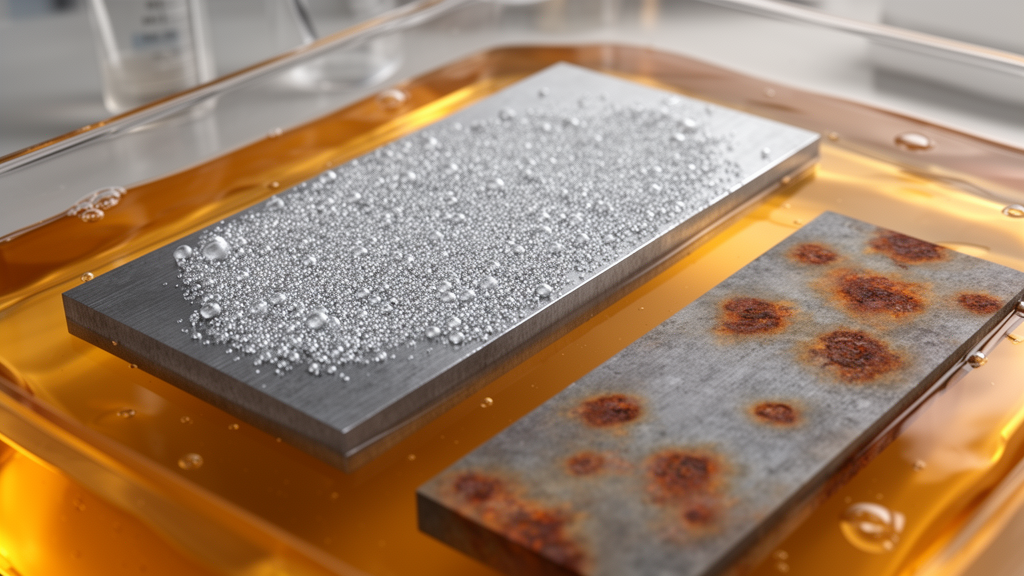
The corrosion-inhibition experiments formed the new application-focused part of the study, following earlier investigation of related compounds’ dielectric and optical properties. Electrochemical and gravimetric tests showed that Ba(SbV0.5AlIII0.5)(PO4)2 effectively inhibited carbon-steel corrosion in 1 M HCl, with efficiencies above 70% when the compound was used at 10−3 M. Adsorption investigations were interpreted as Langmuir-type behavior consistent with spontaneous physisorption. The combined structural, electrical, optical and electrochemical results led the authors to present the phase as promising for microelectronic and dielectric applications, photonic devices and protective-coating systems, although the reported corrosion evidence is specific to carbon steel and hydrochloric acid under the tested laboratory conditions.
Subject of Research: Dielectric, optical and corrosion-inhibiting properties of a yavapaiite-type mixed antimony-aluminum orthophosphate.
Article Title: Synthesis and investigation of a new orthophosphate compound BaII(SbV0.5AlIII0.5)(PO4)2: dielectric properties, optical features, and corrosion inhibition resistance
Article References: Skalli, S. K., chakir, A., Oubahou, M., Mehdaoui, B., Fakhreddine, R., Oumghar, M. O., Tigha, M. R., Naimi, Y., Aatiq, A., & Bouari, A. E. (2026). Synthesis and investigation of a new orthophosphate compound BaII(SbV0.5AlIII0.5)(PO4)2: dielectric properties, optical features, and corrosion inhibition resistance. Journal of Materials Science, 61(40), 30951-30975. https://doi.org/10.1007/s10853-026-13664-1
Image Credits: AI Generated
DOI: 10.1007/s10853-026-13664-1
Keywords: orthophosphate ceramic, yavapaiite structure, corrosion inhibition, carbon steel, hydrochloric acid, dielectric relaxation, optical band gap, impedance spectroscopy, Langmuir adsorption, solid-state synthesis, Synthesis, investigation
Cite Scienmag News
Denise Maddox. (October 25, 2026). Mixed antimony-aluminum orthophosphate inhibits carbon-steel corrosion in hydrochloric acid. Scienmag. https://scienmag.com/mixed-antimony-aluminum-orthophosphate-inhibits-carbon-steel-corrosion-in-hydrochloric-acid/
Denise Maddox. "Mixed antimony-aluminum orthophosphate inhibits carbon-steel corrosion in hydrochloric acid." Scienmag, 25 October 2026, https://scienmag.com/mixed-antimony-aluminum-orthophosphate-inhibits-carbon-steel-corrosion-in-hydrochloric-acid/. Accessed 25 October 2026.
Denise Maddox. "Mixed antimony-aluminum orthophosphate inhibits carbon-steel corrosion in hydrochloric acid." Scienmag. October 25, 2026. https://scienmag.com/mixed-antimony-aluminum-orthophosphate-inhibits-carbon-steel-corrosion-in-hydrochloric-acid/


