


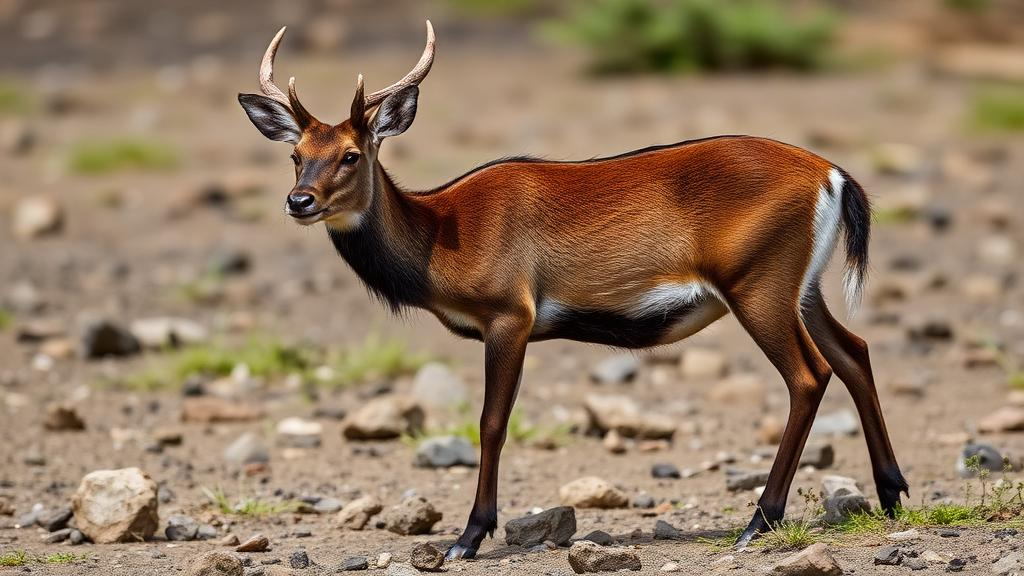
Mitochondrial DNA analysis of pudu deer across five southern Chilean provinces found pronounced genetic separation between Chiloé Island and the mainland, alongside weaker differentiation among populations extending from the Coastal Range through the Central Valley to the Andes. The study, which combined newly collected samples with previously published sequences, identified 33 control-region haplotypes in 47 deer and 12 cytochrome b haplotypes in 30 deer. Chiloé formed a distinct genetic cluster, while analyses by mountain range found that 98.6% of control-region haplotype variation occurred within the Andes, Central Valley and Coastal Range rather than among them.
The researchers sampled or compiled data for pudu deer, or northern pudu (Pudu puda), from Cautín, Valdivia, Osorno, Llanquihue and Chiloé Island, spanning approximately 39°S to 42°S. They also reassembled the mainland samples according to their longitudinal position in the Andes, the Central Valley and the Coastal Range. The analysis used the mitochondrial control region and cytochrome b gene as complementary genetic markers. Coalescent simulations indicated that the samples captured most of the expected mitochondrial diversity, although Valdivia was the only province whose control-region result fell outside the estimated 95% confidence interval for the total number of haplotypes.
Genetic diversity varied among provinces. In the control region, provinces contained four to 14 haplotypes, haplotype diversity ranged from 0.64286 in Chiloé to 0.98333 in Valdivia, and nucleotide diversity ranged from 0.00575 in Llanquihue to 0.01022 in Cautín. Valdivia’s control-region haplotype diversity was significantly higher than that of Llanquihue and Chiloé, but not significantly different from that of Cautín or Osorno. Cautín had significantly higher nucleotide diversity than the other four provinces. The cytochrome b marker was less variable: 14 of 743 nucleotide positions were variable, compared with 36 of 626 control-region positions, and provincial haplotype diversity ranged from 0.222 in Llanquihue to 1.000 in Cautín and Valdivia. The Llanquihue cytochrome b haplotype diversity and nucleotide diversity were significantly lower than those of the other provinces.
Most control-region haplotypes were restricted to a single province. All four detected in Cautín and all four in Chiloé were private to those provinces, as were 13 of 14 in Valdivia, four of six in Osorno and six of eight in Llanquihue. Only control-region haplotypes Y17 and Y05 occurred in more than one province. Cytochrome b showed a similar pattern: one haplotype, A, occurred in all five provinces, while haplotype I was shared by Valdivia and Osorno. The researchers recorded 10 new control-region haplotypes and four new cytochrome b haplotypes, indicating that the sampled geography contained substantial previously undocumented mitochondrial variation. Haplotype frequencies also differed significantly among some geographic groups, including Chiloé, Llanquihue and Cautín for the control region and Chiloé, Llanquihue and Osorno for cytochrome b.
Population-level analyses identified strong provincial structure in the control region. An analysis of molecular variance assigned 41.9% of haplotype variation to differences among provinces and 58.1% to variation within them, producing an overall fixation index of FST = 0.41905. Seven of 10 pairwise provincial comparisons were significant at P < 0.05. The sharpest separation involved Chiloé, whose FST values from the four mainland provinces ranged from 0.59004 to 0.68651. Clustering analysis placed nearly all Chiloé deer in a distinctive group, whereas individuals from Cautín, Valdivia, Osorno and Llanquihue overlapped across one or two clusters. These results are consistent with reduced gene flow between the island and the mainland, although the analysis did not directly measure how often animals cross the Chacao Channel or reproduce there.
Estimated migration numbers based on control-region FST values reinforced that pattern. Chiloé had an estimated 0.22832 to 0.34740 migrants per generation relative to the mainland provinces. Migration estimates among Valdivia, Osorno and Llanquihue were much higher, ranging from 5.18197 to 13.32296, while estimates involving Cautín were intermediate, at 2.47437 to 3.66488. These are model-based estimates rather than direct counts of migrating animals, but they followed the same geographic pattern as the clustering and molecular-variance results: relative isolation for Chiloé, stronger connectivity among several central mainland provinces, and some differentiation involving the northernmost sampled province. The estimate of 13.32296 migrants per generation between Valdivia and Llanquihue was the highest finite mainland value, while the corresponding Chiloé comparisons remained below 0.35.
Tests of demographic history produced evidence consistent with expansion in several areas, although the signal was not identical in every marker or province. The control-region Tajima’s D statistic was significantly negative in Chiloé, at D = −1.65898 and P < 0.05, while control-region Fu’s Fs was significantly negative in Valdivia and Llanquihue. Such negative values can arise from population expansion or genetic hitchhiking, so they do not by themselves identify the demographic process. Cyt b results were negative but not significant in all provinces. When the mainland samples were grouped by longitudinal position, control-region Fu’s Fs was highly significant for the Coastal Range, at Fs = −6.64752 and P < 0.001, while its Tajima’s D was not significant; the Coastal Range cytochrome b Tajima’s D was significantly negative, at D = −1.74110 and P < 0.05. Together, the authors interpreted the longitudinal evidence as consistent with expansion associated with the area’s proposed role as a lowland refuge during Pleistocene glaciations.
The longitudinal comparison showed much less differentiation than the provincial analysis. For control-region sequences, 98.6% of variation was attributed to differences within the three geographic areas and only 1.3% to differences among them. The overall FST was 0.01360 and was not statistically significant at P > 0.05, and no pairwise comparison among the Andes, Central Valley and Coastal Range differed significantly. Estimates of migrants per generation ranged from 14.05932 to infinity, indicating high connectivity in the model. Clustering likewise placed individuals from the three mainland ranges in overlapping groups. The Coastal Range did not have the highest control-region nucleotide diversity: it was lower than in the Andes and Central Valley, at 0.006513 versus 0.007890 and 0.008307, respectively, although the differences in control-region haplotype diversity were not significant.
The authors proposed that the island’s genetic separation reflects both long-term isolation and the barrier created by the Chacao Channel. Earlier work cited in the study estimated divergence between Chiloé and continental pudu deer at at least 217,500 years ago. The present finding that Chiloé shared no control-region haplotypes with mainland populations is compatible with that history, but the new analysis did not directly date the divergence. Pleistocene landscape changes may also have shaped mainland patterns. The relatively high diversity observed in the Andes included haplotypes associated with Cautín, Valdivia and Osorno, which the authors said could be consistent with recolonization from multiple source populations rather than a single expanding wave. This remains a possible interpretation of the sampled haplotypes, not a directly reconstructed migration history.
Current habitat pressures provide a separate possible influence on the observed structure. Forest loss, fragmentation, domestic-dog predation, competition with introduced species and poaching have been identified as threats to pudu deer in southern Chile, but the genetic study did not measure their present effects or establish that recent human activity caused the detected divergence. Its findings instead show low-to-moderate connectivity among some populations, especially between Chiloé and distant mainland provinces, alongside numerous private haplotypes and evidence of expansion in selected areas. Because the deer are threatened in Chile, the authors considered the island population a possible evolutionarily significant unit and suggested that provincial differences may be relevant to future management. The results do not by themselves establish formal conservation units, local adaptation or demographic causation, and the limited sampling means that additional analysis is required to test those possibilities.
Subject of Research: Genetic differentiation and demographic patterns of pudu deer across five provinces in southern Chile
Article Title: Genetic divergence and demography of pudu deer ( Pudu puda ) in five provinces of southern Chile, analyzed through latitudinal and longitudinal ranges
Article References: Colihueque, N., Cabello, J., & Fuentes-Moliz, A. (2022). Genetic divergence and demography of pudu deer (Pudu puda) in five provinces of southern Chile, analyzed through latitudinal and longitudinal ranges. Neotropical Biology and Conservation, 17(2), 117-142. https://doi.org/10.3897/neotropical.17.e81324
Image Credits: AI Generated
DOI: 10.3897/neotropical.17.e81324
Keywords: pudu deer, Pudu puda, southern Chile, Chiloé Island, mitochondrial DNA, genetic diversity, population genetics, Pleistocene refugia, wildlife conservation, gene flow, Genetic, divergence
Cite Scienmag News
Juliet Wilcox. (October 20, 2026). Mitochondrial DNA reveals isolated Chiloé pudu deer populations. Scienmag. https://scienmag.com/mitochondrial-dna-reveals-isolated-chiloe-pudu-deer-populations/
Juliet Wilcox. "Mitochondrial DNA reveals isolated Chiloé pudu deer populations." Scienmag, 20 October 2026, https://scienmag.com/mitochondrial-dna-reveals-isolated-chiloe-pudu-deer-populations/. Accessed 20 October 2026.
Juliet Wilcox. "Mitochondrial DNA reveals isolated Chiloé pudu deer populations." Scienmag. October 20, 2026. https://scienmag.com/mitochondrial-dna-reveals-isolated-chiloe-pudu-deer-populations/


