

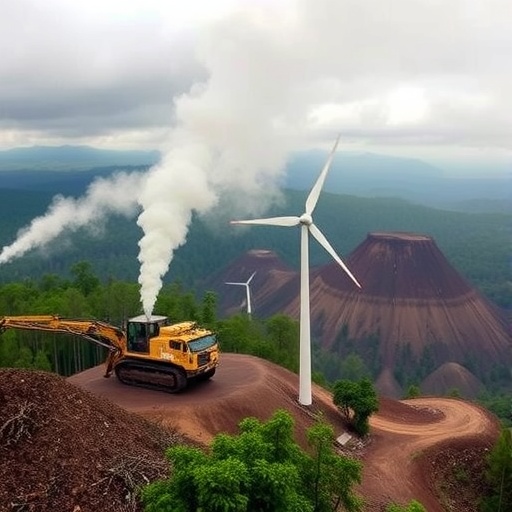
As the world accelerates its shift towards renewable energy and technological solutions to curb climate change, the demand for certain critical minerals, often termed energy transition minerals (ETMs), has surged exponentially. These minerals, including lithium, cobalt, nickel, and rare earth elements, are foundational in manufacturing batteries, electric vehicles, solar panels, and wind turbines—technologies central to reducing greenhouse gas emissions. However, emerging research conducted by Quan and Tan-Soo published in Nature Climate Change unveils a sobering paradox: the very mining activities that enable a low-carbon future might inadvertently exacerbate environmental destruction through deforestation and related emissions.
In their pioneering global analysis, Quan and Tan-Soo combined data from nearly 3,000 mining projects worldwide with state-of-the-art satellite-based forest monitoring systems to quantify the causal impact of ETM mining on deforestation and subsequent greenhouse gas emissions. By employing a sophisticated econometric method known as the staggered difference-in-differences design, the study convincingly isolates the mining activities’ direct influence on forest loss, free from confounding factors. The results are striking and counterintuitive—an average sustained forest loss of approximately 20% within a 10-kilometer radius around mining sites over a 15-year timeframe was observed. This magnitude of loss rivals or even exceeds that associated with conventional mining sectors such as coal and gold, traditionally known for their environmental damage.
Crucially, the spatial distribution of these impacts reveals that ETM mining is disproportionately concentrated in tropical and subtropical forests. These regions are not only biodiversity hotspots but also act as some of the most effective carbon sinks on Earth, storing immense quantities of carbon in their biomass and soils. The incursion of mining operations into these areas thus triggers a dual threat: catastrophic biodiversity loss and the release of large pools of carbon previously sequestered in these forests. The emissions stemming from such land-use changes substantially inflate the overall carbon footprint attributed to these minerals, undermining the environmental benefits sought through their use.
When accounting for deforestation-induced emissions, the carbon footprint attributed to ETM mining stages increases by an average of 63%. For some minerals, this increase soars close to 98%, almost doubling the emissions previously considered in lifecycle assessments. This finding challenges prevailing narratives that past mining emissions were relatively low, calling into question the sustainability credentials of certain energy transition pathways that heavily rely on these minerals without considering land-use change consequences.
The implications of this research resonate far beyond environmental science; they strike at the heart of policy and industrial decision-making. Mitigating climate change is predicated not only on transitioning to cleaner technologies but also on ensuring that the resource extraction fueling this transition does not come at an unacceptable ecological cost. The authors highlight the urgent need for incorporating land-use change emissions into carbon accounting frameworks for minerals, allowing governments and industries to quantify and internalize these externalities.
Technological solutions to this complex challenge might include advancing mineral recycling and circular economy strategies to reduce virgin resource extraction. Simultaneously, responsible sourcing and stringent environmental regulations must be enforced to prevent mining encroachment into ecologically sensitive and carbon-rich forested landscapes. This multidimensional approach would require collaboration among governments, corporations, environmentalists, and indigenous communities to balance developmental imperatives with conservation objectives.
Moreover, the current study emphasizes the importance of monitoring and transparency. Leveraging satellite remote sensing and other geospatial tools enables real-time tracking of mining-driven deforestation, offering policymakers actionable intelligence to halt illegal or unsustainable expansions. The integration of artificial intelligence and machine learning further promises refinement in detecting subtle land-cover changes and predicting high-risk mining zones.
The study also invites a broader reflection on the interconnectedness of environmental crises. While ETMs are pivotal to mitigating climate change, their mining-induced deforestation contributes to climate feedback loops, such as altering local hydrology, increasing fire susceptibility, and accelerating biodiversity loss. These feedbacks impede forest regeneration and carbon sequestration capacity, potentially lurching ecosystems toward tipping points.
On a socio-economic front, indigenous and local communities inhabiting these biodiverse forests bear disproportionate burdens of mining activities. Beyond the environmental degradation, these populations confront land dispossession, cultural erosion, and health hazards. Equitable and inclusive governance mechanisms must therefore accompany technical mitigation efforts to safeguard human rights and livelihoods.
The revelations from Quan and Tan-Soo’s analysis also call for an urgent reassessment of global mineral supply chains and their embedded environmental costs. Financial institutions, investors, and multinational corporations involved in energy transition technologies must integrate deforestation-related risks into environmental, social, and governance (ESG) frameworks to steer capital towards sustainable ventures.
In essence, the transition to a low-carbon future presents a paradox where the pursuit of climate mitigation through ETMs leads to unintended climate consequences from deforestation. Recognizing and quantifying these impacts, as this study does, establish a critical foundation for informed, holistic policy development aimed at achieving climate goals without compromising precious forest ecosystems.
As the energy transition gathers momentum, the quest for a truly sustainable and equitable pathway hinges on reconciling mineral demands with conservation imperatives. This research offers a clarion call for vigilance, innovation, and responsible stewardship, underscoring that climate solutions must be as nuanced and complex as the environmental challenges they seek to solve.
In conclusion, mining-induced deforestation emerges as a significant, previously underappreciated source of greenhouse gas emissions in the context of global energy transitions. Amplifying efforts to reduce this impact is imperative to ensure that the green technologies of tomorrow do not come at the price of today’s forests and biodiversity. The study by Quan and Tan-Soo charts a vital course toward a more comprehensive understanding of the environmental costs associated with ETM mining, paving the way for more sustainable mineral extraction policies worldwide.
Subject of Research: The study investigates the causal effect of energy transition mineral (ETM) mining on deforestation and associated greenhouse gas emissions, assessing the environmental costs of mining vital for global low-carbon technologies.
Article Title: Deforestation-induced emissions from mining energy transition minerals
Article References:
Quan, Y., Tan-Soo, JS. Deforestation-induced emissions from mining energy transition minerals. Nat. Clim. Chang. (2025). https://doi.org/10.1038/s41558-025-02520-w
Image Credits: AI Generated


