

Wednesday, November 4, 2026
Science
No Result
View All Result
  • Login
  • HOME
  • SCIENCE NEWS
  • CONTACT US
  • HOME
  • SCIENCE NEWS
  • CONTACT US
No Result
View All Result
Scienmag
No Result
View All Result
Home Science News Medicine

Minimally Invasive Endoscopic Surgery Shows Better Outcomes for Severe Thoracic Ligament Ossification

October 28, 2026
in Medicine
Ophelia Keating
By Ophelia Keating Scienmag Editorial Profile - Health Services Research
Reading Time: 3 mins read
0
Minimally Invasive Endoscopic Surgery Shows Better Outcomes for Severe Thoracic Ligament Ossification

Minimally Invasive Endoscopic Surgery Shows Better Outcomes for Severe Thoracic Ligament Ossification

65
SHARES
587
VIEWS
Share on FacebookShare on Twitter
ADVERTISEMENT

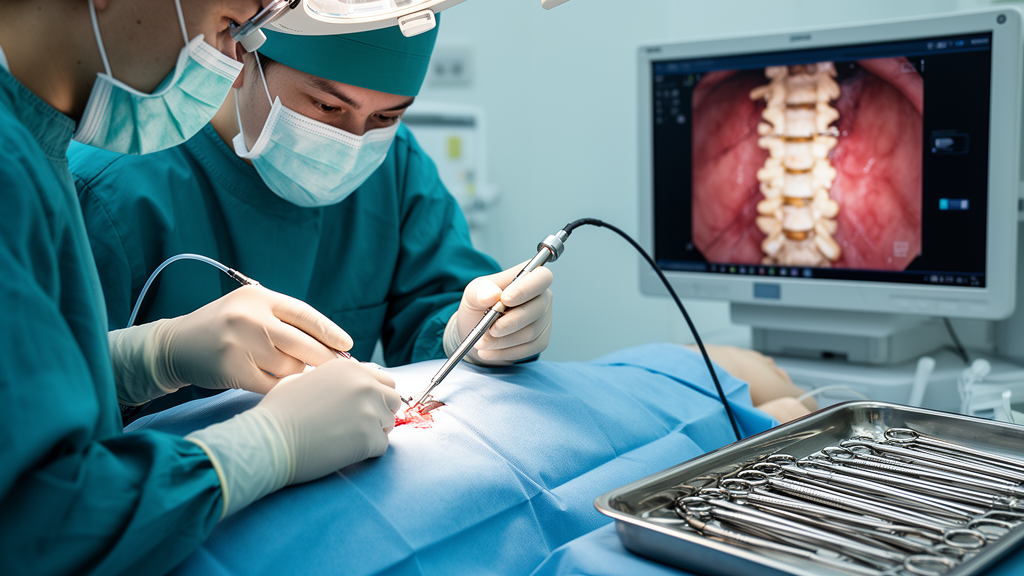
Patients with severe thoracic ossification of the ligamentum flavum, a condition in which a ligament in the spine hardens and compresses the spinal cord, may fare better with a minimally invasive endoscopic technique than with traditional open surgery, according to a retrospective cohort study published in BMC Surgery.

The research team compared unilateral biportal endoscopic (UBE) decompression with open posterior total laminectomy, the conventional approach for relieving pressure on the thoracic spinal cord. Severe cases of this ossification can cause serious thoracic spinal cord dysfunction, and open surgery is associated with substantial trauma and a high risk of complications, which motivated the comparison.

The study drew on 112 patients with severe thoracic ligament ossification and spinal canal invasion of at least 50 percent, admitted between January 2019 and December 2024. To reduce the influence of differences between patient groups, the investigators used propensity score matching, after which 42 patients were assigned to the UBE group and 42 to the open surgery group.

The primary outcomes were the modified Japanese Orthopaedic Association (mJOA) score at 12 months after surgery, the recovery rate, and the proportion of patients reaching the minimum clinically important difference (MCID), a threshold representing a change that patients perceive as meaningful.

At 12 months, the UBE group achieved a mean mJOA score of 8.2 plus or minus 0.9, compared with 6.9 plus or minus 1.1 in the open surgery group. The recovery rate was 43.2 percent in the endoscopic group versus 26.3 percent in the open group, and 88.1 percent of UBE patients reached the MCID compared with 61.9 percent of open surgery patients. All of these differences were statistically significant, with P values below 0.01.

Perioperative indicators also favored the endoscopic approach. Operative time, blood loss, and length of hospital stay were all markedly reduced in the UBE group, with P values below 0.001. Imaging assessment of decompression showed that the cross-sectional area of the dural sac, the protective membrane enclosing the spinal cord, expanded by 228.4 percent after UBE versus 184.5 percent after open surgery, a difference the authors interpret as more comprehensive imaging decompression.

Complication patterns differed as well. Dural tears, a known risk when operating near the spinal cord’s covering, occurred in 4.8 percent of the UBE group and 11.9 percent of the open surgery group. The authors note that this difference was not statistically significant, with a P value above 0.05, so the study does not establish a definitive reduction in this complication.

The study design carries important limitations. As a retrospective cohort study with propensity score matching rather than a randomized trial, it cannot rule out residual confounding, and the matched groups of 42 patients each are relatively small.

Nevertheless, the authors conclude that the UBE technique for treating severe thoracic ossification of the ligamentum flavum can significantly promote neurological function recovery, reduce surgical trauma, and achieve more comprehensive imaging decompression, making it a safe and effective minimally invasive treatment option in their analysis.

Subject of Research: Comparison of unilateral biportal endoscopic surgery with open laminectomy for severe thoracic ossification of the ligamentum flavum

Article Title: A multidimensional analysis of the clinical advantages of unilateral biportal endoscopy in the treatment of severe thoracic lateral fibrous band ossification

Article References: Xie, Y., Lian, Y., Xuan, A., Gu, H., Li, J., & Yu, H. (2026). A multidimensional analysis of the clinical advantages of unilateral biportal endoscopy in the treatment of severe thoracic lateral fibrous band ossification. BMC Surgery. https://doi.org/10.1186/s12893-026-04290-4

Image Credits: AI Generated

DOI: 10.1186/s12893-026-04290-4

Keywords: thoracic ossification of the ligamentum flavum, unilateral biportal endoscopy, UBE, laminectomy, spinal cord decompression, mJOA score, propensity score matching, dural tear, minimally invasive spine surgery, retrospective cohort study, dural sac cross-sectional area, BMC Surgery

Cite Scienmag News

Ophelia Keating. (October 28, 2026). Minimally Invasive Endoscopic Surgery Shows Better Outcomes for Severe Thoracic Ligament Ossification. Scienmag. https://scienmag.com/minimally-invasive-endoscopic-surgery-shows-better-outcomes-for-severe-thoracic-ligament-ossification/

Ophelia Keating. "Minimally Invasive Endoscopic Surgery Shows Better Outcomes for Severe Thoracic Ligament Ossification." Scienmag, 28 October 2026, https://scienmag.com/minimally-invasive-endoscopic-surgery-shows-better-outcomes-for-severe-thoracic-ligament-ossification/. Accessed 4 November 2026.

Ophelia Keating. "Minimally Invasive Endoscopic Surgery Shows Better Outcomes for Severe Thoracic Ligament Ossification." Scienmag. October 28, 2026. https://scienmag.com/minimally-invasive-endoscopic-surgery-shows-better-outcomes-for-severe-thoracic-ligament-ossification/

Tags: BMC Surgerydural sac cross-sectional areadural tearendoscopic vs open spine surgery outcomeslaminectomyminimally invasive endoscopic spine surgeryminimally invasive spine surgeryminimally invasive spine surgery benefitsmJOA scoreopen posterior laminectomy comparisonpatient-reported outcomes in spinal decompressionpostoperative recovery in thoracic spinal surgeriespropensity score matchingretrospective cohort studyretrospective cohort study in spine surgerysevere thoracic spinal cord compressionspinal cord decompressionspinal cord dysfunction managementsurgical approach for ligamentum flavum ossificationthoracic ligament ossification treatmentthoracic ossification of the ligamentum flavumUBEunilateral biportal endoscopic decompressionunilateral biportal endoscopy
Share26Tweet16
Previous Post

Jordanian women with PCOS show heavier anxiety, depression and skin burden

Next Post

Two-thirds of painful training weeks in track-and-field athletes go unlabelled as injuries

Related Posts

Mining soils in North China show high stomach solubility of cadmium and lead
Earth Science

Mining soils in North China show high stomach solubility of cadmium and lead

November 4, 2026
Ultrasound reference values for trochlear knee cartilage established in 506 healthy Black African adults
Medicine

Ultrasound reference values for trochlear knee cartilage established in 506 healthy Black African adults

November 4, 2026
Endoscopic Spine Fusion Cuts Blood Loss and Hospital Stay in Back Surgery Study
Medicine

Endoscopic Spine Fusion Cuts Blood Loss and Hospital Stay in Back Surgery Study

November 4, 2026
TACMONO-XL trial to test whether tacrolimus monotherapy can cut infections in older kidney transplant recipients
Medicine

TACMONO-XL trial to test whether tacrolimus monotherapy can cut infections in older kidney transplant recipients

November 4, 2026
Anti-CGRP Migraine Drugs Cut Monthly Headache Days by Nearly Half in Catalan Cohort
Medicine

Anti-CGRP Migraine Drugs Cut Monthly Headache Days by Nearly Half in Catalan Cohort

November 4, 2026
Most nurses at Ugandan hospital miss at least one of the Five Rights of antimicrobial administration, survey finds
Medicine

Most nurses at Ugandan hospital miss at least one of the Five Rights of antimicrobial administration, survey finds

November 4, 2026
Next Post
Two-thirds of painful training weeks in track-and-field athletes go unlabelled as injuries

Two-thirds of painful training weeks in track-and-field athletes go unlabelled as injuries

  • Mothers who receive childcare support from maternal grandparents show more optimized

    Mothers who receive childcare support from maternal grandparents show more parental warmth, finds NTU Singapore study

    27656 shares
    Share 11059 Tweet 6912
  • University of Seville Breaks 120-Year-Old Mystery, Revises a Key Einstein Concept

    1061 shares
    Share 424 Tweet 265
  • Bee body mass, pathogens and local climate influence heat tolerance

    682 shares
    Share 273 Tweet 171
  • Researchers record first-ever images and data of a shark experiencing a boat strike

    546 shares
    Share 218 Tweet 137
  • Groundbreaking Clinical Trial Reveals Lubiprostone Enhances Kidney Function

    531 shares
    Share 212 Tweet 133
Science

Embark on a thrilling journey of discovery with Scienmag.com—your ultimate source for cutting-edge breakthroughs. Immerse yourself in a world where curiosity knows no limits and tomorrow’s possibilities become today’s reality!

RECENT NEWS

  • D-Cysteine Keeps Fresh-Cut Button Mushrooms White and Fresh by Triggering Internal Hydrogen Sulfide
  • Mining soils in North China show high stomach solubility of cadmium and lead
  • Chinese Philosophy of Engineering Puts Creation Before Science
  • Plants turn water into electricity as hydrovoltaic devices reach 1.2 volts

Categories

  • Agriculture
  • Anthropology
  • Archaeology
  • Athmospheric
  • Biology
  • Biotechnology
  • Blog
  • Bussines
  • Cancer
  • Chemistry
  • Climate
  • Earth Science
  • Editorial Policy
  • Marine
  • Mathematics
  • Medicine
  • Pediatry
  • Policy
  • Psychology & Psychiatry
  • Science Education
  • Science News
  • Social Science
  • Space
  • Technology and Engineering

Subscribe to Blog via Email

Enter your email address to subscribe to this blog and receive notifications of new posts by email.

Join 5,149 other subscribers

© 2025 Scienmag - Science Magazine

Welcome Back!

Login to your account below

Forgotten Password?

Retrieve your password

Please enter your username or email address to reset your password.

Log In
No Result
View All Result
  • HOME
  • SCIENCE NEWS
  • CONTACT US

© 2025 Scienmag - Science Magazine

Discover more from Science

Subscribe now to keep reading and get access to the full archive.

Continue reading

