

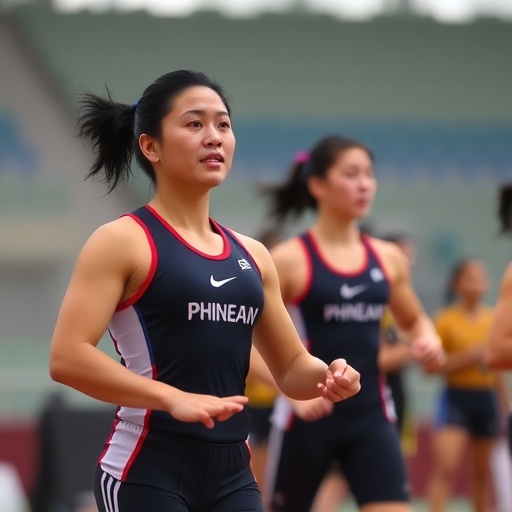
In an era increasingly defined by mental resilience and psychological well-being, a groundbreaking study has shed new light on the interconnections between mindfulness, self-efficacy, and overall satisfaction in sports training and competition among university-level basketball athletes in China. Published recently in BMC Psychology, this comprehensive research conducted by Zhao, Liu, Yang, and colleagues offers an unprecedented glimpse into the cognitive and emotional factors that underpin athletic performance and satisfaction in competitive sports environments.
The study probes deeply into the concept of mindfulness, a psychological process of bringing one’s attention to present experiences with openness and without judgment. Mindfulness has been extensively studied in general populations for its beneficial impacts on mental health, yet its precise role in high-stakes sports training remains less explored. By focusing on athletes within the China University Basketball Association (CUBA), this research targets a specific cohort where performance pressure is intense, and where mental fortitude can be as critical as physical prowess.
Self-efficacy, defined as an individual’s belief in their ability to execute actions necessary to achieve specific performance attainments, emerges as a pivotal factor in this research. Past sports psychology literature has repeatedly underscored its importance in motivating athletes to persevere through challenges, improve skills, and maintain focus under pressure. The current study’s longitudinal design allows the researchers to observe how shifts in mindfulness potentially influence changes in self-efficacy levels over time, offering powerful evidence for causality rather than mere association.
Moreover, the research extends beyond internal psychological metrics to consider the athletes’ satisfaction with their training and competitive experiences. As satisfaction is crucial for sustained engagement and athletic development, understanding its predictors can lead to targeted interventions improving not just performance, but also overall well-being. The study’s cross-sectional and longitudinal approaches enable a holistic look at how psychological variables evolve and interact over time, providing rich, dynamic insights rather than isolated snapshots.
Methodologically, the research employed rigorous psychometric assessment tools specifically adapted for the athletic population, ensuring sensitivity to the unique pressures of university-level basketball athletes. Questionnaire data were collected across multiple time points spanning a competitive season, facilitating the analysis of trends and patterns in mindfulness, self-efficacy, and satisfaction. This temporal depth addresses a common criticism in sports psychology research where cross-sectional designs limit interpretative power.
One of the more remarkable findings of the study is the bidirectional relationship observed between mindfulness and self-efficacy. Athletes who cultivated higher mindfulness not only experienced greater confidence in their training capacities but also reported enhanced satisfaction with their competitive performances. Conversely, increases in self-efficacy seemed to reinforce athletes’ mindful engagement, suggesting a virtuous cycle where cognitive and emotional readiness feed into each other for optimal outcomes.
The implications for coaching and athlete development programs are profound. Traditional training often emphasizes physical conditioning and tactical skills, but the evidence presented by Zhao et al. advocates for incorporating mindfulness training and psychological skills enhancement as integral components of athlete preparation. This could manifest in guided meditation sessions, mental skills workshops, or cognitive-behavioral techniques tailored to the sports context, potentially transforming how teams cultivate competitive excellence.
Furthermore, these findings arrive at a pivotal moment when mental health in sports is gaining greater recognition globally. Competitive athletes are not immune to stress, anxiety, or burnout—issues that can severely impair both athletic and personal lives. By substantiating the protective and performance-enhancing roles of mindfulness and self-efficacy, this study provides scientific backing for mental health initiatives designed specifically for sports contexts, reinforcing the need for holistic athlete care.
From a cultural perspective, the focus on Chinese university basketball athletes also provides valuable cross-cultural insights. Sports psychology research has historically been dominated by Western contexts, but Zhao and colleagues broaden the scope by contextualizing psychological constructs within China’s unique educational and athletic frameworks. This attention to cultural specificity enriches the global understanding of athlete psychology and opens avenues for tailored interventions sensitive to local norms and values.
The longitudinal aspect of the study is particularly noteworthy, as it underscores how psychological traits are not static but evolve with experience, training, and competitive outcomes. Monitoring changes in mindfulness and self-efficacy over a season provides dynamic data that can inform timing and focus of psychological support programs, ensuring they align with the athletes’ developmental phases and stress points in competition cycles.
While the research highlights promising correlations and pathways, it also invites further inquiry into the underpinning neural and physiological mechanisms. Future studies integrating neuroimaging, hormonal profiles, and real-time performance data could elucidate how mindfulness and self-efficacy translate into tangible physical readiness and execution under pressure. Such multidisciplinary approaches will enrich the conversation between cognitive science, sports medicine, and athletic coaching.
Crucially, this study challenges existing paradigms that separate mental and physical training in sports. Instead, it champions an integrated model where psychological attributes like mindfulness are not ancillary but central to achieving peak athletic performance and satisfaction. This integrative perspective is likely to captivate coaches, sports psychologists, and athletes seeking scientifically informed pathways to competitive success and personal fulfillment.
The sheer depth and scope of Zhao et al.’s research also pave the way for innovation in athlete monitoring technologies. Wearable devices and mobile applications could harness mindfulness training techniques and self-efficacy assessments as part of athlete management systems, promoting personalized mental skills development and real-time feedback during training and competitions.
In sum, the present study stands as a landmark contribution to sports psychology literature, providing robust empirical data on the intertwined relationships among mindfulness, self-efficacy, and satisfaction. Its methodological rigor, coupled with longitudinal insights and cultural relevance, ensures it will resonate widely within sports science communities. More importantly, by illuminating pathways to enhanced mental resilience and performance satisfaction, it offers athletes and coaches scientifically grounded strategies to navigate the complex psychological demands of modern competitive basketball.
As the sporting world continues to embrace holistic and evidence-based approaches to athlete preparation, this research serves as a clarion call emphasizing the critical role of mental processes in defining success. Far beyond physical skillsets, it is the cultivation of mindful awareness and robust self-beliefs that may ultimately distinguish the outstanding from the merely good, inspiring a new paradigm where psychological excellence equals sporting triumph.
Subject of Research: The interplay between mindfulness, self-efficacy in sports training, and training competition satisfaction in university-level basketball athletes.
Article Title: The relationship between China university basketball association athletes’ mindfulness, self-efficacy in sports training, and training competition satisfaction: a cross-sectional and longitudinal study.
Article References:
Zhao, Y., Liu, J., Yang, X. et al. The relationship between China university basketball association athletes’ mindfulness, self-efficacy in sports training, and training competition satisfaction: a cross-sectional and longitudinal study


