


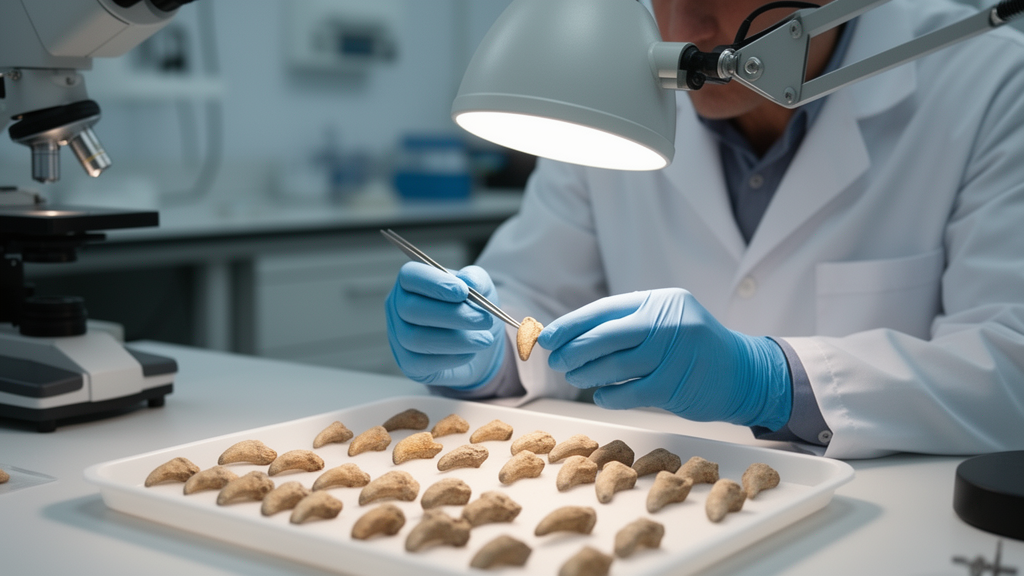
Deep in museum collections across Europe, Asia, and the United States, the baby teeth of an extinct hornless rhinoceros have been quietly waiting for more than a century to tell their story. A new study published in Fossil Record has now examined juvenile skulls, mandibles, and deciduous teeth of four species of Chilotherium, a genus of hornless rhinoceroses that roamed Eurasia during the Late Miocene, roughly 9 to 5.7 million years ago. The findings show that these milk teeth, long overlooked by palaeontologists, carry a surprising wealth of information about species identity, tooth eruption patterns, and even the stress of being born.
Chilotherium is a notoriously difficult genus. More than 30 species have been assigned to it at some point, and the resulting taxonomic confusion has often made it impossible to identify incomplete fossils with confidence. The genus was established by the Swedish palaeontologist T. Ringström in 1924, based on material collected during the Sino-Swedish expedition in China. Its most characteristic features include a depression in the frontal bones, widely separated parietal crests, a wide mandibular symphysis bearing large tusk-like lower second incisors, and short limb bones. While the permanent teeth of chilotheres are well documented and highly diagnostic, the deciduous dentition has remained almost entirely unknown for most species.
The new research, led by a team studying material from four key fossil localities, focused on Chilotherium persiae from Maragheh in Iran, Chilotherium habereri from Kutschwan in China, Chilotherium schlosseri from the Greek island of Samos, and Chilotherium anderssoni from Daijiagou, also in China. These sites span the geographic range of the genus, from eastern China to the Balkan Peninsula, and cover a time window from about 9 million years ago at Maragheh to roughly 5.7 million years ago at Daijiagou. The specimens, housed in institutions including the American Museum of Natural History, the Natural History Museum in London, the Senckenberg Museum in Frankfurt, and the State Museum of Natural History Stuttgart, among many others, represent one of the most comprehensive juvenile samples ever assembled for any fossil rhinoceros group.
To peer inside teeth that had not yet fully erupted, the team used micro-computed tomography scanning at the Senckenberg Centre for Human Evolution and Palaeoenvironment and the University of Tübingen. The scans, performed with a Nikon XT H 320 μCT scanner at voltages between 165 and 225 kilovolts, revealed hidden dental features and confirmed the presence of enamel defects in specimens whose teeth were still embedded in bone. The resulting virtual sections are now publicly available on MorphoSource, allowing other researchers to verify and extend the observations.
One of the most striking results concerns the sequence in which the milk teeth emerged. Across all four species, the second and third deciduous premolars, known as d/D2 and d/D3, were the first to erupt, and this must have happened immediately after birth, because no specimen in the entire sample preserves these teeth in an unerupted state. The first upper deciduous premolar, D1, and the fourth deciduous premolar, d/D4, erupted later, and here the team detected an intriguing difference. In most chilotheres, D1 erupts before or at the same time as D4, but in Chilotherium schlosseri from Samos, the single specimen preserving both teeth shows D4 fully erupted while D1 had barely begun to emerge, its root not yet even formed. This delayed eruption of D1 is unique among the studied species and may prove to be a distinguishing characteristic.
The morphology of the deciduous premolars themselves turned out to be far more informative than expected. In Chilotherium habereri, the D1 is the smallest of any studied chilothere, with both length and width values clearly lower than in the other species. In Chilotherium schlosseri, the deciduous premolars frequently bear enamel plications, small folds that are much rarer in the other three species, along with a consistently closed medifossette in D2 and strong lingual cingula. Chilotherium persiae and Chilotherium anderssoni occupy intermediate positions, with overlapping but distinguishable features. These differences suggest that, contrary to earlier assumptions that milk teeth were too variable to be useful for species identification, certain dental characters in the deciduous dentition can indeed help discriminate between chilothere species.
Perhaps the most remarkable discovery involves enamel hypoplasia, a defect in tooth development that occurs when an animal experiences significant physiological or nutritional stress during the secretory phase of enamel formation. The team examined 152 deciduous teeth across the four species and found a striking pattern. Hypoplasia in the second and third deciduous premolars was rare, affecting only about 4 percent and 8 percent of those teeth respectively. But in the fourth deciduous premolar, d/D4, hypoplasia was present in every single specimen of every species, without exception. The position of the defect was also remarkably consistent: in Chilotherium persiae, Chilotherium habereri, and Chilotherium anderssoni, it appeared as a thin horizontal groove near the base of the crown on the lingual side and an omega-shaped groove in the middle of the ectoloph on the buccal side.
The uniformity of this defect across dozens of individuals from different species and localities points to a single, universal cause. The researchers systematically evaluated the three main known triggers of enamel hypoplasia: localised trauma, genetic defects, and systemic stress. Localised trauma was ruled out because the defects appear symmetrically on both sides of the jaw. Genetic defects were excluded because no other congenital anomalies were observed and the hypoplasia is confined to a single tooth position. Systemic stress, however, fits perfectly, because it affects all teeth developing at the time of the stressful event. Since d/D4 forms around the time of birth in rhinoceroses, as demonstrated by studies of extant white and black rhinoceroses where d4 is fully formed within months of birth, the team concluded that this hypoplasia records the physiological stress of birth itself.
Chilotherium schlosseri from Samos presented an exception that may be just as informative as the rule. In this species, the birth-related hypoplasia in d/D4 is positioned at the very base of the crown rather than in the middle, and it takes the form of an almost straight horizontal line rather than an omega shape. The researchers explored several possible explanations, including differences in tooth crown height, earlier dental development, variations in gestation length, and environmental factors related to the different climates of Greece versus China. None of these alone fully accounts for the displacement, but a combination of climatic conditions affecting breeding season and subtle interspecific differences in physiology remains plausible. Intriguingly, the position of the hypoplasia in Chilotherium schlosseri is so consistent within the species that it could even serve as an additional diagnostic feature.
The broader implications of this work extend beyond chilotheres. Deciduous teeth have historically been neglected in phylogenetic and taxonomic analyses of rhinoceroses, even though recent studies in other mammal groups, such as hippopotamuses, have demonstrated their systematic value. The current study shows that milk teeth can preserve consistent, taxonomically informative characters and should be incorporated into future systematic and developmental studies of fossil rhinoceroses. As the Late Miocene was a time of dramatic environmental change, with expanding grasslands and shifting climates across Eurasia, understanding how these hornless rhinoceroses grew, developed, and responded to stress at the very beginning of life offers a rare window into the biology of animals that vanished millions of years ago, preserved in something as small and seemingly insignificant as a baby tooth.
Subject of Research: Ontogenetic development and deciduous dentition of the Late Miocene hornless rhinoceros genus Chilotherium across Eurasia
Article Title: Deciduous dentition and ontogenetic development of the skull and teeth of Chilotherium ( Mammalia , Perissodactyla , Rhinocerotidae ) from the Late Miocene of Eurasia
Article References: Kampouridis, P., Pandolfi, L., Kyriakouli, C., Spassov, N., & Böhme, M. (2026). Deciduous dentition and ontogenetic development of the skull and teeth of Chilotherium (Mammalia, Perissodactyla, Rhinocerotidae) from the Late Miocene of Eurasia. Fossil Record, 29(1), 373-410. https://doi.org/10.3897/fr.29.192018
Image Credits: AI Generated
DOI: 10.3897/fr.29.192018
Keywords: Chilotherium, Rhinocerotidae, deciduous dentition, enamel hypoplasia, Late Miocene, paleontology, tooth eruption, ontogeny, Eurasia, fossil rhinoceros, Maragheh, Samos
Cite Scienmag News
Gavin Prescott. (October 16, 2026). Milk Teeth of Extinct Hornless Rhinos Reveal Birth Stress and Species Secrets. Scienmag. https://scienmag.com/milk-teeth-of-extinct-hornless-rhinos-reveal-birth-stress-and-species-secrets/
Gavin Prescott. "Milk Teeth of Extinct Hornless Rhinos Reveal Birth Stress and Species Secrets." Scienmag, 16 October 2026, https://scienmag.com/milk-teeth-of-extinct-hornless-rhinos-reveal-birth-stress-and-species-secrets/. Accessed 16 October 2026.
Gavin Prescott. "Milk Teeth of Extinct Hornless Rhinos Reveal Birth Stress and Species Secrets." Scienmag. October 16, 2026. https://scienmag.com/milk-teeth-of-extinct-hornless-rhinos-reveal-birth-stress-and-species-secrets/


