


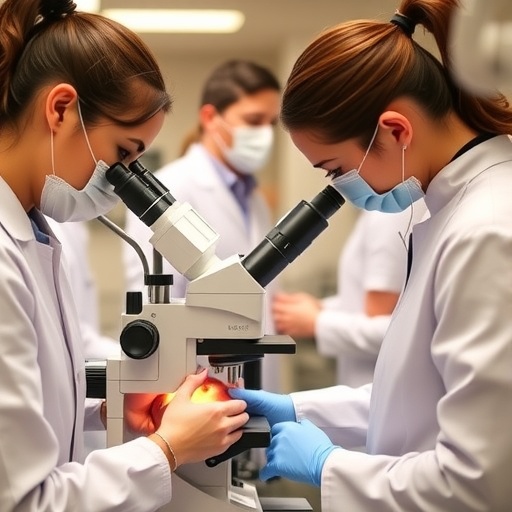
In a groundbreaking study published in BMC Medical Education, a team of researchers, including Li, Yang, and Zhang, focused on the pivotal influence that a structured educational approach has on undergraduate dental students’ competencies in microscopic dentistry. As modern dentistry increasingly embraces microscopic techniques, this study sheds light on how such educational methods can enhance knowledge, attitudes, and overall satisfaction among budding dental practitioners. With the complexities of dental procedures continuing to evolve, adapting educational frameworks to incorporate microscopic principles is not just beneficial—it is essential.
The researchers meticulously designed a step-by-step course tailored to undergraduate dental students, a demographic that is often apprehensive about incorporating advanced technologies in their future practices. Microscopic dentistry represents a profound shift, as many procedures can now be accomplished with unprecedented precision, allowing for outcomes that can significantly improve patient health and satisfaction. In completing this course, students faced a comprehensive and systematic introduction to the nuanced world of dental microscopy, which traditionally received limited attention in dental curriculums.
Throughout this course, participants engaged with a variety of educational tools, including hands-on training with state-of-the-art microscopes, video demonstrations, and interactive sessions that fostered discussion and reflection. The engagement in such diverse pedagogical strategies was aimed at bolstering their competencies while also addressing common anxieties linked to new technologies. Importantly, the study noted, students were encouraged to embrace a growth mindset and view challenges not as obstacles, but as opportunities for personal and professional development in their practice.
As dental students ventured further into the course, their initial trepidation began to dissipate. The research team evaluated the participants at various intervals to gauge changes in their knowledge and self-confidence. The findings were striking; students reported significant improvements not only in their understanding of the microscopic modalities but also in their attitudes toward the incorporation of these methodologies into their future dental practices. As they grasped the practical applications—ranging from performing intricate endodontic procedures to diagnosing otherwise indiscernible pathologies—their enthusiasm for the discipline surged.
Evaluating the effectiveness of educational interventions is crucial, especially in fields where technology and methods constantly evolve. The study’s robust assessment framework included pre-course and post-course surveys that quantified participants’ confidence levels, knowledge retention, and overall satisfaction with the learning experience. Notably, the statistics revealed a remarkable increase in self-assuredness among the students post-completion, affirming the course’s effectiveness in preparing them for the realities of modern practice.
Another compelling aspect of the research was its focus on the intrinsic motivations of the students. Detailed analyses indicated that as students became more adept at using microscopic techniques, they also developed a deeper appreciation for the artistry intrinsic to dentistry. This aspect of their education underscored the idea that effective teaching extends beyond simple knowledge transfer—it cultivates an environment wherein creativity and technical skills can flourish harmoniously.
Further dissecting the students’ feedback, the researchers observed a common theme: satisfaction derived not only from mastering new techniques but also from the community of learners that had formed within the course. Group discussions, collaborative exercises, and peer-to-peer teaching occasions fostered a sense of camaraderie that ultimately enhanced the overall learning experience. Such social interactions are invaluable as they mimic the collaborative nature of real-life dental practice, where teamwork plays a crucial role in patient outcomes.
In conjunction with fostering a community, the course placed a strong emphasis on the ethical considerations surrounding the use of advanced technologies in dentistry. Students engaged in discussions about patient consent, the importance of transparency in procedures, and how to communicate effectively with patients about the benefits and potential risks of microscopic interventions. This focus on ethical practices ensures that graduates are not only skilled technicians but also conscientious professionals committed to the well-being of their patients.
Technological advancements are transforming the dental industry at an unprecedented pace, making it essential for educational institutions to adapt accordingly. The rapid integration of microscopic dentistry into clinical practices amplifies the need for a curriculum that aligns with emerging tools and techniques. By addressing this critical gap in traditional dental education, institutions can equip students with not just theoretical knowledge, but practical skills that are essential in today’s forefront of dental advancements.
Looking ahead, the insights derived from this study are poised to influence future curricular developments within dental education. As more programs adopt holistic and technologically integrated approaches, the anticipation of improved student outcomes and enhanced patient care quality grows. Advocates for change within dental education are encouraged to utilize this research as a foundation for advocating innovative practices that prioritize both skill development and patient involvement.
Remarkably, the course’s success story does not rest solely on the students’ individual accomplishments; it also serves as a clarion call for educators to continually seek methods that bridge the gap between traditional teachings and modern practices in dentistry. The progress made through this course illustrates that educational environments can indeed transform apprehension into confidence, aligning student competencies with the needs of contemporary dental practices.
In conclusion, as demonstrated by this study, the successful integration of microscopic techniques into dental education fosters a generation of practitioners who are not only knowledgeable but also capable of navigating the complexities of modern dentistry. By embracing innovative teaching methodologies, dental faculties can ensure their students are not just ready to face the future of dental practices but are excited and inspired to do so. The transforming landscape of dentistry starts with education, and courses like the one pioneered by Li, Yang, and Zhang represent a significant stride in shaping the future of the profession.
Li, Z., Yang, G., Zhang, H. et al. Undergraduate dental students’ knowledge, attitudes, and satisfaction following a step-by-step course in microscopic dentistry.
BMC Med Educ 25, 1376 (2025). https://doi.org/10.1186/s12909-025-07947-5
Cite Scienmag News
Courtney Benton. (October 8, 2025). Microscopic Dentistry Course Boosts Dental Students’ Knowledge and Satisfaction. Scienmag. https://scienmag.com/microscopic-dentistry-course-boosts-dental-students-knowledge-and-satisfaction/
Courtney Benton. "Microscopic Dentistry Course Boosts Dental Students’ Knowledge and Satisfaction." Scienmag, 8 October 2025, https://scienmag.com/microscopic-dentistry-course-boosts-dental-students-knowledge-and-satisfaction/. Accessed 4 September 2026.
Courtney Benton. "Microscopic Dentistry Course Boosts Dental Students’ Knowledge and Satisfaction." Scienmag. October 8, 2025. https://scienmag.com/microscopic-dentistry-course-boosts-dental-students-knowledge-and-satisfaction/


