


Microplastics have quietly become one of the most pervasive pollutants on Earth, and a new comprehensive review argues that their greatest danger may not be what they are made of, but what they carry. Published in Environmental Monitoring and Assessment by researchers from the Bhabha Atomic Research Centre and Homi Bhabha National Institute in Mumbai, the analysis synthesizes roughly 235 studies conducted between 2004 and 2025 into a single unified framework of how microplastics interact with other contaminants, what that means for toxicology, and how well current monitoring and remediation strategies actually work. The verdict is sobering: these tiny particles are now documented in marine, freshwater, terrestrial and even atmospheric environments, where their small size and near-permanent persistence allow them to disperse widely and accumulate over decades.
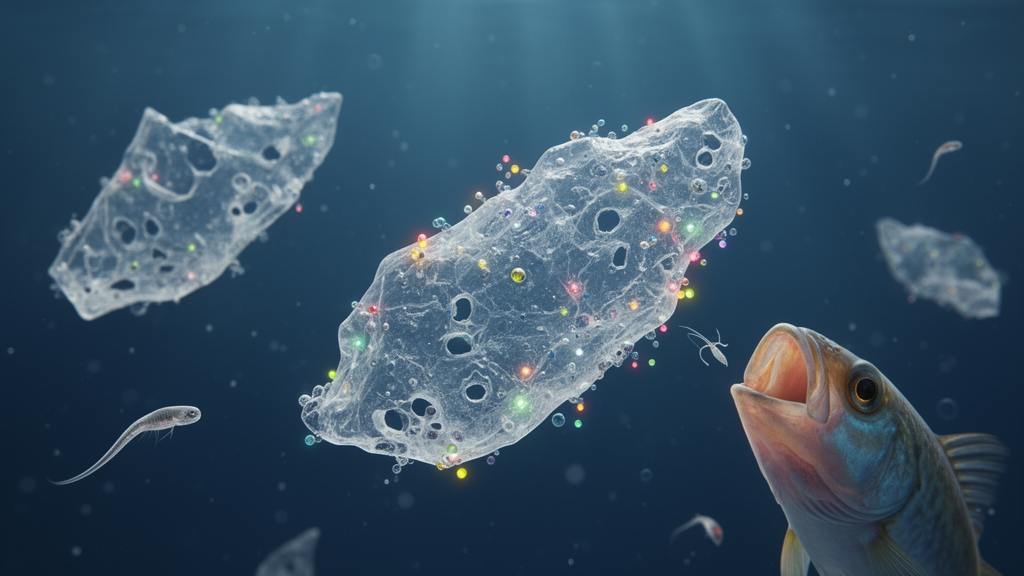
The core of the problem lies in a role that scientists describe as a vector. Microplastics do not merely pollute on their own account; they act as carriers for hydrophobic organic compounds, heavy metals and radionuclides, influencing how these contaminants move through the environment, how bioavailable they become to living organisms, and whether they transfer up food webs. Because plastics are hydrophobic, they preferentially adsorb oily pollutants such as persistent organic compounds, concentrating them on particle surfaces at levels far higher than in the surrounding water. Studies cited in the review show organic micropollutants on plastic debris collected from the open ocean, remote beaches and urban shores alike, confirming that this sorption happens everywhere plastics meet seawater.
The review details the mechanisms behind these interactions with technical precision. For organic pollutants, adsorption onto microplastics is governed by polymer type, particle size, surface area and solution chemistry, including pH, salinity and the presence of natural organic matter. Aging matters enormously: weathered particles, whose surfaces become rougher and more oxidized after prolonged exposure to sunlight, show altered adsorption capacities. Research on sulfonamide antibiotics, for instance, found contrasting effects of aging on adsorption depending on the compound, while Fenton aging significantly changed the heavy metal adsorption capacity of polystyrene particles. For heavy metals, sorption involves electrostatic attraction, complexation with surface functional groups and, in some cases, precipitation. Studies of trace metal adsorption onto plastic resin pellets in marine and freshwater environments established early evidence that plastics scavenge metals such as cadmium, lead and copper from water, and later work on divalent ions including copper, nickel and zinc clarified the interfacial dynamics involved.
Perhaps the most striking section of the review is its in-depth evaluation of microplastics-radionuclide interactions, an area the authors identify as comparatively underexplored. Radionuclides are radioactive isotopes that enter the environment from nuclear facilities, weapons testing fallout, medical applications and naturally occurring sources. The review places particular emphasis on aqueous speciation, oxidation state and competitive ions as the factors governing radionuclide sorption mechanisms. In plain terms, whether a radioactive element sticks to a plastic particle depends on what chemical form it takes in water, what charge that form carries, and whether other ions in solution compete for the same binding sites. Experimental studies have now demonstrated that microplastics can sorb uranium, neptunium, americium, cesium, strontium and radioiodine, with polyethylene-derived particles shown to interact with radioactive cesium and strontium in marine conditions and PET plastics described in one cited study as a Trojan horse for radionuclides.
The toxicological implications of these combined exposures are extensive. Once ingested, microplastics can translocate beyond the gut: early research showed that microscopic plastic ingested by mussels crosses into the circulatory system, and subsequent work documented particles in the tissues of fish, invertebrates and even mammals. Laboratory studies cited in the review report oxidative stress, antioxidant defense activation, neurotoxic effects, lipid peroxidation, immune responses, behavioral changes and transcriptional alterations in organisms ranging from copepods and zebrafish to earthworms and plants. In fish, exposure to microplastics has been linked to hepatic stress and molecular damage, while in plants, particles have been shown to inhibit germination, induce genotoxicity and disrupt root cell physiology. The review also highlights the co-exposure problem: organisms rarely encounter microplastics alone, and joint toxicity studies combining particles with arsenic, antidepressants and pesticides suggest that the combined effects can differ from what either stressor causes individually.
Trophic transfer adds another layer of concern. Experiments tracing benzo[a]pyrene from microplastics through brine shrimp to zebrafish demonstrated that plastic-associated pollutants can move up a food web, inducing detoxification enzymes in the predator. Field studies have documented microplastics in top predators including marine mammals, and surveys of commercial fish and shellfish from the Mediterranean, North Sea, Persian Gulf and Bohai Sea confirm widespread contamination of seafood species. Human exposure follows from these pathways, with consumption studies estimating that people ingest microplastics through food, and with household fiber fallout during meals identified as a significant exposure route alongside dietary intake. The discovery and quantification of plastic particle pollution in human blood, published in 2022 and cited in the review, marked a turning point in assessing internal exposure, and scoping reviews now catalog microplastics detected in human tissues and organs.
Monitoring and detection strategies form a critical part of the review’s framework, and the authors evaluate them with unusual candor. The gold standard techniques for identifying microplastics are spectroscopic: Fourier transform infrared spectroscopy, Raman spectroscopy and their microscopic variants allow researchers to determine polymer type and particle dimensions. Near-infrared hyperspectral imaging coupled with chemometrics offers comprehensive and rapid identification, laser direct infrared spectroscopy enables high-throughput automated analysis of surface waters, and emerging methods include laser-induced breakdown spectroscopy, Mueller matrix polarimetry, fluorescence-based detection and electrochemical sensors. Artificial intelligence and machine learning are increasingly deployed to automate quantification and classification, including deep learning applied to scanning electron micrographs. Yet the review stresses that how measurements are made matters: comparisons of micro-FTIR and micro-Raman quantification of drinking water show that method choice affects results, mesh selectivity of sampling nets influences what particles are captured, and harmonized protocols remain essential for compiling data across studies.
Remediation is the final pillar, and here the review assesses effectiveness across a spectrum of approaches. Conventional wastewater and drinking water treatment plants already remove a substantial fraction of microplastics through coagulation and flocculation, with iron-based coagulants showing particular promise, and advanced treatment technologies applied to wastewater effluent have demonstrated further removal. Beyond engineered systems, the review catalogues photocatalytic degradation using titanium dioxide-based and other catalysts, advanced oxidation processes, magnetic polyoxometalate-supported ionic liquid phases for water purification, zeolite-based nanocomposites for effluent treatment, and bioadsorbents derived from natural materials. Biological approaches include biodegradation by microorganisms and fungi, with marine fungal species shown to degrade polyethylene particles, and phytoremediation, in which aquatic plants remove microplastics from water, identified as a promising emerging strategy.
The review’s synthesis of roughly two decades of research also exposes persistent knowledge gaps. The authors note that microplastics-contaminant interactions are shaped by environmental conditions that vary across ecosystems, making it difficult to generalize laboratory findings to real-world exposure scenarios. Radionuclide interactions remain comparatively understudied relative to organic pollutants and heavy metals, and the role of speciation and competitive ions in natural waters is only beginning to be resolved. Standardization of sampling, extraction and analytical protocols across complex environmental matrices, from soils and sediments to atmospheric dust, is still incomplete, complicating risk assessment. The review identifies these gaps not as failures but as priorities, arguing that closing them is essential for developing informed mitigation strategies.
What emerges from this comprehensive evaluation is a picture of microplastics as far more than an isolated pollutant. They are persistent particles that alter soil properties and microbial activity, change water chemistry, disrupt organism physiology and, crucially, concentrate and transport other contaminants through ecosystems and food webs. The authors, led by first authors Sonali Yadav and Sabyasachi Rout, argue that understanding these interactions within a unified framework is the key to effective risk management. As plastic production continues and environmental stocks grow, the review’s message is clear: the danger of microplastics lies in their persistence, their ubiquity and their capacity to act as carriers for the contaminants that surround them, making integrated monitoring, standardized detection and multi-strategy remediation the defining challenges for protecting ecosystems and human health in the decades ahead.
Subject of Research: Microplastics as an emerging threat to ecosystems: a comprehensive review of their interactions with contaminants, toxicological implications, monitoring and remediation strategies
Article Title: Microplastics as an emerging threat to ecosystems: a comprehensive review of their interactions with contaminants, toxicological implications, monitoring and remediation strategies
Article References: Yadav, S., Rout, S., Pulhani, V., & Kumar, A. V. (2026). Microplastics as an emerging threat to ecosystems: a comprehensive review of their interactions with contaminants, toxicological implications, monitoring and remediation strategies. Environmental Monitoring and Assessment, 198(9), Article 1010. https://doi.org/10.1007/s10661-026-15843-8
Image Credits: AI Generated
DOI: 10.1007/s10661-026-15843-8
Keywords: Microplastics, emerging, threat, ecosystems, comprehensive, review, interactions, contaminants, toxicological, implications, monitoring, remediation
Cite Scienmag News
Russell Cooper. (October 19, 2026). Microplastics Are Trojan Horses Carrying Contaminants Into Ecosystems. Scienmag. https://scienmag.com/microplastics-are-trojan-horses-carrying-contaminants-into-ecosystems/
Russell Cooper. "Microplastics Are Trojan Horses Carrying Contaminants Into Ecosystems." Scienmag, 19 October 2026, https://scienmag.com/microplastics-are-trojan-horses-carrying-contaminants-into-ecosystems/. Accessed 19 October 2026.
Russell Cooper. "Microplastics Are Trojan Horses Carrying Contaminants Into Ecosystems." Scienmag. October 19, 2026. https://scienmag.com/microplastics-are-trojan-horses-carrying-contaminants-into-ecosystems/


