


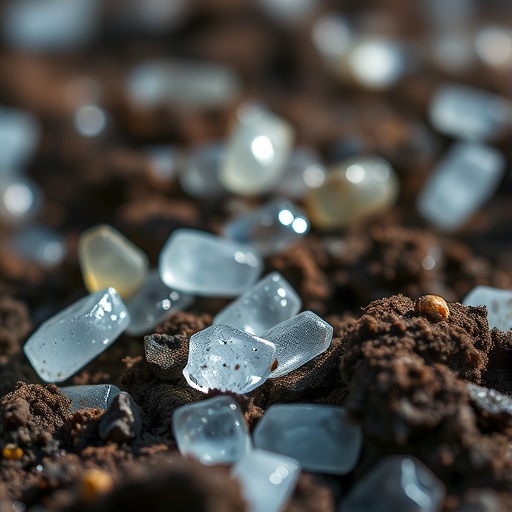
Microplastics and toxic metals are spreading together through agricultural soils, river sediments, gardens, and natural ecosystems, creating a contamination problem more complex than either pollutant alone. A new review published in New Contaminants shows that microplastics can alter how heavy metals move through soil, how easily they are absorbed by organisms, and how they travel into plants, animals, and ultimately the human food chain. The effects are not uniform: the same plastic particle may immobilize one metal while making another more mobile, depending on soil chemistry, plastic aging, microbial activity, and the chemical form of the contaminant.
The review examines interactions between microplastics and five priority pollutants—lead, chromium, cadmium, arsenic, and mercury. These metals differ substantially in their charge, chemical reactivity, oxidation state, and affinity for minerals and organic matter. Microplastics add another layer of complexity because their surfaces can bind contaminants, transport them across soil, and provide habitats for microbial communities. As particles weather under sunlight, temperature changes, and mechanical abrasion, their surfaces develop oxygen-containing functional groups that can interact with metal ions and alter their environmental behavior.
“Microplastics should not be viewed simply as passive particles in contaminated soils,” said corresponding author Kunlong Hui. According to the review, plastic particles can act as sorbents, mobile carriers, and reactive interfaces where chemical and biological transformations occur. Their influence also changes over time. Fresh polyethylene or polystyrene particles may behave differently from weathered particles covered with biofilms, mineral coatings, or dissolved organic matter. These transformations can determine whether a metal remains attached to the soil, dissolves into soil water, or moves with plastic particles toward plant roots and groundwater.
Lead provides a clear example of why stronger binding does not necessarily mean lower environmental risk. Weathering creates oxygen-rich groups on microplastic surfaces that can form strong surface complexes with lead, particularly in neutral or weakly alkaline soils. This may reduce the concentration of freely dissolved lead in some conditions. However, lead attached to lightweight, mobile plastic particles can still be transported through soil pores and deposited near plant roots. Once there, the particles may increase the opportunity for lead to enter root tissues and move into vascular systems, potentially extending contamination from soil to crops.
Chromium follows a different pathway because its toxicity depends heavily on oxidation state. Trivalent chromium, Cr(III), is generally less mobile and less toxic than hexavalent chromium, Cr(VI), which can move more readily through soil and poses greater risks to organisms. Microplastics may influence chromium through adsorption, but they can also affect the redox reactions that convert one form into the other. This means that chromium pollution cannot be assessed simply by measuring the total amount of metal present. Researchers must determine which chemical species exist, how stable they are, and whether plastic surfaces, organic compounds, or microbial processes are promoting oxidation or reduction.
Cadmium is especially sensitive to changes in the soil environment surrounding plant roots. Aging microplastics and biofilms may provide additional sites for cadmium attachment, while the particles can simultaneously modify acidity, dissolved organic carbon, microbial communities, and sulfur cycling. Each of these factors can change the balance between bound and dissolved cadmium. A reduction in freely available cadmium could lower immediate exposure, but changes in rhizosphere chemistry may also release the metal from mineral surfaces or organic matter. The result may be an unpredictable shift in cadmium uptake by crops and soil organisms.
Arsenic and mercury are governed by still more complicated processes. Arsenic exists in several chemical forms, including negatively charged species that compete with phosphate and interact strongly with iron minerals. Microplastics may alter these interactions, particularly when biodegradable plastics release easily consumed carbon during decomposition. That carbon can stimulate microbial activity and potentially increase arsenic mobilization or methylation in certain soils. Mercury remains less well understood, but available evidence indicates that plastic-derived dissolved organic matter may influence mercury methylation, photoreduction, and the re-release of mercury into soil water. These processes could affect both toxicity and movement through food webs.
The review challenges the assumption that biodegradable plastics are automatically safer than conventional materials in contaminated environments. As biodegradable plastics break down, they can release organic compounds, change microbial metabolism, and develop new reactive surfaces. These effects may reduce the persistence of the plastic itself while increasing short-term chemical activity in the soil. In a metal-contaminated field, degradation could therefore produce outcomes very different from those associated with persistent plastics such as polyethylene or polystyrene. Environmental safety depends not only on how quickly a plastic disappears, but also on what it releases and how those products influence contaminants.
The consequences extend beyond soil chemistry. Mixtures of microplastics and metals can reshape microbial communities, damage soil fauna, increase oxidative stress in plants, and facilitate contaminant transfer through crops, livestock, dust, and predators. In soils containing several metals, pollutants may compete for the same binding sites on plastic surfaces, clay minerals, or organic matter. One metal may become more strongly retained while another is displaced into a mobile form. The review therefore calls for a metal- and polymer-specific approach to risk assessment and remediation, supported by long-term field studies that reflect realistic mixtures, aging, redox changes, microbial interactions, and cross-trophic transfer. Reducing risk will require strategies that address both the metal itself and the plastic particles that may carry it through the environment.
News Publication Date: 6-Jun-2026
Web References: New Contaminants: https://www.maxapress.com/newcontam; DOI: 10.48130/newcontam-0026-0015
References: Liang X, Wang L, Sun C, Hui K, Zhang J, et al. 2026. “The interplay between microplastics and heavy metals in soil: altered risks and differential responses.” New Contaminants 2: e018. DOI: 10.48130/newcontam-0026-0015
Keywords
Microplastics, heavy metals, soil contamination, lead, chromium, cadmium, arsenic, mercury, biodegradable plastics, environmental toxicity, soil remediation, food-chain transfer
Cite Scienmag News
Denise Maddox. (August 7, 2026). Microplastics Alter Soil Heavy-Metal Risks Differently Across Metals. Scienmag. https://scienmag.com/microplastics-alter-soil-heavy-metal-risks-differently-across-metals/
Denise Maddox. "Microplastics Alter Soil Heavy-Metal Risks Differently Across Metals." Scienmag, 7 August 2026, https://scienmag.com/microplastics-alter-soil-heavy-metal-risks-differently-across-metals/. Accessed 4 September 2026.
Denise Maddox. "Microplastics Alter Soil Heavy-Metal Risks Differently Across Metals." Scienmag. August 7, 2026. https://scienmag.com/microplastics-alter-soil-heavy-metal-risks-differently-across-metals/


